Trigonometride, trigonometrik özdeşlikler trigonometrik fonksiyonları içeren ve eşitliğin her iki tarafının da tanımlandığı değişkenlerin her değeri için doğru olan eşitliklerdir . Geometrik olarak, bunlar bir veya daha fazla açının belirli fonksiyonlarını içeren özdeşliklerdir . Bunlar üçgen özdeşliklerinden farklıdır, bunlar potansiyel olarak açıları içeren ama aynı zamanda kenar uzunluklarını veya bir üçgenin diğer uzunluklarını da içeren özdeşliklerdir.
Bu özdeşlikler, trigonometrik fonksiyonları içeren ifadelerin basitleştirilmesi gerektiğinde kullanışlıdır. Önemli bir uygulama, trigonometrik olmayan fonksiyonların integrasyonudur : yaygın bir teknik, önce bir trigonometrik fonksiyonla ikame kuralı kullanmayı ve ardından ortaya çıkan integrali bir trigonometrik özdeşlikle basitleştirmeyi içerir.
Trigonometrik fonksiyonlar ve bunların birim çember üzerindeki karşılıkları. Tüm dik açılı üçgenler benzerdir, yani karşılık gelen kenarları arasındaki oranlar aynıdır.
S
i
n
{\displaystyle Sin}
,
c
o
s
{\displaystyle cos}
ve
t
a
n
{\displaystyle tan}
için birim uzunluktaki yarıçap, onları tanımlayan üçgenin hipotenüsünü oluşturur. Karşılıklı özdeşlikler, bu birim çizginin artık hipotenüs olmadığı üçgenlerde kenarların oranları olarak ortaya çıkar.
Mavi gölgeli üçgen
1
+
cot
2
θ
=
csc
2
θ
{\displaystyle 1+\cot ^{2}\theta =\csc ^{2}\theta }
özdeşliğini,
kırmızı gölgeli üçgen ise
tan
2
θ
+
1
=
sec
2
θ
{\displaystyle \tan ^{2}\theta +1=\sec ^{2}\theta }
özdeşliğini göstermektedir.
Sinüs ve kosinüs arasındaki temel ilişki Pisagor özdeşliği ile verilir:
sin
2
θ
+
cos
2
θ
=
1
,
{\displaystyle \sin ^{2}\theta +\cos ^{2}\theta =1,}
burada
sin
2
θ
=
(
sin
θ
)
2
{\displaystyle \sin ^{2}\theta =(\sin \theta )^{2}}
cos
2
θ
=
(
cos
θ
)
2
{\displaystyle \cos ^{2}\theta =(\cos \theta )^{2}}
Bu Pisagor teoreminin bir versiyonu olarak görülebilir ve birim çember için
x
2
+
y
2
=
1
{\displaystyle x^{2}+y^{2}=1}
sin
θ
=
±
1
−
cos
2
θ
,
cos
θ
=
±
1
−
sin
2
θ
.
{\displaystyle {\begin{aligned}\sin \theta &=\pm {\sqrt {1-\cos ^{2}\theta }},\\\cos \theta &=\pm {\sqrt {1-\sin ^{2}\theta }}.\end{aligned}}}
Burada işaret
θ
{\displaystyle \theta }
çeyreğine (kuadrantına) bağlıdır.
Bu özdeşliği
sin
2
θ
{\displaystyle \sin ^{2}\theta }
cos
2
θ
{\displaystyle \cos ^{2}\theta }
1
+
cot
2
θ
=
csc
2
θ
1
+
tan
2
θ
=
sec
2
θ
sec
2
θ
+
csc
2
θ
=
sec
2
θ
csc
2
θ
{\displaystyle {\begin{aligned}&1+\cot ^{2}\theta =\csc ^{2}\theta \\&1+\tan ^{2}\theta =\sec ^{2}\theta \\&\sec ^{2}\theta +\csc ^{2}\theta =\sec ^{2}\theta \csc ^{2}\theta \end{aligned}}}
Bu özdeşlikleri kullanarak, herhangi bir trigonometrik fonksiyonu diğer herhangi bir fonksiyon cinsinden (artı veya eksi işaretine kadar ) ifade etmek mümkündür:
Her bir trigonometrik fonksiyon diğer beş fonksiyonun her biri cinsinden[ 1]
cinsinden
sin
θ
{\displaystyle \sin \theta }
csc
θ
{\displaystyle \csc \theta }
cos
θ
{\displaystyle \cos \theta }
sec
θ
{\displaystyle \sec \theta }
tan
θ
{\displaystyle \tan \theta }
cot
θ
{\displaystyle \cot \theta }
sin
θ
=
{\displaystyle \sin \theta =}
sin
θ
{\displaystyle \sin \theta }
1
csc
θ
{\displaystyle {\frac {1}{\csc \theta }}}
±
1
−
cos
2
θ
{\displaystyle \pm {\sqrt {1-\cos ^{2}\theta }}}
±
sec
2
θ
−
1
sec
θ
{\displaystyle \pm {\frac {\sqrt {\sec ^{2}\theta -1}}{\sec \theta }}}
±
tan
θ
1
+
tan
2
θ
{\displaystyle \pm {\frac {\tan \theta }{\sqrt {1+\tan ^{2}\theta }}}}
±
1
1
+
cot
2
θ
{\displaystyle \pm {\frac {1}{\sqrt {1+\cot ^{2}\theta }}}}
csc
θ
=
{\displaystyle \csc \theta =}
1
sin
θ
{\displaystyle {\frac {1}{\sin \theta }}}
csc
θ
{\displaystyle \csc \theta }
±
1
1
−
cos
2
θ
{\displaystyle \pm {\frac {1}{\sqrt {1-\cos ^{2}\theta }}}}
±
sec
θ
sec
2
θ
−
1
{\displaystyle \pm {\frac {\sec \theta }{\sqrt {\sec ^{2}\theta -1}}}}
±
1
+
tan
2
θ
tan
θ
{\displaystyle \pm {\frac {\sqrt {1+\tan ^{2}\theta }}{\tan \theta }}}
±
1
+
cot
2
θ
{\displaystyle \pm {\sqrt {1+\cot ^{2}\theta }}}
cos
θ
=
{\displaystyle \cos \theta =}
±
1
−
sin
2
θ
{\displaystyle \pm {\sqrt {1-\sin ^{2}\theta }}}
±
csc
2
θ
−
1
csc
θ
{\displaystyle \pm {\frac {\sqrt {\csc ^{2}\theta -1}}{\csc \theta }}}
cos
θ
{\displaystyle \cos \theta }
1
sec
θ
{\displaystyle {\frac {1}{\sec \theta }}}
±
1
1
+
tan
2
θ
{\displaystyle \pm {\frac {1}{\sqrt {1+\tan ^{2}\theta }}}}
±
cot
θ
1
+
cot
2
θ
{\displaystyle \pm {\frac {\cot \theta }{\sqrt {1+\cot ^{2}\theta }}}}
sec
θ
=
{\displaystyle \sec \theta =}
±
1
1
−
sin
2
θ
{\displaystyle \pm {\frac {1}{\sqrt {1-\sin ^{2}\theta }}}}
±
csc
θ
csc
2
θ
−
1
{\displaystyle \pm {\frac {\csc \theta }{\sqrt {\csc ^{2}\theta -1}}}}
1
cos
θ
{\displaystyle {\frac {1}{\cos \theta }}}
sec
θ
{\displaystyle \sec \theta }
±
1
+
tan
2
θ
{\displaystyle \pm {\sqrt {1+\tan ^{2}\theta }}}
±
1
+
cot
2
θ
cot
θ
{\displaystyle \pm {\frac {\sqrt {1+\cot ^{2}\theta }}{\cot \theta }}}
tan
θ
=
{\displaystyle \tan \theta =}
±
sin
θ
1
−
sin
2
θ
{\displaystyle \pm {\frac {\sin \theta }{\sqrt {1-\sin ^{2}\theta }}}}
±
1
csc
2
θ
−
1
{\displaystyle \pm {\frac {1}{\sqrt {\csc ^{2}\theta -1}}}}
±
1
−
cos
2
θ
cos
θ
{\displaystyle \pm {\frac {\sqrt {1-\cos ^{2}\theta }}{\cos \theta }}}
±
sec
2
θ
−
1
{\displaystyle \pm {\sqrt {\sec ^{2}\theta -1}}}
tan
θ
{\displaystyle \tan \theta }
1
cot
θ
{\displaystyle {\frac {1}{\cot \theta }}}
cot
θ
=
{\displaystyle \cot \theta =}
±
1
−
sin
2
θ
sin
θ
{\displaystyle \pm {\frac {\sqrt {1-\sin ^{2}\theta }}{\sin \theta }}}
±
csc
2
θ
−
1
{\displaystyle \pm {\sqrt {\csc ^{2}\theta -1}}}
±
cos
θ
1
−
cos
2
θ
{\displaystyle \pm {\frac {\cos \theta }{\sqrt {1-\cos ^{2}\theta }}}}
±
1
sec
2
θ
−
1
{\displaystyle \pm {\frac {1}{\sqrt {\sec ^{2}\theta -1}}}}
1
tan
θ
{\displaystyle {\frac {1}{\tan \theta }}}
cot
θ
{\displaystyle \cot \theta }
Birim çember incelenerek trigonometrik fonksiyonların aşağıdaki özellikleri belirlenebilir.
α
{\displaystyle \alpha }
yansıma açısını
π
4
{\displaystyle {\frac {\pi }{4}}}
artışlarla kaydırırken (
a ,
b ) koordinatlarının dönüşümü.
Bir Öklid vektörünün yönü bir
θ
,
{\displaystyle \theta ,}
x
{\displaystyle x}
x
{\displaystyle x}
θ
{\displaystyle \theta }
α
,
{\displaystyle \alpha ,}
θ
′
{\displaystyle \theta ^{\prime }}
θ
′
=
2
α
−
θ
.
\theta ^{\prime }=2\alpha -\theta .
Bu açıların trigonometrik fonksiyonlarının değerleri
θ
,
θ
′
{\displaystyle \theta ,\;\theta ^{\prime }}
α
{\displaystyle \alpha }
indirgeme formülleri olarak da bilinir.[ 2]
α
=
0
{\displaystyle \alpha =0}
θ
{\displaystyle \theta }
[ 3] tek/çift özdeşlikler
α
=
π
4
{\displaystyle \alpha ={\frac {\pi }{4}}}
θ
{\displaystyle \theta }
α
=
π
2
{\displaystyle \alpha ={\frac {\pi }{2}}}
θ
{\displaystyle \theta }
α
=
3
π
4
{\displaystyle \alpha ={\frac {3\pi }{4}}}
θ
{\displaystyle \theta }
α
=
π
{\displaystyle \alpha =\pi }
θ
{\displaystyle \theta }
α
=
0
{\displaystyle \alpha =0}
sin
(
−
θ
)
=
−
sin
θ
{\displaystyle \sin(-\theta )=-\sin \theta }
sin
(
π
2
−
θ
)
=
cos
θ
{\displaystyle \sin \left({\tfrac {\pi }{2}}-\theta \right)=\cos \theta }
sin
(
π
−
θ
)
=
+
sin
θ
{\displaystyle \sin(\pi -\theta )=+\sin \theta }
sin
(
3
π
2
−
θ
)
=
−
cos
θ
{\displaystyle \sin \left({\tfrac {3\pi }{2}}-\theta \right)=-\cos \theta }
sin
(
2
π
−
θ
)
=
−
sin
(
θ
)
=
sin
(
−
θ
)
{\displaystyle \sin(2\pi -\theta )=-\sin(\theta )=\sin(-\theta )}
cos
(
−
θ
)
=
+
cos
θ
{\displaystyle \cos(-\theta )=+\cos \theta }
cos
(
π
2
−
θ
)
=
sin
θ
{\displaystyle \cos \left({\tfrac {\pi }{2}}-\theta \right)=\sin \theta }
cos
(
π
−
θ
)
=
−
cos
θ
{\displaystyle \cos(\pi -\theta )=-\cos \theta }
cos
(
3
π
2
−
θ
)
=
−
sin
θ
{\displaystyle \cos \left({\tfrac {3\pi }{2}}-\theta \right)=-\sin \theta }
cos
(
2
π
−
θ
)
=
+
cos
(
θ
)
=
cos
(
−
θ
)
{\displaystyle \cos(2\pi -\theta )=+\cos(\theta )=\cos(-\theta )}
tan
(
−
θ
)
=
−
tan
θ
{\displaystyle \tan(-\theta )=-\tan \theta }
tan
(
π
2
−
θ
)
=
cot
θ
{\displaystyle \tan \left({\tfrac {\pi }{2}}-\theta \right)=\cot \theta }
tan
(
π
−
θ
)
=
−
tan
θ
{\displaystyle \tan(\pi -\theta )=-\tan \theta }
tan
(
3
π
2
−
θ
)
=
+
cot
θ
{\displaystyle \tan \left({\tfrac {3\pi }{2}}-\theta \right)=+\cot \theta }
tan
(
2
π
−
θ
)
=
−
tan
(
θ
)
=
tan
(
−
θ
)
{\displaystyle \tan(2\pi -\theta )=-\tan(\theta )=\tan(-\theta )}
csc
(
−
θ
)
=
−
csc
θ
{\displaystyle \csc(-\theta )=-\csc \theta }
csc
(
π
2
−
θ
)
=
sec
θ
{\displaystyle \csc \left({\tfrac {\pi }{2}}-\theta \right)=\sec \theta }
csc
(
π
−
θ
)
=
+
csc
θ
{\displaystyle \csc(\pi -\theta )=+\csc \theta }
csc
(
3
π
2
−
θ
)
=
−
sec
θ
{\displaystyle \csc \left({\tfrac {3\pi }{2}}-\theta \right)=-\sec \theta }
csc
(
2
π
−
θ
)
=
−
csc
(
θ
)
=
csc
(
−
θ
)
{\displaystyle \csc(2\pi -\theta )=-\csc(\theta )=\csc(-\theta )}
sec
(
−
θ
)
=
+
sec
θ
{\displaystyle \sec(-\theta )=+\sec \theta }
sec
(
π
2
−
θ
)
=
csc
θ
{\displaystyle \sec \left({\tfrac {\pi }{2}}-\theta \right)=\csc \theta }
sec
(
π
−
θ
)
=
−
sec
θ
{\displaystyle \sec(\pi -\theta )=-\sec \theta }
sec
(
3
π
2
−
θ
)
=
−
csc
θ
{\displaystyle \sec \left({\tfrac {3\pi }{2}}-\theta \right)=-\csc \theta }
sec
(
2
π
−
θ
)
=
+
sec
(
θ
)
=
sec
(
−
θ
)
{\displaystyle \sec(2\pi -\theta )=+\sec(\theta )=\sec(-\theta )}
cot
(
−
θ
)
=
−
cot
θ
{\displaystyle \cot(-\theta )=-\cot \theta }
cot
(
π
2
−
θ
)
=
tan
θ
{\displaystyle \cot \left({\tfrac {\pi }{2}}-\theta \right)=\tan \theta }
cot
(
π
−
θ
)
=
−
cot
θ
{\displaystyle \cot(\pi -\theta )=-\cot \theta }
cot
(
3
π
2
−
θ
)
=
+
tan
θ
{\displaystyle \cot \left({\tfrac {3\pi }{2}}-\theta \right)=+\tan \theta }
cot
(
2
π
−
θ
)
=
−
cot
(
θ
)
=
cot
(
−
θ
)
{\displaystyle \cot(2\pi -\theta )=-\cot(\theta )=\cot(-\theta )}
θ
{\displaystyle \theta }
açısını
π
2
{\displaystyle {\frac {\pi }{2}}}
artışlarla kaydırırken
(
a ,
b ) koordinatlarının dönüşümü.
Bir çeyrek
Bir yarım
Tam[ 4]
Periyot
sin
(
θ
±
π
2
)
=
±
cos
θ
{\displaystyle \sin(\theta \pm {\tfrac {\pi }{2}})=\pm \cos \theta }
sin
(
θ
+
π
)
=
−
sin
θ
{\displaystyle \sin(\theta +\pi )=-\sin \theta }
sin
(
θ
+
k
⋅
2
π
)
=
+
sin
θ
{\displaystyle \sin(\theta +k\cdot 2\pi )=+\sin \theta }
2
π
{\displaystyle 2\pi }
cos
(
θ
±
π
2
)
=
∓
sin
θ
{\displaystyle \cos(\theta \pm {\tfrac {\pi }{2}})=\mp \sin \theta }
cos
(
θ
+
π
)
=
−
cos
θ
{\displaystyle \cos(\theta +\pi )=-\cos \theta }
cos
(
θ
+
k
⋅
2
π
)
=
+
cos
θ
{\displaystyle \cos(\theta +k\cdot 2\pi )=+\cos \theta }
2
π
{\displaystyle 2\pi }
csc
(
θ
±
π
2
)
=
±
sec
θ
{\displaystyle \csc(\theta \pm {\tfrac {\pi }{2}})=\pm \sec \theta }
csc
(
θ
+
π
)
=
−
csc
θ
{\displaystyle \csc(\theta +\pi )=-\csc \theta }
csc
(
θ
+
k
⋅
2
π
)
=
+
csc
θ
{\displaystyle \csc(\theta +k\cdot 2\pi )=+\csc \theta }
2
π
{\displaystyle 2\pi }
sec
(
θ
±
π
2
)
=
∓
csc
θ
{\displaystyle \sec(\theta \pm {\tfrac {\pi }{2}})=\mp \csc \theta }
sec
(
θ
+
π
)
=
−
sec
θ
{\displaystyle \sec(\theta +\pi )=-\sec \theta }
sec
(
θ
+
k
⋅
2
π
)
=
+
sec
θ
{\displaystyle \sec(\theta +k\cdot 2\pi )=+\sec \theta }
2
π
{\displaystyle 2\pi }
tan
(
θ
±
π
4
)
=
tan
θ
±
1
1
∓
tan
θ
{\displaystyle \tan(\theta \pm {\tfrac {\pi }{4}})={\tfrac {\tan \theta \pm 1}{1\mp \tan \theta }}}
tan
(
θ
+
π
2
)
=
−
cot
θ
{\displaystyle \tan(\theta +{\tfrac {\pi }{2}})=-\cot \theta }
tan
(
θ
+
k
⋅
π
)
=
+
tan
θ
{\displaystyle \tan(\theta +k\cdot \pi )=+\tan \theta }
π
{\displaystyle \pi }
cot
(
θ
±
π
4
)
=
cot
θ
∓
1
1
±
cot
θ
{\displaystyle \cot(\theta \pm {\tfrac {\pi }{4}})={\tfrac {\cot \theta \mp 1}{1\pm \cot \theta }}}
cot
(
θ
+
π
2
)
=
−
tan
θ
{\displaystyle \cot(\theta +{\tfrac {\pi }{2}})=-\tan \theta }
cot
(
θ
+
k
⋅
π
)
=
+
cot
θ
{\displaystyle \cot(\theta +k\cdot \pi )=+\cot \theta }
π
{\displaystyle \pi }
Trigonometrik fonksiyonların işareti açının çeyreğine (kuadrantına) bağlıdır. Eğer
−
π
<
θ
≤
π
{\displaystyle {-\pi }<\theta \leq \pi }
sgn işaret fonksiyonu ise,
sgn
(
sin
θ
)
=
sgn
(
csc
θ
)
=
{
+
1
0
<
θ
<
π
ise
−
1
−
π
<
θ
<
0
ise
0
θ
∈
{
0
,
π
}
ise
sgn
(
cos
θ
)
=
sgn
(
sec
θ
)
=
{
+
1
−
1
2
π
<
θ
<
1
2
π
ise
−
1
−
π
<
θ
<
−
1
2
π
veya
1
2
π
<
θ
<
π
ise
0
θ
∈
{
−
1
2
π
,
1
2
π
}
ise
sgn
(
tan
θ
)
=
sgn
(
cot
θ
)
=
{
+
1
−
π
<
θ
<
−
1
2
π
veya
0
<
θ
<
1
2
π
ise
−
1
−
1
2
π
<
θ
<
0
veya
1
2
π
<
θ
<
π
ise
0
θ
∈
{
−
1
2
π
,
0
,
1
2
π
,
π
}
ise
{\displaystyle {\begin{aligned}\operatorname {sgn}(\sin \theta )=\operatorname {sgn}(\csc \theta )&={\begin{cases}+1&\ 0<\theta <\pi \ {\text{ ise}}\\-1&\ {-\pi }<\theta <0\ {\text{ ise}}\\0&\ \theta \in \{0,\pi \}\ {\text{ ise}}\end{cases}}\\[5mu]\operatorname {sgn}(\cos \theta )=\operatorname {sgn}(\sec \theta )&={\begin{cases}+1&\ {-{\tfrac {1}{2}}\pi }<\theta <{\tfrac {1}{2}}\pi \ {\text{ ise}}\\-1&\ {-\pi }<\theta <-{\tfrac {1}{2}}\pi \ \ {\text{veya}}\ \ {\tfrac {1}{2}}\pi <\theta <\pi \ {\text{ ise}}\\0&\ \theta \in {\bigl \{}{-{\tfrac {1}{2}}\pi },{\tfrac {1}{2}}\pi {\bigr \}}\ {\text{ ise}}\end{cases}}\\[5mu]\operatorname {sgn}(\tan \theta )=\operatorname {sgn}(\cot \theta )&={\begin{cases}+1&\ {-\pi }<\theta <-{\tfrac {1}{2}}\pi \ \ {\text{veya}}\ \ 0<\theta <{\tfrac {1}{2}}\pi \ {\text{ ise}}\\-1&\ {-{\tfrac {1}{2}}\pi }<\theta <0\ \ {\text{veya}}\ \ {\tfrac {1}{2}}\pi <\theta <\pi \ {\text{ ise}}\\0&\ \theta \in {\bigl \{}{-{\tfrac {1}{2}}\pi },0,{\tfrac {1}{2}}\pi ,\pi {\bigr \}}\ {\text{ ise}}\end{cases}}\end{aligned}}}
Trigonometrik fonksiyonlar ortak periyot
2
π
,
{\displaystyle 2\pi ,}
(
−
π
,
π
]
,
{\displaystyle (-\pi ,\pi ],}
θ değerleri için tekrar eden değerler alırlar (yukarıdaki § Kaymalar ve periyodiklik bölümüne bakın).
Bunlar aynı zamanda açı toplam ve fark teoremleri (veya formülleri ) olarak da bilinir.
sin
(
α
+
β
)
=
sin
α
cos
β
+
cos
α
sin
β
sin
(
α
−
β
)
=
sin
α
cos
β
−
cos
α
sin
β
cos
(
α
+
β
)
=
cos
α
cos
β
−
sin
α
sin
β
cos
(
α
−
β
)
=
cos
α
cos
β
+
sin
α
sin
β
{\displaystyle {\begin{aligned}\sin(\alpha +\beta )&=\sin \alpha \cos \beta +\cos \alpha \sin \beta \\\sin(\alpha -\beta )&=\sin \alpha \cos \beta -\cos \alpha \sin \beta \\\cos(\alpha +\beta )&=\cos \alpha \cos \beta -\sin \alpha \sin \beta \\\cos(\alpha -\beta )&=\cos \alpha \cos \beta +\sin \alpha \sin \beta \end{aligned}}}
sin
(
α
−
β
)
{\displaystyle \sin(\alpha -\beta )}
cos
(
α
−
β
)
{\displaystyle \cos(\alpha -\beta )}
−
β
{\displaystyle -\beta }
β
{\displaystyle \beta }
sin
(
−
β
)
=
−
sin
(
β
)
{\displaystyle \sin(-\beta )=-\sin(\beta )}
cos
(
−
β
)
=
cos
(
β
)
{\displaystyle \cos(-\beta )=\cos(\beta )}
Bu özdeşlikler, diğer trigonometrik fonksiyonlar için toplam ve fark özdeşliklerini de içeren aşağıdaki tablonun ilk iki satırında özetlenmiştir.
Sinüs
sin
(
α
±
β
)
{\displaystyle \sin(\alpha \pm \beta )}
=
{\displaystyle =}
sin
α
cos
β
±
cos
α
sin
β
{\displaystyle \sin \alpha \cos \beta \pm \cos \alpha \sin \beta }
[ 5] [ 6]
Kosinüs
cos
(
α
±
β
)
{\displaystyle \cos(\alpha \pm \beta )}
=
{\displaystyle =}
cos
α
cos
β
∓
sin
α
sin
β
{\displaystyle \cos \alpha \cos \beta \mp \sin \alpha \sin \beta }
[ 6] [ 7]
Tanjant
tan
(
α
±
β
)
{\displaystyle \tan(\alpha \pm \beta )}
=
{\displaystyle =}
tan
α
±
tan
β
1
∓
tan
α
tan
β
{\displaystyle {\frac {\tan \alpha \pm \tan \beta }{1\mp \tan \alpha \tan \beta }}}
[ 6] [ 8]
Kosekant
csc
(
α
±
β
)
{\displaystyle \csc(\alpha \pm \beta )}
=
{\displaystyle =}
sec
α
sec
β
csc
α
csc
β
sec
α
csc
β
±
csc
α
sec
β
{\displaystyle {\frac {\sec \alpha \sec \beta \csc \alpha \csc \beta }{\sec \alpha \csc \beta \pm \csc \alpha \sec \beta }}}
[ 9]
Sekant
sec
(
α
±
β
)
{\displaystyle \sec(\alpha \pm \beta )}
=
{\displaystyle =}
sec
α
sec
β
csc
α
csc
β
csc
α
csc
β
∓
sec
α
sec
β
{\displaystyle {\frac {\sec \alpha \sec \beta \csc \alpha \csc \beta }{\csc \alpha \csc \beta \mp \sec \alpha \sec \beta }}}
[ 9]
Kotanjant
cot
(
α
±
β
)
{\displaystyle \cot(\alpha \pm \beta )}
=
{\displaystyle =}
cot
α
cot
β
∓
1
cot
β
±
cot
α
{\displaystyle {\frac {\cot \alpha \cot \beta \mp 1}{\cot \beta \pm \cot \alpha }}}
[ 6] [ 10]
Arksinüs
arcsin
x
±
arcsin
y
{\displaystyle \arcsin x\pm \arcsin y}
=
{\displaystyle =}
arcsin
(
x
1
−
y
2
±
y
1
−
x
2
y
)
{\displaystyle \arcsin \left(x{\sqrt {1-y^{2}}}\pm y{\sqrt {1-x^{2}{\vphantom {y}}}}\right)}
[ 11]
Arkkosinüs
arccos
x
±
arccos
y
{\displaystyle \arccos x\pm \arccos y}
=
{\displaystyle =}
arccos
(
x
y
∓
(
1
−
x
2
)
(
1
−
y
2
)
)
{\displaystyle \arccos \left(xy\mp {\sqrt {\left(1-x^{2}\right)\left(1-y^{2}\right)}}\right)}
[ 12]
Arktanjant
arctan
x
±
arctan
y
{\displaystyle \arctan x\pm \arctan y}
=
{\displaystyle =}
arctan
(
x
±
y
1
∓
x
y
)
{\displaystyle \arctan \left({\frac {x\pm y}{1\mp xy}}\right)}
[ 13]
Arkkotanjant
arccot
x
±
arccot
y
{\displaystyle \operatorname {arccot} x\pm \operatorname {arccot} y}
=
{\displaystyle =}
arccot
(
x
y
∓
1
y
±
x
)
{\displaystyle \operatorname {arccot} \left({\frac {xy\mp 1}{y\pm x}}\right)}
∑
i
=
1
∞
θ
i
\sum _{i=1}^{\infty }\theta _{i}
mutlak yakınsar olduğunda;
sin
(
∑
i
=
1
∞
θ
i
)
=
∑
tek
k
≥
1
(
−
1
)
k
−
1
2
∑
A
⊆
{
1
,
2
,
3
,
…
}
|
A
|
=
k
(
∏
i
∈
A
sin
θ
i
∏
i
∉
A
cos
θ
i
)
cos
(
∑
i
=
1
∞
θ
i
)
=
∑
çift
k
≥
0
(
−
1
)
k
2
∑
A
⊆
{
1
,
2
,
3
,
…
}
|
A
|
=
k
(
∏
i
∈
A
sin
θ
i
∏
i
∉
A
cos
θ
i
)
.
{\displaystyle {\begin{aligned}{\sin }{\biggl (}\sum _{i=1}^{\infty }\theta _{i}{\biggl )}&=\sum _{{\text{tek}}\ k\geq 1}(-1)^{\frac {k-1}{2}}\!\!\sum _{\begin{smallmatrix}A\subseteq \{\,1,2,3,\dots \,\}\\\left|A\right|=k\end{smallmatrix}}{\biggl (}\prod _{i\in A}\sin \theta _{i}\prod _{i\not \in A}\cos \theta _{i}{\biggr )}\\{\cos }{\biggl (}\sum _{i=1}^{\infty }\theta _{i}{\biggr )}&=\sum _{{\text{çift}}\ k\geq 0}(-1)^{\frac {k}{2}}\,\sum _{\begin{smallmatrix}A\subseteq \{\,1,2,3,\dots \,\}\\\left|A\right|=k\end{smallmatrix}}{\biggl (}\prod _{i\in A}\sin \theta _{i}\prod _{i\not \in A}\cos \theta _{i}{\biggr )}.\end{aligned}}}
∑
i
=
1
∞
θ
i
\sum _{i=1}^{\infty }\theta _{i}
lim
i
→
∞
θ
i
=
0
,
\lim _{i\to \infty }\theta _{i}=0,
lim
i
→
∞
sin
θ
i
=
0
,
\lim _{i\to \infty }\sin \theta _{i}=0,
lim
i
→
∞
cos
θ
i
=
1.
\lim _{i\to \infty }\cos \theta _{i}=1.
dual sonlu çok sayıda kosinüs çarpanı vardır. Sonsuz sayıda sinüs çarpanı olan terimler zorunlu olarak sıfıra eşit olacaktır.
θ
i
{\displaystyle \theta _{i}}
e
k
{\displaystyle e_{k}}
k
=
0
,
1
,
2
,
3
,
…
{\displaystyle k=0,1,2,3,\ldots }
k inci derece temel simetrik polinom olsun:
x
i
=
tan
θ
i
{\displaystyle x_{i}=\tan \theta _{i}}
i
=
0
,
1
,
2
,
3
,
…
,
{\displaystyle i=0,1,2,3,\ldots ,}
e
0
=
1
e
1
=
∑
i
x
i
=
∑
i
tan
θ
i
e
2
=
∑
i
<
j
x
i
x
j
=
∑
i
<
j
tan
θ
i
tan
θ
j
e
3
=
∑
i
<
j
<
k
x
i
x
j
x
k
=
∑
i
<
j
<
k
tan
θ
i
tan
θ
j
tan
θ
k
⋮
⋮
{\displaystyle {\begin{aligned}e_{0}&=1\\[6pt]e_{1}&=\sum _{i}x_{i}&&=\sum _{i}\tan \theta _{i}\\[6pt]e_{2}&=\sum _{i<j}x_{i}x_{j}&&=\sum _{i<j}\tan \theta _{i}\tan \theta _{j}\\[6pt]e_{3}&=\sum _{i<j<k}x_{i}x_{j}x_{k}&&=\sum _{i<j<k}\tan \theta _{i}\tan \theta _{j}\tan \theta _{k}\\&\ \ \vdots &&\ \ \vdots \end{aligned}}}
Öyleyse yukarıdaki sinüs ve kosinüs toplam formüllerini kullanarak,
tan
(
∑
i
θ
i
)
=
sin
(
∑
i
θ
i
)
/
∏
i
cos
θ
i
cos
(
∑
i
θ
i
)
/
∏
i
cos
θ
i
=
∑
tek
k
≥
1
(
−
1
)
k
−
1
2
∑
A
⊆
{
1
,
2
,
3
,
…
}
|
A
|
=
k
∏
i
∈
A
tan
θ
i
∑
çift
k
≥
0
(
−
1
)
k
2
∑
A
⊆
{
1
,
2
,
3
,
…
}
|
A
|
=
k
∏
i
∈
A
tan
θ
i
=
e
1
−
e
3
+
e
5
−
⋯
e
0
−
e
2
+
e
4
−
⋯
cot
(
∑
i
θ
i
)
=
e
0
−
e
2
+
e
4
−
⋯
e
1
−
e
3
+
e
5
−
⋯
{\displaystyle {\begin{aligned}{\tan }{\Bigl (}\sum _{i}\theta _{i}{\Bigr )}&={\frac {{\sin }{\bigl (}\sum _{i}\theta _{i}{\bigr )}/\prod _{i}\cos \theta _{i}}{{\cos }{\bigl (}\sum _{i}\theta _{i}{\bigr )}/\prod _{i}\cos \theta _{i}}}\\[10pt]&={\frac {\displaystyle \sum _{{\text{tek}}\ k\geq 1}(-1)^{\frac {k-1}{2}}\sum _{\begin{smallmatrix}A\subseteq \{1,2,3,\dots \}\\\left|A\right|=k\end{smallmatrix}}\prod _{i\in A}\tan \theta _{i}}{\displaystyle \sum _{{\text{çift}}\ k\geq 0}~(-1)^{\frac {k}{2}}~~\sum _{\begin{smallmatrix}A\subseteq \{1,2,3,\dots \}\\\left|A\right|=k\end{smallmatrix}}\prod _{i\in A}\tan \theta _{i}}}={\frac {e_{1}-e_{3}+e_{5}-\cdots }{e_{0}-e_{2}+e_{4}-\cdots }}\\[10pt]{\cot }{\Bigl (}\sum _{i}\theta _{i}{\Bigr )}&={\frac {e_{0}-e_{2}+e_{4}-\cdots }{e_{1}-e_{3}+e_{5}-\cdots }}\end{aligned}}}
Sağ taraftaki terim sayısı sol taraftaki terim sayısına bağlıdır.
Örneğin:
tan
(
θ
1
+
θ
2
)
=
e
1
e
0
−
e
2
=
x
1
+
x
2
1
−
x
1
x
2
=
tan
θ
1
+
tan
θ
2
1
−
tan
θ
1
tan
θ
2
,
tan
(
θ
1
+
θ
2
+
θ
3
)
=
e
1
−
e
3
e
0
−
e
2
=
(
x
1
+
x
2
+
x
3
)
−
(
x
1
x
2
x
3
)
1
−
(
x
1
x
2
+
x
1
x
3
+
x
2
x
3
)
,
tan
(
θ
1
+
θ
2
+
θ
3
+
θ
4
)
=
e
1
−
e
3
e
0
−
e
2
+
e
4
=
(
x
1
+
x
2
+
x
3
+
x
4
)
−
(
x
1
x
2
x
3
+
x
1
x
2
x
4
+
x
1
x
3
x
4
+
x
2
x
3
x
4
)
1
−
(
x
1
x
2
+
x
1
x
3
+
x
1
x
4
+
x
2
x
3
+
x
2
x
4
+
x
3
x
4
)
+
(
x
1
x
2
x
3
x
4
)
,
{\displaystyle {\begin{aligned}\tan(\theta _{1}+\theta _{2})&={\frac {e_{1}}{e_{0}-e_{2}}}={\frac {x_{1}+x_{2}}{1\ -\ x_{1}x_{2}}}={\frac {\tan \theta _{1}+\tan \theta _{2}}{1\ -\ \tan \theta _{1}\tan \theta _{2}}},\\[8pt]\tan(\theta _{1}+\theta _{2}+\theta _{3})&={\frac {e_{1}-e_{3}}{e_{0}-e_{2}}}={\frac {(x_{1}+x_{2}+x_{3})\ -\ (x_{1}x_{2}x_{3})}{1\ -\ (x_{1}x_{2}+x_{1}x_{3}+x_{2}x_{3})}},\\[8pt]\tan(\theta _{1}+\theta _{2}+\theta _{3}+\theta _{4})&={\frac {e_{1}-e_{3}}{e_{0}-e_{2}+e_{4}}}\\[8pt]&={\frac {(x_{1}+x_{2}+x_{3}+x_{4})\ -\ (x_{1}x_{2}x_{3}+x_{1}x_{2}x_{4}+x_{1}x_{3}x_{4}+x_{2}x_{3}x_{4})}{1\ -\ (x_{1}x_{2}+x_{1}x_{3}+x_{1}x_{4}+x_{2}x_{3}+x_{2}x_{4}+x_{3}x_{4})\ +\ (x_{1}x_{2}x_{3}x_{4})}},\end{aligned}}}
ve bunun gibi. Sadece sonlu sayıda terim olması durumu matematiksel tümevarım ile kanıtlanabilir.[ 14] [ 15]
sec
(
∑
i
θ
i
)
=
∏
i
sec
θ
i
e
0
−
e
2
+
e
4
−
⋯
csc
(
∑
i
θ
i
)
=
∏
i
sec
θ
i
e
1
−
e
3
+
e
5
−
⋯
{\displaystyle {\begin{aligned}{\sec }{\Bigl (}\sum _{i}\theta _{i}{\Bigr )}&={\frac {\prod _{i}\sec \theta _{i}}{e_{0}-e_{2}+e_{4}-\cdots }}\\[8pt]{\csc }{\Bigl (}\sum _{i}\theta _{i}{\Bigr )}&={\frac {\prod _{i}\sec \theta _{i}}{e_{1}-e_{3}+e_{5}-\cdots }}\end{aligned}}}
Burada
e
k
{\displaystyle e_{k}}
n değişkenlerinde k inci derece temel simetrik polinom olup,
x
i
=
tan
θ
i
,
{\displaystyle x_{i}=\tan \theta _{i},}
i
=
1
,
…
,
n
,
{\displaystyle i=1,\dots ,n,}
[ 16]
Örneğin,
sec
(
α
+
β
+
γ
)
=
sec
α
sec
β
sec
γ
1
−
tan
α
tan
β
−
tan
α
tan
γ
−
tan
β
tan
γ
csc
(
α
+
β
+
γ
)
=
sec
α
sec
β
sec
γ
tan
α
+
tan
β
+
tan
γ
−
tan
α
tan
β
tan
γ
.
{\displaystyle {\begin{aligned}\sec(\alpha +\beta +\gamma )&={\frac {\sec \alpha \sec \beta \sec \gamma }{1-\tan \alpha \tan \beta -\tan \alpha \tan \gamma -\tan \beta \tan \gamma }}\\[8pt]\csc(\alpha +\beta +\gamma )&={\frac {\sec \alpha \sec \beta \sec \gamma }{\tan \alpha +\tan \beta +\tan \gamma -\tan \alpha \tan \beta \tan \gamma }}.\end{aligned}}}
Batlamyus teoremi ile sinüs için açı toplamı trigonometri özdeşliği arasındaki ilişkiyi gösteren şekil. Batlamyus teoremi, karşılıklı kenarların uzunluklarının çarpımlarının toplamının köşegenlerin uzunluklarının çarpımına eşit olduğunu belirtir. Bu kenar uzunlukları yukarıdaki şekilde gösterilen sin ve cos değerleri cinsinden ifade edildiğinde, sinüs için açı toplamı trigonometrik özdeşliği elde edilir: sin(α + β ) = sin α cos β + cos α sin β .
Batlamyus teoremi, trigonometrik özdeşlikler tarihinde önemlidir, çünkü sinüs ve kosinüs için toplam ve fark formüllerine eşdeğer sonuçlar ilk kez bu şekilde kanıtlanmıştır. Teorem, yandaki şekilde gösterildiği gibi
A
B
C
D
{\displaystyle ABCD}
[ 17]
Thales teoremi ile,
∠
D
A
B
{\displaystyle \angle DAB}
∠
D
C
B
{\displaystyle \angle DCB}
D
A
B
{\displaystyle DAB}
D
C
B
{\displaystyle DCB}
B
D
¯
{\displaystyle {\overline {BD}}}
A
B
¯
=
sin
α
{\displaystyle {\overline {AB}}=\sin \alpha }
A
D
¯
=
cos
α
{\displaystyle {\overline {AD}}=\cos \alpha }
B
C
¯
=
sin
β
{\displaystyle {\overline {BC}}=\sin \beta }
C
D
¯
=
cos
β
{\displaystyle {\overline {CD}}=\cos \beta }
Çevre açı teoremine göre, çemberin merkezindeki
A
C
¯
{\displaystyle {\overline {AC}}}
∠
A
D
C
{\displaystyle \angle ADC}
2
(
α
+
β
)
{\displaystyle 2(\alpha +\beta )}
α
+
β
{\displaystyle \alpha +\beta }
1
2
{\frac {1}{2}}
A
C
¯
{\displaystyle {\overline {AC}}}
2
×
1
2
sin
(
α
+
β
)
2\times {\frac {1}{2}}\sin(\alpha +\beta )
sin
(
α
+
β
)
{\displaystyle \sin(\alpha +\beta )}
sin
(
α
+
β
)
{\displaystyle \sin(\alpha +\beta )}
Bu değerler, Batlamyus teoreminin
|
A
C
¯
|
⋅
|
B
D
¯
|
=
|
A
B
¯
|
⋅
|
C
D
¯
|
+
|
A
D
¯
|
⋅
|
B
C
¯
|
{\displaystyle |{\overline {AC}}|\cdot |{\overline {BD}}|=|{\overline {AB}}|\cdot |{\overline {CD}}|+|{\overline {AD}}|\cdot |{\overline {BC}}|}
sin
(
α
+
β
)
=
sin
α
cos
β
+
cos
α
sin
β
{\displaystyle \sin(\alpha +\beta )=\sin \alpha \cos \beta +\cos \alpha \sin \beta }
sin
(
α
−
β
)
{\displaystyle \sin(\alpha -\beta )}
C
D
¯
{\displaystyle {\overline {CD}}}
B
D
¯
{\displaystyle {\overline {BD}}}
[ 17]
Tn , n inci Chebyshev polinomudur
cos
(
n
θ
)
=
T
n
(
cos
θ
)
{\displaystyle \cos(n\theta )=T_{n}(\cos \theta )}
[ 18]
de Moivre formülü , i sanal birimdir
cos
(
n
θ
)
+
i
sin
(
n
θ
)
=
(
cos
θ
+
i
sin
θ
)
n
{\displaystyle \cos(n\theta )+i\sin(n\theta )=(\cos \theta +i\sin \theta )^{n}}
[ 19]
Sinüs için çift açı formülünün görsel ifadesi. Birim kenarlı ve
2
θ
{\displaystyle 2\theta }
açılı yukarıdaki ikizkenar üçgen için alan
1 / 2 × taban × yükseklik iki yönde hesaplanır. Dik durumdayken alan
sin
θ
cos
θ
{\displaystyle \sin \theta \cos \theta }
şeklindedir. Yan yattığında ise aynı alan
1
2
sin
2
θ
{\frac {1}{2}}\sin 2\theta
. Bu nedenle,
sin
2
θ
=
2
sin
θ
cos
θ
.
{\displaystyle \sin 2\theta =2\sin \theta \cos \theta .}
Bir açının iki katı için formüller.[ 20]
sin
(
2
θ
)
=
2
sin
θ
cos
θ
=
(
sin
θ
+
cos
θ
)
2
−
1
=
2
tan
θ
1
+
tan
2
θ
{\displaystyle \sin(2\theta )=2\sin \theta \cos \theta =(\sin \theta +\cos \theta )^{2}-1={\frac {2\tan \theta }{1+\tan ^{2}\theta }}}
cos
(
2
θ
)
=
cos
2
θ
−
sin
2
θ
=
2
cos
2
θ
−
1
=
1
−
2
sin
2
θ
=
1
−
tan
2
θ
1
+
tan
2
θ
{\displaystyle \cos(2\theta )=\cos ^{2}\theta -\sin ^{2}\theta =2\cos ^{2}\theta -1=1-2\sin ^{2}\theta ={\frac {1-\tan ^{2}\theta }{1+\tan ^{2}\theta }}}
tan
(
2
θ
)
=
2
tan
θ
1
−
tan
2
θ
{\displaystyle \tan(2\theta )={\frac {2\tan \theta }{1-\tan ^{2}\theta }}}
cot
(
2
θ
)
=
cot
2
θ
−
1
2
cot
θ
=
1
−
tan
2
θ
2
tan
θ
{\displaystyle \cot(2\theta )={\frac {\cot ^{2}\theta -1}{2\cot \theta }}={\frac {1-\tan ^{2}\theta }{2\tan \theta }}}
sec
(
2
θ
)
=
sec
2
θ
2
−
sec
2
θ
=
1
+
tan
2
θ
1
−
tan
2
θ
{\displaystyle \sec(2\theta )={\frac {\sec ^{2}\theta }{2-\sec ^{2}\theta }}={\frac {1+\tan ^{2}\theta }{1-\tan ^{2}\theta }}}
csc
(
2
θ
)
=
sec
θ
csc
θ
2
=
1
+
tan
2
θ
2
tan
θ
{\displaystyle \csc(2\theta )={\frac {\sec \theta \csc \theta }{2}}={\frac {1+\tan ^{2}\theta }{2\tan \theta }}}
Üç kat açılar için formüller.[ 20]
sin
(
3
θ
)
=
3
sin
θ
−
4
sin
3
θ
=
4
sin
θ
sin
(
π
3
−
θ
)
sin
(
π
3
+
θ
)
{\displaystyle \sin(3\theta )=3\sin \theta -4\sin ^{3}\theta =4\sin \theta \sin \left({\frac {\pi }{3}}-\theta \right)\sin \left({\frac {\pi }{3}}+\theta \right)}
cos
(
3
θ
)
=
4
cos
3
θ
−
3
cos
θ
=
4
cos
θ
cos
(
π
3
−
θ
)
cos
(
π
3
+
θ
)
{\displaystyle \cos(3\theta )=4\cos ^{3}\theta -3\cos \theta =4\cos \theta \cos \left({\frac {\pi }{3}}-\theta \right)\cos \left({\frac {\pi }{3}}+\theta \right)}
tan
(
3
θ
)
=
3
tan
θ
−
tan
3
θ
1
−
3
tan
2
θ
=
tan
θ
tan
(
π
3
−
θ
)
tan
(
π
3
+
θ
)
{\displaystyle \tan(3\theta )={\frac {3\tan \theta -\tan ^{3}\theta }{1-3\tan ^{2}\theta }}=\tan \theta \tan \left({\frac {\pi }{3}}-\theta \right)\tan \left({\frac {\pi }{3}}+\theta \right)}
cot
(
3
θ
)
=
3
cot
θ
−
cot
3
θ
1
−
3
cot
2
θ
{\displaystyle \cot(3\theta )={\frac {3\cot \theta -\cot ^{3}\theta }{1-3\cot ^{2}\theta }}}
sec
(
3
θ
)
=
sec
3
θ
4
−
3
sec
2
θ
{\displaystyle \sec(3\theta )={\frac {\sec ^{3}\theta }{4-3\sec ^{2}\theta }}}
csc
(
3
θ
)
=
csc
3
θ
3
csc
2
θ
−
4
{\displaystyle \csc(3\theta )={\frac {\csc ^{3}\theta }{3\csc ^{2}\theta -4}}}
Çok katlı açılar için formüller.[ 21]
sin
(
n
θ
)
=
∑
k
tek
(
−
1
)
k
−
1
2
(
n
k
)
cos
n
−
k
θ
sin
k
θ
=
sin
θ
∑
i
=
0
(
n
+
1
)
/
2
∑
j
=
0
i
(
−
1
)
i
−
j
(
n
2
i
+
1
)
(
i
j
)
cos
n
−
2
(
i
−
j
)
−
1
θ
=
2
(
n
−
1
)
∏
k
=
0
n
−
1
sin
(
k
π
/
n
+
θ
)
{\displaystyle {\begin{aligned}\sin(n\theta )&=\sum _{k{\text{ tek}}}(-1)^{\frac {k-1}{2}}{n \choose k}\cos ^{n-k}\theta \sin ^{k}\theta =\sin \theta \sum _{i=0}^{(n+1)/2}\sum _{j=0}^{i}(-1)^{i-j}{n \choose 2i+1}{i \choose j}\cos ^{n-2(i-j)-1}\theta \\{}&=2^{(n-1)}\prod _{k=0}^{n-1}\sin(k\pi /n+\theta )\end{aligned}}}
cos
(
n
θ
)
=
∑
k
çift
(
−
1
)
k
2
(
n
k
)
cos
n
−
k
θ
sin
k
θ
=
∑
i
=
0
n
/
2
∑
j
=
0
i
(
−
1
)
i
−
j
(
n
2
i
)
(
i
j
)
cos
n
−
2
(
i
−
j
)
θ
{\displaystyle \cos(n\theta )=\sum _{k{\text{ çift}}}(-1)^{\frac {k}{2}}{n \choose k}\cos ^{n-k}\theta \sin ^{k}\theta =\sum _{i=0}^{n/2}\sum _{j=0}^{i}(-1)^{i-j}{n \choose 2i}{i \choose j}\cos ^{n-2(i-j)}\theta }
cos
(
(
2
n
+
1
)
θ
)
=
(
−
1
)
n
2
2
n
∏
k
=
0
2
n
cos
(
k
π
/
(
2
n
+
1
)
−
θ
)
{\displaystyle \cos((2n+1)\theta )=(-1)^{n}2^{2n}\prod _{k=0}^{2n}\cos(k\pi /(2n+1)-\theta )}
cos
(
2
n
θ
)
=
(
−
1
)
n
2
2
n
−
1
∏
k
=
0
2
n
−
1
cos
(
(
1
+
2
k
)
π
/
(
4
n
)
−
θ
)
{\displaystyle \cos(2n\theta )=(-1)^{n}2^{2n-1}\prod _{k=0}^{2n-1}\cos((1+2k)\pi /(4n)-\theta )}
tan
(
n
θ
)
=
∑
k
tek
(
−
1
)
k
−
1
2
(
n
k
)
tan
k
θ
∑
k
çift
(
−
1
)
k
2
(
n
k
)
tan
k
θ
{\displaystyle \tan(n\theta )={\frac {\sum _{k{\text{ tek}}}(-1)^{\frac {k-1}{2}}{n \choose k}\tan ^{k}\theta }{\sum _{k{\text{ çift}}}(-1)^{\frac {k}{2}}{n \choose k}\tan ^{k}\theta }}}
Chebyshev yöntemi,
(
n
−
1
)
{\displaystyle (n-1)}
(
n
−
2
)
{\displaystyle (n-2)}
n inci çok katlı açı formülünü bulmak için bir özyineleme algoritmasıdır .[ 22]
cos
(
n
x
)
{\displaystyle \cos(nx)}
cos
(
(
n
−
1
)
x
)
{\displaystyle \cos((n-1)x)}
cos
(
(
n
−
2
)
x
)
{\displaystyle \cos((n-2)x)}
cos
(
x
)
{\displaystyle \cos(x)}
cos
(
n
x
)
=
2
cos
x
cos
(
(
n
−
1
)
x
)
−
cos
(
(
n
−
2
)
x
)
{\displaystyle \cos(nx)=2\cos x\cos((n-1)x)-\cos((n-2)x)}
Bu durum aşağıdaki formüllerin toplanmasıyla kanıtlanabilir:
cos
(
(
n
−
1
)
x
+
x
)
=
cos
(
(
n
−
1
)
x
)
cos
x
−
sin
(
(
n
−
1
)
x
)
sin
x
cos
(
(
n
−
1
)
x
−
x
)
=
cos
(
(
n
−
1
)
x
)
cos
x
+
sin
(
(
n
−
1
)
x
)
sin
x
{\displaystyle {\begin{aligned}\cos((n-1)x+x)&=\cos((n-1)x)\cos x-\sin((n-1)x)\sin x\\\cos((n-1)x-x)&=\cos((n-1)x)\cos x+\sin((n-1)x)\sin x\end{aligned}}}
Tümevarım yoluyla
cos
(
n
x
)
{\displaystyle \cos(nx)}
cos
x
,
{\displaystyle \cos x,}
Chebyshev polinomları#Trigonometrik tanım .
Benzer şekilde,
sin
(
n
x
)
{\displaystyle \sin(nx)}
sin
(
(
n
−
1
)
x
)
,
{\displaystyle \sin((n-1)x),}
sin
(
(
n
−
2
)
x
)
,
{\displaystyle \sin((n-2)x),}
cos
x
{\displaystyle \cos x}
sin
(
n
x
)
=
2
cos
x
sin
(
(
n
−
1
)
x
)
−
sin
(
(
n
−
2
)
x
)
{\displaystyle \sin(nx)=2\cos x\sin((n-1)x)-\sin((n-2)x)}
Bu,
sin
(
(
n
−
1
)
x
+
x
)
{\displaystyle \sin((n-1)x+x)}
sin
(
(
n
−
1
)
x
−
x
)
{\displaystyle \sin((n-1)x-x)}
Chebyshev yöntemine benzer bir amaca hizmet ederek, tanjnat için şunu yazabiliriz:
tan
(
n
x
)
=
tan
(
(
n
−
1
)
x
)
+
tan
x
1
−
tan
(
(
n
−
1
)
x
)
tan
x
.
{\displaystyle \tan(nx)={\frac {\tan((n-1)x)+\tan x}{1-\tan((n-1)x)\tan x}}\,.}
sin
θ
2
=
sgn
(
sin
θ
2
)
1
−
cos
θ
2
cos
θ
2
=
sgn
(
cos
θ
2
)
1
+
cos
θ
2
tan
θ
2
=
1
−
cos
θ
sin
θ
=
sin
θ
1
+
cos
θ
=
csc
θ
−
cot
θ
=
tan
θ
1
+
sec
θ
=
sgn
(
sin
θ
)
1
−
cos
θ
1
+
cos
θ
=
−
1
+
sgn
(
cos
θ
)
1
+
tan
2
θ
tan
θ
cot
θ
2
=
1
+
cos
θ
sin
θ
=
sin
θ
1
−
cos
θ
=
csc
θ
+
cot
θ
=
sgn
(
sin
θ
)
1
+
cos
θ
1
−
cos
θ
sec
θ
2
=
sgn
(
cos
θ
2
)
2
1
+
cos
θ
csc
θ
2
=
sgn
(
sin
θ
2
)
2
1
−
cos
θ
{\displaystyle {\begin{aligned}\sin {\frac {\theta }{2}}&=\operatorname {sgn} \left(\sin {\frac {\theta }{2}}\right){\sqrt {\frac {1-\cos \theta }{2}}}\\[3pt]\cos {\frac {\theta }{2}}&=\operatorname {sgn} \left(\cos {\frac {\theta }{2}}\right){\sqrt {\frac {1+\cos \theta }{2}}}\\[3pt]\tan {\frac {\theta }{2}}&={\frac {1-\cos \theta }{\sin \theta }}={\frac {\sin \theta }{1+\cos \theta }}=\csc \theta -\cot \theta ={\frac {\tan \theta }{1+\sec {\theta }}}\\[6mu]&=\operatorname {sgn}(\sin \theta ){\sqrt {\frac {1-\cos \theta }{1+\cos \theta }}}={\frac {-1+\operatorname {sgn}(\cos \theta ){\sqrt {1+\tan ^{2}\theta }}}{\tan \theta }}\\[3pt]\cot {\frac {\theta }{2}}&={\frac {1+\cos \theta }{\sin \theta }}={\frac {\sin \theta }{1-\cos \theta }}=\csc \theta +\cot \theta =\operatorname {sgn}(\sin \theta ){\sqrt {\frac {1+\cos \theta }{1-\cos \theta }}}\\\sec {\frac {\theta }{2}}&=\operatorname {sgn} \left(\cos {\frac {\theta }{2}}\right){\sqrt {\frac {2}{1+\cos \theta }}}\\\csc {\frac {\theta }{2}}&=\operatorname {sgn} \left(\sin {\frac {\theta }{2}}\right){\sqrt {\frac {2}{1-\cos \theta }}}\\\end{aligned}}}
[ 23] [ 24]
Ayrıca
tan
η
±
θ
2
=
sin
η
±
sin
θ
cos
η
+
cos
θ
tan
(
θ
2
+
π
4
)
=
sec
θ
+
tan
θ
1
−
sin
θ
1
+
sin
θ
=
|
1
−
tan
θ
2
|
|
1
+
tan
θ
2
|
{\displaystyle {\begin{aligned}\tan {\frac {\eta \pm \theta }{2}}&={\frac {\sin \eta \pm \sin \theta }{\cos \eta +\cos \theta }}\\[3pt]\tan \left({\frac {\theta }{2}}+{\frac {\pi }{4}}\right)&=\sec \theta +\tan \theta \\[3pt]{\sqrt {\frac {1-\sin \theta }{1+\sin \theta }}}&={\frac {\left|1-\tan {\frac {\theta }{2}}\right|}{\left|1+\tan {\frac {\theta }{2}}\right|}}\end{aligned}}}
Bunlar, toplam ve fark özdeşlikleri ya da çoklu açı formülleri kullanılarak gösterilebilir.
Sinüs
Kosinüs
Tanjant
Kotanjant
Çift açı formülü[ 25] [ 26]
sin
(
2
θ
)
=
2
sin
θ
cos
θ
=
2
tan
θ
1
+
tan
2
θ
{\displaystyle {\begin{aligned}\sin(2\theta )&=2\sin \theta \cos \theta \ \\&={\frac {2\tan \theta }{1+\tan ^{2}\theta }}\end{aligned}}}
cos
(
2
θ
)
=
cos
2
θ
−
sin
2
θ
=
2
cos
2
θ
−
1
=
1
−
2
sin
2
θ
=
1
−
tan
2
θ
1
+
tan
2
θ
{\displaystyle {\begin{aligned}\cos(2\theta )&=\cos ^{2}\theta -\sin ^{2}\theta \\&=2\cos ^{2}\theta -1\\&=1-2\sin ^{2}\theta \\&={\frac {1-\tan ^{2}\theta }{1+\tan ^{2}\theta }}\end{aligned}}}
tan
(
2
θ
)
=
2
tan
θ
1
−
tan
2
θ
{\displaystyle \tan(2\theta )={\frac {2\tan \theta }{1-\tan ^{2}\theta }}}
cot
(
2
θ
)
=
cot
2
θ
−
1
2
cot
θ
{\displaystyle \cot(2\theta )={\frac {\cot ^{2}\theta -1}{2\cot \theta }}}
Üç kat açı formülü[ 18] [ 27]
sin
(
3
θ
)
=
−
sin
3
θ
+
3
cos
2
θ
sin
θ
=
−
4
sin
3
θ
+
3
sin
θ
{\displaystyle {\begin{aligned}\sin(3\theta )&=-\sin ^{3}\theta +3\cos ^{2}\theta \sin \theta \\&=-4\sin ^{3}\theta +3\sin \theta \end{aligned}}}
cos
(
3
θ
)
=
cos
3
θ
−
3
sin
2
θ
cos
θ
=
4
cos
3
θ
−
3
cos
θ
{\displaystyle {\begin{aligned}\cos(3\theta )&=\cos ^{3}\theta -3\sin ^{2}\theta \cos \theta \\&=4\cos ^{3}\theta -3\cos \theta \end{aligned}}}
tan
(
3
θ
)
=
3
tan
θ
−
tan
3
θ
1
−
3
tan
2
θ
{\displaystyle \tan(3\theta )={\frac {3\tan \theta -\tan ^{3}\theta }{1-3\tan ^{2}\theta }}}
cot
(
3
θ
)
=
3
cot
θ
−
cot
3
θ
1
−
3
cot
2
θ
{\displaystyle \cot(3\theta )={\frac {3\cot \theta -\cot ^{3}\theta }{1-3\cot ^{2}\theta }}}
Yarım açı formülü[ 23] [ 24]
sin
θ
2
=
sgn
(
sin
θ
2
)
1
−
cos
θ
2
(
or
sin
2
θ
2
=
1
−
cos
θ
2
)
{\displaystyle {\begin{aligned}&\sin {\frac {\theta }{2}}=\operatorname {sgn} \left(\sin {\frac {\theta }{2}}\right){\sqrt {\frac {1-\cos \theta }{2}}}\\\\&\left({\text{or }}\sin ^{2}{\frac {\theta }{2}}={\frac {1-\cos \theta }{2}}\right)\end{aligned}}}
cos
θ
2
=
sgn
(
cos
θ
2
)
1
+
cos
θ
2
(
or
cos
2
θ
2
=
1
+
cos
θ
2
)
{\displaystyle {\begin{aligned}&\cos {\frac {\theta }{2}}=\operatorname {sgn} \left(\cos {\frac {\theta }{2}}\right){\sqrt {\frac {1+\cos \theta }{2}}}\\\\&\left({\text{or }}\cos ^{2}{\frac {\theta }{2}}={\frac {1+\cos \theta }{2}}\right)\end{aligned}}}
tan
θ
2
=
csc
θ
−
cot
θ
=
±
1
−
cos
θ
1
+
cos
θ
=
sin
θ
1
+
cos
θ
=
1
−
cos
θ
sin
θ
tan
η
+
θ
2
=
sin
η
+
sin
θ
cos
η
+
cos
θ
tan
(
θ
2
+
π
4
)
=
sec
θ
+
tan
θ
1
−
sin
θ
1
+
sin
θ
=
|
1
−
tan
θ
2
|
|
1
+
tan
θ
2
|
tan
θ
2
=
tan
θ
1
+
1
+
tan
2
θ
for
θ
∈
(
−
π
2
,
π
2
)
{\displaystyle {\begin{aligned}\tan {\frac {\theta }{2}}&=\csc \theta -\cot \theta \\&=\pm \,{\sqrt {\frac {1-\cos \theta }{1+\cos \theta }}}\\[3pt]&={\frac {\sin \theta }{1+\cos \theta }}\\[3pt]&={\frac {1-\cos \theta }{\sin \theta }}\\[5pt]\tan {\frac {\eta +\theta }{2}}&={\frac {\sin \eta +\sin \theta }{\cos \eta +\cos \theta }}\\[5pt]\tan \left({\frac {\theta }{2}}+{\frac {\pi }{4}}\right)&=\sec \theta +\tan \theta \\[5pt]{\sqrt {\frac {1-\sin \theta }{1+\sin \theta }}}&={\frac {\left|1-\tan {\frac {\theta }{2}}\right|}{\left|1+\tan {\frac {\theta }{2}}\right|}}\\[5pt]\tan {\frac {\theta }{2}}&={\frac {\tan \theta }{1+{\sqrt {1+\tan ^{2}\theta }}}}\\&{\text{for }}\theta \in \left(-{\tfrac {\pi }{2}},{\tfrac {\pi }{2}}\right)\end{aligned}}}
cot
θ
2
=
csc
θ
+
cot
θ
=
±
1
+
cos
θ
1
−
cos
θ
=
sin
θ
1
−
cos
θ
=
1
+
cos
θ
sin
θ
{\displaystyle {\begin{aligned}\cot {\frac {\theta }{2}}&=\csc \theta +\cot \theta \\&=\pm \,{\sqrt {\frac {1+\cos \theta }{1-\cos \theta }}}\\[3pt]&={\frac {\sin \theta }{1-\cos \theta }}\\[4pt]&={\frac {1+\cos \theta }{\sin \theta }}\end{aligned}}}
Sinüs ve kosinüs için üç kat açı formülünün yalnızca tek bir fonksiyonun kuvvetlerini içermesi, açıyı üçe bölmenin pergel ve düzeç konstrüksiyonu geometrik problemini kübik denklem çözme cebirsel problemiyle ilişkilendirmeye izin verir, bu da alan teorisi tarafından verilen araçları kullanarak üçlemenin genel olarak imkansız olduğunu kanıtlamaya izin verir.[kaynak belirtilmeli
Üçte bir açı için trigonometrik özdeşlikleri hesaplamak amacıyla bir formül mevcuttur, ancak bu 4x 3 − 3x + d = 0 kübik denklemin sıfırlarını yani köklerini bulmayı gerektirir, burada
x
{\displaystyle x}
d kosinüs fonksiyonunun tam açıdaki bilinen değeridir. Bununla birlikte, bu denklemin diskriminantı pozitiftir, bu nedenle bu denklemin üç reel kökü vardır (bunlardan sadece biri üçte birlik açının kosinüsü için çözümdür). Bu çözümlerin hiçbiri küp köklerin altında ara karmaşık sayılar kullandıkları için gerçek bir cebirsel ifadeye indirgenemez.
Kosinüs çift açı formülünün ikinci ve üçüncü versiyonlarının çözülmesiyle elde edilir.
Sinüs
Kosinüs
Diğer
sin
2
θ
=
1
−
cos
(
2
θ
)
2
{\displaystyle \sin ^{2}\theta ={\frac {1-\cos(2\theta )}{2}}}
cos
2
θ
=
1
+
cos
(
2
θ
)
2
{\displaystyle \cos ^{2}\theta ={\frac {1+\cos(2\theta )}{2}}}
sin
2
θ
cos
2
θ
=
1
−
cos
(
4
θ
)
8
{\displaystyle \sin ^{2}\theta \cos ^{2}\theta ={\frac {1-\cos(4\theta )}{8}}}
sin
3
θ
=
3
sin
θ
−
sin
(
3
θ
)
4
{\displaystyle \sin ^{3}\theta ={\frac {3\sin \theta -\sin(3\theta )}{4}}}
cos
3
θ
=
3
cos
θ
+
cos
(
3
θ
)
4
{\displaystyle \cos ^{3}\theta ={\frac {3\cos \theta +\cos(3\theta )}{4}}}
sin
3
θ
cos
3
θ
=
3
sin
(
2
θ
)
−
sin
(
6
θ
)
32
{\displaystyle \sin ^{3}\theta \cos ^{3}\theta ={\frac {3\sin(2\theta )-\sin(6\theta )}{32}}}
sin
4
θ
=
3
−
4
cos
(
2
θ
)
+
cos
(
4
θ
)
8
{\displaystyle \sin ^{4}\theta ={\frac {3-4\cos(2\theta )+\cos(4\theta )}{8}}}
cos
4
θ
=
3
+
4
cos
(
2
θ
)
+
cos
(
4
θ
)
8
{\displaystyle \cos ^{4}\theta ={\frac {3+4\cos(2\theta )+\cos(4\theta )}{8}}}
sin
4
θ
cos
4
θ
=
3
−
4
cos
(
4
θ
)
+
cos
(
8
θ
)
128
{\displaystyle \sin ^{4}\theta \cos ^{4}\theta ={\frac {3-4\cos(4\theta )+\cos(8\theta )}{128}}}
sin
5
θ
=
10
sin
θ
−
5
sin
(
3
θ
)
+
sin
(
5
θ
)
16
{\displaystyle \sin ^{5}\theta ={\frac {10\sin \theta -5\sin(3\theta )+\sin(5\theta )}{16}}}
cos
5
θ
=
10
cos
θ
+
5
cos
(
3
θ
)
+
cos
(
5
θ
)
16
{\displaystyle \cos ^{5}\theta ={\frac {10\cos \theta +5\cos(3\theta )+\cos(5\theta )}{16}}}
sin
5
θ
cos
5
θ
=
10
sin
(
2
θ
)
−
5
sin
(
6
θ
)
+
sin
(
10
θ
)
512
{\displaystyle \sin ^{5}\theta \cos ^{5}\theta ={\frac {10\sin(2\theta )-5\sin(6\theta )+\sin(10\theta )}{512}}}
Genel olarak
sin
θ
{\displaystyle \sin \theta }
cos
θ
{\displaystyle \cos \theta }
De Moivre formülü , Euler formülü ve binom teoremi kullanılarak çıkarılabilir.
n ...ise
cos
n
θ
{\displaystyle \cos ^{n}\theta }
sin
n
θ
{\displaystyle \sin ^{n}\theta }
n tekse
cos
n
θ
=
2
2
n
∑
k
=
0
n
−
1
2
(
n
k
)
cos
(
(
n
−
2
k
)
θ
)
{\displaystyle \cos ^{n}\theta ={\frac {2}{2^{n}}}\sum _{k=0}^{\frac {n-1}{2}}{\binom {n}{k}}\cos {{\big (}(n-2k)\theta {\big )}}}
sin
n
θ
=
2
2
n
∑
k
=
0
n
−
1
2
(
−
1
)
(
n
−
1
2
−
k
)
(
n
k
)
sin
(
(
n
−
2
k
)
θ
)
{\displaystyle \sin ^{n}\theta ={\frac {2}{2^{n}}}\sum _{k=0}^{\frac {n-1}{2}}(-1)^{\left({\frac {n-1}{2}}-k\right)}{\binom {n}{k}}\sin {{\big (}(n-2k)\theta {\big )}}}
n çiftse
cos
n
θ
=
1
2
n
(
n
n
2
)
+
2
2
n
∑
k
=
0
n
2
−
1
(
n
k
)
cos
(
(
n
−
2
k
)
θ
)
{\displaystyle \cos ^{n}\theta ={\frac {1}{2^{n}}}{\binom {n}{\frac {n}{2}}}+{\frac {2}{2^{n}}}\sum _{k=0}^{{\frac {n}{2}}-1}{\binom {n}{k}}\cos {{\big (}(n-2k)\theta {\big )}}}
sin
n
θ
=
1
2
n
(
n
n
2
)
+
2
2
n
∑
k
=
0
n
2
−
1
(
−
1
)
(
n
2
−
k
)
(
n
k
)
cos
(
(
n
−
2
k
)
θ
)
{\displaystyle \sin ^{n}\theta ={\frac {1}{2^{n}}}{\binom {n}{\frac {n}{2}}}+{\frac {2}{2^{n}}}\sum _{k=0}^{{\frac {n}{2}}-1}(-1)^{\left({\frac {n}{2}}-k\right)}{\binom {n}{k}}\cos {{\big (}(n-2k)\theta {\big )}}}
Bir
ikizkenar üçgen kullanarak prostaphaeresis hesaplamaları için toplam ve fark-çarpım kosinüs özdeşliğinin kanıtı
Çarpım-toplam özdeşlikleri[ 28] prosthaphaeresis formülleri, açı toplam teoremleri kullanılarak sağ tarafları genişletilerek kanıtlanabilir. Tarihsel olarak, bunlardan ilk dördü, astronomik hesaplamalar için kullanan Johannes Werner 'den sonra Werner formülleri olarak biliniyordu.[ 29] genlik modülasyonu ve toplam-çarpım formüllerinin uygulamaları için vuru (akustik) ile faz dedektörü bölümlerine bakınız.
cos
θ
cos
φ
=
cos
(
θ
−
φ
)
+
cos
(
θ
+
φ
)
2
{\displaystyle \cos \theta \,\cos \varphi ={\cos(\theta -\varphi )+\cos(\theta +\varphi ) \over 2}}
sin
θ
sin
φ
=
cos
(
θ
−
φ
)
−
cos
(
θ
+
φ
)
2
{\displaystyle \sin \theta \,\sin \varphi ={\cos(\theta -\varphi )-\cos(\theta +\varphi ) \over 2}}
sin
θ
cos
φ
=
sin
(
θ
+
φ
)
+
sin
(
θ
−
φ
)
2
{\displaystyle \sin \theta \,\cos \varphi ={\sin(\theta +\varphi )+\sin(\theta -\varphi ) \over 2}}
cos
θ
sin
φ
=
sin
(
θ
+
φ
)
−
sin
(
θ
−
φ
)
2
{\displaystyle \cos \theta \,\sin \varphi ={\sin(\theta +\varphi )-\sin(\theta -\varphi ) \over 2}}
tan
θ
tan
φ
=
cos
(
θ
−
φ
)
−
cos
(
θ
+
φ
)
cos
(
θ
−
φ
)
+
cos
(
θ
+
φ
)
{\displaystyle \tan \theta \,\tan \varphi ={\frac {\cos(\theta -\varphi )-\cos(\theta +\varphi )}{\cos(\theta -\varphi )+\cos(\theta +\varphi )}}}
tan
θ
cot
φ
=
sin
(
θ
+
φ
)
+
sin
(
θ
−
φ
)
sin
(
θ
+
φ
)
−
sin
(
θ
−
φ
)
{\displaystyle \tan \theta \,\cot \varphi ={\frac {\sin(\theta +\varphi )+\sin(\theta -\varphi )}{\sin(\theta +\varphi )-\sin(\theta -\varphi )}}}
∏
k
=
1
n
cos
θ
k
=
1
2
n
∑
e
∈
S
cos
(
e
1
θ
1
+
⋯
+
e
n
θ
n
)
burada
e
=
(
e
1
,
…
,
e
n
)
∈
S
=
{
1
,
−
1
}
n
{\displaystyle {\begin{aligned}\prod _{k=1}^{n}\cos \theta _{k}&={\frac {1}{2^{n}}}\sum _{e\in S}\cos(e_{1}\theta _{1}+\cdots +e_{n}\theta _{n})\\[6pt]&{\text{burada }}e=(e_{1},\ldots ,e_{n})\in S=\{1,-1\}^{n}\end{aligned}}}
∏
k
=
1
n
sin
θ
k
=
(
−
1
)
⌊
n
2
⌋
2
n
{
∑
e
∈
S
cos
(
e
1
θ
1
+
⋯
+
e
n
θ
n
)
∏
j
=
1
n
e
j
n
çift ise
,
∑
e
∈
S
sin
(
e
1
θ
1
+
⋯
+
e
n
θ
n
)
∏
j
=
1
n
e
j
n
tek ise
{\displaystyle \prod _{k=1}^{n}\sin \theta _{k}={\frac {(-1)^{\left\lfloor {\frac {n}{2}}\right\rfloor }}{2^{n}}}{\begin{cases}\displaystyle \sum _{e\in S}\cos(e_{1}\theta _{1}+\cdots +e_{n}\theta _{n})\prod _{j=1}^{n}e_{j}\;n\;{\text{çift ise}},\\\displaystyle \sum _{e\in S}\sin(e_{1}\theta _{1}+\cdots +e_{n}\theta _{n})\prod _{j=1}^{n}e_{j}\;n\;{\text{tek ise}}\end{cases}}}
Sinüs ve kosinüs için toplam-çarpım özdeşliklerini gösteren şekil.
Mavi dik açılı üçgen
θ
{\displaystyle \theta }
açısına ve
kırmızı dik açılı üçgen
φ
{\displaystyle \varphi }
açısına sahiptir. Her ikisinin de hipotenüs uzunluğu 1'dir. Burada
p
{\displaystyle p}
ve
q
{\displaystyle q}
olarak adlandırılan yardımcı açılar,
p
=
(
θ
+
φ
)
/
2
{\displaystyle p=(\theta +\varphi )/2}
ve
q
=
(
θ
−
φ
)
/
2
{\displaystyle q=(\theta -\varphi )/2}
olacak şekilde oluşturulur. Bu nedenle,
θ
=
p
+
q
{\displaystyle \theta =p+q}
ve
φ
=
p
−
q
{\displaystyle \varphi =p-q}
. Bu, her biri hipotenüs
cos
q
{\displaystyle \cos q}
ve tabanlarında
p
{\displaystyle p}
açısı olan iki eş mor dış çizgi üçgenin
A
F
G
{\displaystyle AFG}
ve
F
C
E
{\displaystyle FCE}
inşa edilmesini sağlar.
Kırmızı ve
mavi üçgenlerin yüksekliklerinin toplamı
sin
θ
+
sin
φ
{\displaystyle \sin \theta +\sin \varphi }
'dir ve bu bir
mor üçgenin yüksekliğinin iki katına eşittir, yani
2
sin
p
cos
q
{\displaystyle 2\sin p\cos q}
. Bu denklemdeki
p
{\displaystyle p}
ve
q
{\displaystyle q}
değerlerini
θ
{\displaystyle \theta }
ve
φ
{\displaystyle \varphi }
cinsinden yazmak sinüs için bir toplam-çarpım özdeşliği verir:
sin
θ
+
sin
φ
=
2
sin
(
θ
+
φ
2
)
cos
(
θ
−
φ
2
)
{\displaystyle \sin \theta +\sin \varphi =2\sin \left({\frac {\theta +\varphi }{2}}\right)\cos \left({\frac {\theta -\varphi }{2}}\right)}
. Benzer şekilde,
kırmızı ve
mavi üçgenlerin genişliklerinin toplamı kosinüs için karşılık gelen özdeşliği verir.
Toplam-çarpım özdeşlikleri aşağıdaki gibidir:[ 30]
sin
θ
±
sin
φ
=
2
sin
(
θ
±
φ
2
)
cos
(
θ
∓
φ
2
)
{\displaystyle \sin \theta \pm \sin \varphi =2\sin \left({\frac {\theta \pm \varphi }{2}}\right)\cos \left({\frac {\theta \mp \varphi }{2}}\right)}
cos
θ
+
cos
φ
=
2
cos
(
θ
+
φ
2
)
cos
(
θ
−
φ
2
)
{\displaystyle \cos \theta +\cos \varphi =2\cos \left({\frac {\theta +\varphi }{2}}\right)\cos \left({\frac {\theta -\varphi }{2}}\right)}
cos
θ
−
cos
φ
=
−
2
sin
(
θ
+
φ
2
)
sin
(
θ
−
φ
2
)
{\displaystyle \cos \theta -\cos \varphi =-2\sin \left({\frac {\theta +\varphi }{2}}\right)\sin \left({\frac {\theta -\varphi }{2}}\right)}
tan
θ
±
tan
φ
=
sin
(
θ
±
φ
)
cos
θ
cos
φ
{\displaystyle \tan \theta \pm \tan \varphi ={\frac {\sin(\theta \pm \varphi )}{\cos \theta \,\cos \varphi }}}
Charles Hermite aşağıdaki özdeşliği göstermiştir.[ 31]
a
1
,
…
,
a
n
{\displaystyle a_{1},\ldots ,a_{n}}
π 'nin bir tam sayı katı kadar farklı olmayan karmaşık sayılar olduğunu varsayalım. Varsayalım ki
A
n
,
k
=
∏
1
≤
j
≤
n
j
≠
k
cot
(
a
k
−
a
j
)
{\displaystyle A_{n,k}=\prod _{\begin{smallmatrix}1\leq j\leq n\\j\neq k\end{smallmatrix}}\cot(a_{k}-a_{j})}
(özellikle,
A
1
,
1
,
{\displaystyle A_{1,1},}
boş çarpım olmak üzere, 1'dir).O halde
cot
(
z
−
a
1
)
⋯
cot
(
z
−
a
n
)
=
cos
n
π
2
+
∑
k
=
1
n
A
n
,
k
cot
(
z
−
a
k
)
.
{\displaystyle \cot(z-a_{1})\cdots \cot(z-a_{n})=\cos {\frac {n\pi }{2}}+\sum _{k=1}^{n}A_{n,k}\cot(z-a_{k}).}
Aşikar olmayan en basit örnek n = 2
cot
(
z
−
a
1
)
cot
(
z
−
a
2
)
=
−
1
+
cot
(
a
1
−
a
2
)
cot
(
z
−
a
1
)
+
cot
(
a
2
−
a
1
)
cot
(
z
−
a
2
)
.
{\displaystyle \cot(z-a_{1})\cot(z-a_{2})=-1+\cot(a_{1}-a_{2})\cot(z-a_{1})+\cot(a_{2}-a_{1})\cot(z-a_{2}).}
n , m aralarında asal tam sayıları için
∏
k
=
1
n
(
2
a
+
2
cos
(
2
π
k
m
n
+
x
)
)
=
2
(
T
n
(
a
)
+
(
−
1
)
n
+
m
cos
(
n
x
)
)
{\displaystyle \prod _{k=1}^{n}\left(2a+2\cos \left({\frac {2\pi km}{n}}+x\right)\right)=2\left(T_{n}(a)+{(-1)}^{n+m}\cos(nx)\right)}
burada Tn Chebyshev polinomudur .[kaynak belirtilmeli
Sinüs fonksiyonu için aşağıdaki ilişki geçerlidir;
∏
k
=
1
n
−
1
sin
(
k
π
n
)
=
n
2
n
−
1
.
{\displaystyle \prod _{k=1}^{n-1}\sin \left({\frac {k\pi }{n}}\right)={\frac {n}{2^{n-1}}}.}
Daha genel olarak bir n > 0[ 32]
sin
(
n
x
)
=
2
n
−
1
∏
k
=
0
n
−
1
sin
(
k
n
π
+
x
)
=
2
n
−
1
∏
k
=
1
n
sin
(
k
n
π
−
x
)
.
{\displaystyle \sin(nx)=2^{n-1}\prod _{k=0}^{n-1}\sin \left({\frac {k}{n}}\pi +x\right)=2^{n-1}\prod _{k=1}^{n}\sin \left({\frac {k}{n}}\pi -x\right).}
veya kiriş fonksiyonu
crd
x
≡
2
sin
1
2
x
{\textstyle \operatorname {crd} x\equiv 2\sin {\tfrac {1}{2}}x}
crd
(
n
x
)
=
∏
k
=
1
n
crd
(
k
n
2
π
−
x
)
.
{\displaystyle \operatorname {crd} (nx)=\prod _{k=1}^{n}\operatorname {crd} \left({\frac {k}{n}}2\pi -x\right).}
Bu,
z
n
−
1
{\textstyle z^{n}-1}
çarpanlara ayrılmasından gelir. (bkz. birimin kökü ): Herhangi bir karmaşık z ve bir tam sayı n > 0
z
n
−
1
=
∏
k
=
1
n
(
z
−
exp
(
k
n
2
π
i
)
)
.
{\displaystyle z^{n}-1=\prod _{k=1}^{n}\left(z-\exp {\Bigl (}{\frac {k}{n}}2\pi i{\Bigr )}\right).}
Bazı amaçlar için, aynı periyot veya frekansta ancak farklı faz kaymaları olan sinüs dalgalarının herhangi bir doğrusal kombinasyonunun da aynı periyot veya frekansa ancak farklı bir faz kaymasına sahip bir sinüs dalgası olduğunu bilmek önemlidir. Bu sinüzoidal veri uydurma için kullanışlıdır. Ölçülen veya gözlemlenen veriler, aşağıdaki faz içi ve kareleme bileşenleri temelinin a ve b bilinmeyenleri ile doğrusal olarak ilişkili olduğundan,
c
{\displaystyle c}
φ
{\displaystyle \varphi }
Jacobyen ile sonuçlanır.
Sinüs ve kosinüs dalgalarının doğrusal kombinasyonu veya harmonik toplamı, faz kayması ve ölçeklendirilmiş genliğe sahip tek bir sinüs dalgasına eşdeğerdir,[ 33] [ 34]
a
cos
x
+
b
sin
x
=
c
cos
(
x
+
φ
)
{\displaystyle a\cos x+b\sin x=c\cos(x+\varphi )}
burada
a
≠
0
{\displaystyle a\neq 0}
c
{\displaystyle c}
φ
{\displaystyle \varphi }
c
=
sgn
(
a
)
a
2
+
b
2
,
φ
=
arctan
(
−
b
/
a
)
,
{\displaystyle {\begin{aligned}c&=\operatorname {sgn}(a){\sqrt {a^{2}+b^{2}}},\\\varphi &={\arctan }{\bigl (}{-b/a}{\bigr )},\end{aligned}}}
Daha genel olarak, keyfi faz kaymaları için
a
sin
(
x
+
θ
a
)
+
b
sin
(
x
+
θ
b
)
=
c
sin
(
x
+
φ
)
{\displaystyle a\sin(x+\theta _{a})+b\sin(x+\theta _{b})=c\sin(x+\varphi )}
Burada
c
{\displaystyle c}
φ
{\displaystyle \varphi }
c
2
=
a
2
+
b
2
+
2
a
b
cos
(
θ
a
−
θ
b
)
,
tan
φ
=
a
sin
θ
a
+
b
sin
θ
b
a
cos
θ
a
+
b
cos
θ
b
.
{\displaystyle {\begin{aligned}c^{2}&=a^{2}+b^{2}+2ab\cos \left(\theta _{a}-\theta _{b}\right),\\\tan \varphi &={\frac {a\sin \theta _{a}+b\sin \theta _{b}}{a\cos \theta _{a}+b\cos \theta _{b}}}.\end{aligned}}}
Genel durum şu şekildedir[ 34]
∑
i
a
i
sin
(
x
+
θ
i
)
=
a
sin
(
x
+
θ
)
,
{\displaystyle \sum _{i}a_{i}\sin(x+\theta _{i})=a\sin(x+\theta ),}
a
2
=
∑
i
,
j
a
i
a
j
cos
(
θ
i
−
θ
j
)
{\displaystyle a^{2}=\sum _{i,j}a_{i}a_{j}\cos(\theta _{i}-\theta _{j})}
tan
θ
=
∑
i
a
i
sin
θ
i
∑
i
a
i
cos
θ
i
.
{\displaystyle \tan \theta ={\frac {\sum _{i}a_{i}\sin \theta _{i}}{\sum _{i}a_{i}\cos \theta _{i}}}.}
Adını Joseph Louis Lagrange 'dan alan bu özdeşlikler şunlardır:[ 35] [ 36] [ 37]
∑
k
=
0
n
sin
k
θ
=
cos
1
2
θ
−
cos
(
(
n
+
1
2
)
θ
)
2
sin
1
2
θ
∑
k
=
0
n
cos
k
θ
=
sin
1
2
θ
+
sin
(
(
n
+
1
2
)
θ
)
2
sin
1
2
θ
{\displaystyle {\begin{aligned}\sum _{k=0}^{n}\sin k\theta &={\frac {\cos {\tfrac {1}{2}}\theta -\cos \left(\left(n+{\tfrac {1}{2}}\right)\theta \right)}{2\sin {\tfrac {1}{2}}\theta }}\\[5pt]\sum _{k=0}^{n}\cos k\theta &={\frac {\sin {\tfrac {1}{2}}\theta +\sin \left(\left(n+{\tfrac {1}{2}}\right)\theta \right)}{2\sin {\tfrac {1}{2}}\theta }}\end{aligned}}}
θ
≢
0
(
mod
2
π
)
{\displaystyle \theta \not \equiv 0{\pmod {2\pi }}}
İlgili bir fonksiyon Dirichlet çekirdeğidir :
D
n
(
θ
)
=
1
+
2
∑
k
=
1
n
cos
k
θ
=
sin
(
(
n
+
1
2
)
θ
)
sin
1
2
θ
.
{\displaystyle D_{n}(\theta )=1+2\sum _{k=1}^{n}\cos k\theta ={\frac {\sin \left(\left(n+{\tfrac {1}{2}}\right)\theta \right)}{\sin {\tfrac {1}{2}}\theta }}.}
Benzer bir özdeşlik[ 38]
∑
k
=
1
n
cos
(
2
k
−
1
)
α
=
sin
(
2
n
α
)
2
sin
α
.
{\displaystyle \sum _{k=1}^{n}\cos(2k-1)\alpha ={\frac {\sin(2n\alpha )}{2\sin \alpha }}.}
Kanıt aşağıdaki gibidir. açı toplam ve fark özdeşlikleri kullanılarak,
sin
(
A
+
B
)
−
sin
(
A
−
B
)
=
2
cos
A
sin
B
.
{\displaystyle \sin(A+B)-\sin(A-B)=2\cos A\sin B.}
O zaman aşağıdaki formülü inceleyelim,
2
sin
α
∑
k
=
1
n
cos
(
2
k
−
1
)
α
=
2
sin
α
cos
α
+
2
sin
α
cos
3
α
+
2
sin
α
cos
5
α
+
…
+
2
sin
α
cos
(
2
n
−
1
)
α
{\displaystyle 2\sin \alpha \sum _{k=1}^{n}\cos(2k-1)\alpha =2\sin \alpha \cos \alpha +2\sin \alpha \cos 3\alpha +2\sin \alpha \cos 5\alpha +\ldots +2\sin \alpha \cos(2n-1)\alpha }
ve bu formül yukarıdaki özdeşlik kullanılarak yazılabilir,
2
sin
α
∑
k
=
1
n
cos
(
2
k
−
1
)
α
=
∑
k
=
1
n
(
sin
(
2
k
α
)
−
sin
(
2
(
k
−
1
)
α
)
)
=
(
sin
2
α
−
sin
0
)
+
(
sin
4
α
−
sin
2
α
)
+
(
sin
6
α
−
sin
4
α
)
+
…
+
(
sin
(
2
n
α
)
−
sin
(
2
(
n
−
1
)
α
)
)
=
sin
(
2
n
α
)
.
{\displaystyle {\begin{aligned}&2\sin \alpha \sum _{k=1}^{n}\cos(2k-1)\alpha \\&\quad =\sum _{k=1}^{n}(\sin(2k\alpha )-\sin(2(k-1)\alpha ))\\&\quad =(\sin 2\alpha -\sin 0)+(\sin 4\alpha -\sin 2\alpha )+(\sin 6\alpha -\sin 4\alpha )+\ldots +(\sin(2n\alpha )-\sin(2(n-1)\alpha ))\\&\quad =\sin(2n\alpha ).\end{aligned}}}
Dolayısıyla, bu formülü
2
sin
α
{\displaystyle 2\sin \alpha }
Eğer
f
(
x
)
{\displaystyle f(x)}
doğrusal kesirli dönüşüm tarafından veriliyorsa
f
(
x
)
=
(
cos
α
)
x
−
sin
α
(
sin
α
)
x
+
cos
α
,
{\displaystyle f(x)={\frac {(\cos \alpha )x-\sin \alpha }{(\sin \alpha )x+\cos \alpha }},}
g
(
x
)
=
(
cos
β
)
x
−
sin
β
(
sin
β
)
x
+
cos
β
,
{\displaystyle g(x)={\frac {(\cos \beta )x-\sin \beta }{(\sin \beta )x+\cos \beta }},}
f
(
g
(
x
)
)
=
g
(
f
(
x
)
)
=
(
cos
(
α
+
β
)
)
x
−
sin
(
α
+
β
)
(
sin
(
α
+
β
)
)
x
+
cos
(
α
+
β
)
.
{\displaystyle f{\big (}g(x){\big )}=g{\big (}f(x){\big )}={\frac {{\big (}\cos(\alpha +\beta ){\big )}x-\sin(\alpha +\beta )}{{\big (}\sin(\alpha +\beta ){\big )}x+\cos(\alpha +\beta )}}.}
Daha açık bir ifadeyle, eğer tüm
α
{\displaystyle \alpha }
f
α
{\displaystyle f_{\alpha }}
f
{\displaystyle f}
f
α
∘
f
β
=
f
α
+
β
.
{\displaystyle f_{\alpha }\circ f_{\beta }=f_{\alpha +\beta }.}
Eğer
x
{\displaystyle x}
f
(
x
)
{\displaystyle f(x)}
−
α
{\displaystyle -\alpha }
Euler'in formülü, herhangi bir gerçek sayı x için:[ 39]
e
i
x
=
cos
x
+
i
sin
x
,
{\displaystyle e^{ix}=\cos x+i\sin x,}
burada i sanal birimdir . x yerine -x koyduğumuzda aşağıdaki ifadeyi elde ederiz:
e
−
i
x
=
cos
(
−
x
)
+
i
sin
(
−
x
)
=
cos
x
−
i
sin
x
.
{\displaystyle e^{-ix}=\cos(-x)+i\sin(-x)=\cos x-i\sin x.}
Bu iki denklem, kosinüs ve sinüsü üstel fonksiyon cinsinden çözmek için kullanılabilir. Spesifik olarak,[ 40] [ 41]
cos
x
=
e
i
x
+
e
−
i
x
2
{\displaystyle \cos x={\frac {e^{ix}+e^{-ix}}{2}}}
sin
x
=
e
i
x
−
e
−
i
x
2
i
{\displaystyle \sin x={\frac {e^{ix}-e^{-ix}}{2i}}}
Bu formüller, diğer birçok trigonometrik özdeşliği kanıtlamak için kullanışlıdır. Örneğin,
e i (θ +φ )e iθ e iφ
cos(θ + φ ) + i sin(θ + φ ) = (cos θ + i sin θ ) (cos φ + i sin φ ) = (cos θ cos φ − sin θ sin φ ) + i (cos θ sin φ + sin θ cos φ ) .
Sol tarafın reel kısmının, sağ tarafın reel kısmına eşit olması kosinüs için bir açı toplama formülüdür. Sanal kısımların eşitliği sinüs için bir açı toplama formülü verir.
Aşağıdaki tablo trigonometrik fonksiyonları ve bunların terslerini üstel fonksiyon ve karmaşık logaritma cinsinden ifade etmektedir.
Fonksiyon
Ters fonksiyon[ 42]
sin
θ
=
e
i
θ
−
e
−
i
θ
2
i
{\displaystyle \sin \theta ={\frac {e^{i\theta }-e^{-i\theta }}{2i}}}
arcsin
x
=
−
i
ln
(
i
x
+
1
−
x
2
)
{\displaystyle \arcsin x=-i\,\ln \left(ix+{\sqrt {1-x^{2}}}\right)}
cos
θ
=
e
i
θ
+
e
−
i
θ
2
{\displaystyle \cos \theta ={\frac {e^{i\theta }+e^{-i\theta }}{2}}}
arccos
x
=
−
i
ln
(
x
+
x
2
−
1
)
{\displaystyle \arccos x=-i\ln \left(x+{\sqrt {x^{2}-1}}\right)}
tan
θ
=
−
i
e
i
θ
−
e
−
i
θ
e
i
θ
+
e
−
i
θ
{\displaystyle \tan \theta =-i\,{\frac {e^{i\theta }-e^{-i\theta }}{e^{i\theta }+e^{-i\theta }}}}
arctan
x
=
i
2
ln
(
i
+
x
i
−
x
)
{\displaystyle \arctan x={\frac {i}{2}}\ln \left({\frac {i+x}{i-x}}\right)}
csc
θ
=
2
i
e
i
θ
−
e
−
i
θ
{\displaystyle \csc \theta ={\frac {2i}{e^{i\theta }-e^{-i\theta }}}}
arccsc
x
=
−
i
ln
(
i
x
+
1
−
1
x
2
)
{\displaystyle \operatorname {arccsc} x=-i\,\ln \left({\frac {i}{x}}+{\sqrt {1-{\frac {1}{x^{2}}}}}\right)}
sec
θ
=
2
e
i
θ
+
e
−
i
θ
{\displaystyle \sec \theta ={\frac {2}{e^{i\theta }+e^{-i\theta }}}}
arcsec
x
=
−
i
ln
(
1
x
+
i
1
−
1
x
2
)
{\displaystyle \operatorname {arcsec} x=-i\,\ln \left({\frac {1}{x}}+i{\sqrt {1-{\frac {1}{x^{2}}}}}\right)}
cot
θ
=
i
e
i
θ
+
e
−
i
θ
e
i
θ
−
e
−
i
θ
{\displaystyle \cot \theta =i\,{\frac {e^{i\theta }+e^{-i\theta }}{e^{i\theta }-e^{-i\theta }}}}
arccot
x
=
i
2
ln
(
x
−
i
x
+
i
)
{\displaystyle \operatorname {arccot} x={\frac {i}{2}}\ln \left({\frac {x-i}{x+i}}\right)}
cis
θ
=
e
i
θ
{\displaystyle \operatorname {cis} \theta =e^{i\theta }}
arccis
x
=
−
i
ln
x
{\displaystyle \operatorname {arccis} x=-i\ln x}
Trigonometrik fonksiyonları tanımlamak için bir kuvvet serisi açılımı kullanıldığında, aşağıdaki özdeşlikler elde edilir:[ 43]
sin
x
=
x
−
x
3
3
!
+
x
5
5
!
−
x
7
7
!
+
⋯
=
∑
n
=
0
∞
(
−
1
)
n
x
2
n
+
1
(
2
n
+
1
)
!
,
{\displaystyle \sin x=x-{\frac {x^{3}}{3!}}+{\frac {x^{5}}{5!}}-{\frac {x^{7}}{7!}}+\cdots =\sum _{n=0}^{\infty }{\frac {(-1)^{n}x^{2n+1}}{(2n+1)!}},}
cos
x
=
1
−
x
2
2
!
+
x
4
4
!
−
x
6
6
!
+
⋯
=
∑
n
=
0
∞
(
−
1
)
n
x
2
n
(
2
n
)
!
.
{\displaystyle \cos x=1-{\frac {x^{2}}{2!}}+{\frac {x^{4}}{4!}}-{\frac {x^{6}}{6!}}+\cdots =\sum _{n=0}^{\infty }{\frac {(-1)^{n}x^{2n}}{(2n)!}}.}
Özel fonksiyon uygulamaları için, trigonometrik fonksiyonlar için aşağıdaki sonsuz çarpım formülleri kullanışlıdır:[ 44] [ 45]
sin
x
=
x
∏
n
=
1
∞
(
1
−
x
2
π
2
n
2
)
,
cos
x
=
∏
n
=
1
∞
(
1
−
x
2
π
2
(
n
−
1
2
)
)
2
)
,
sinh
x
=
x
∏
n
=
1
∞
(
1
+
x
2
π
2
n
2
)
,
cosh
x
=
∏
n
=
1
∞
(
1
+
x
2
π
2
(
n
−
1
2
)
)
2
)
.
{\displaystyle {\begin{aligned}\sin x&=x\prod _{n=1}^{\infty }\left(1-{\frac {x^{2}}{\pi ^{2}n^{2}}}\right),&\cos x&=\prod _{n=1}^{\infty }\left(1-{\frac {x^{2}}{\pi ^{2}\left(n-{\frac {1}{2}}\right)\!{\vphantom {)}}^{2}}}\right),\\[10mu]\sinh x&=x\prod _{n=1}^{\infty }\left(1+{\frac {x^{2}}{\pi ^{2}n^{2}}}\right),&\cosh x&=\prod _{n=1}^{\infty }\left(1+{\frac {x^{2}}{\pi ^{2}\left(n-{\frac {1}{2}}\right)\!{\vphantom {)}}^{2}}}\right).\end{aligned}}}
Aşağıdaki özdeşlikler, bir trigonometrik fonksiyonun bir ters trigonometrik fonksiyonla bileşiminin sonucunu verir.[ 46]
sin
(
arcsin
x
)
=
x
cos
(
arcsin
x
)
=
1
−
x
2
tan
(
arcsin
x
)
=
x
1
−
x
2
sin
(
arccos
x
)
=
1
−
x
2
cos
(
arccos
x
)
=
x
tan
(
arccos
x
)
=
1
−
x
2
x
sin
(
arctan
x
)
=
x
1
+
x
2
cos
(
arctan
x
)
=
1
1
+
x
2
tan
(
arctan
x
)
=
x
sin
(
arccsc
x
)
=
1
x
cos
(
arccsc
x
)
=
x
2
−
1
x
tan
(
arccsc
x
)
=
1
x
2
−
1
sin
(
arcsec
x
)
=
x
2
−
1
x
cos
(
arcsec
x
)
=
1
x
tan
(
arcsec
x
)
=
x
2
−
1
sin
(
arccot
x
)
=
1
1
+
x
2
cos
(
arccot
x
)
=
x
1
+
x
2
tan
(
arccot
x
)
=
1
x
{\displaystyle {\begin{aligned}\sin(\arcsin x)&=x&\cos(\arcsin x)&={\sqrt {1-x^{2}}}&\tan(\arcsin x)&={\frac {x}{\sqrt {1-x^{2}}}}\\\sin(\arccos x)&={\sqrt {1-x^{2}}}&\cos(\arccos x)&=x&\tan(\arccos x)&={\frac {\sqrt {1-x^{2}}}{x}}\\\sin(\arctan x)&={\frac {x}{\sqrt {1+x^{2}}}}&\cos(\arctan x)&={\frac {1}{\sqrt {1+x^{2}}}}&\tan(\arctan x)&=x\\\sin(\operatorname {arccsc} x)&={\frac {1}{x}}&\cos(\operatorname {arccsc} x)&={\frac {\sqrt {x^{2}-1}}{x}}&\tan(\operatorname {arccsc} x)&={\frac {1}{\sqrt {x^{2}-1}}}\\\sin(\operatorname {arcsec} x)&={\frac {\sqrt {x^{2}-1}}{x}}&\cos(\operatorname {arcsec} x)&={\frac {1}{x}}&\tan(\operatorname {arcsec} x)&={\sqrt {x^{2}-1}}\\\sin(\operatorname {arccot} x)&={\frac {1}{\sqrt {1+x^{2}}}}&\cos(\operatorname {arccot} x)&={\frac {x}{\sqrt {1+x^{2}}}}&\tan(\operatorname {arccot} x)&={\frac {1}{x}}\\\end{aligned}}}
Yukarıdaki her bir denklemin her iki tarafının çarpımsal tersi alındığında
csc
=
1
sin
,
sec
=
1
cos
,
ve
cot
=
1
tan
{\displaystyle \csc ={\frac {1}{\sin }},\;\sec ={\frac {1}{\cos }},{\text{ ve }}\cot ={\frac {1}{\tan }}}
cot
(
arcsin
x
)
{\displaystyle \cot(\arcsin x)}
cot
(
arcsin
x
)
=
1
tan
(
arcsin
x
)
=
1
x
1
−
x
2
=
1
−
x
2
x
{\displaystyle \cot(\arcsin x)={\frac {1}{\tan(\arcsin x)}}={\frac {1}{\frac {x}{\sqrt {1-x^{2}}}}}={\frac {\sqrt {1-x^{2}}}{x}}}
csc
(
arccos
x
)
{\displaystyle \csc(\arccos x)}
sec
(
arccos
x
)
{\displaystyle \sec(\arccos x)}
csc
(
arccos
x
)
=
1
sin
(
arccos
x
)
=
1
1
−
x
2
ve
sec
(
arccos
x
)
=
1
cos
(
arccos
x
)
=
1
x
.
{\displaystyle \csc(\arccos x)={\frac {1}{\sin(\arccos x)}}={\frac {1}{\sqrt {1-x^{2}}}}\qquad {\text{ ve }}\quad \sec(\arccos x)={\frac {1}{\cos(\arccos x)}}={\frac {1}{x}}.}
Aşağıdaki özdeşlikler, yansıma özdeşlikleri tarafından ortaya konmuştur.
x
,
r
,
s
,
−
x
,
−
r
,
ve
−
s
{\displaystyle x,r,s,-x,-r,{\text{ ve }}-s}
π
2
=
arcsin
(
x
)
+
arccos
(
x
)
=
arctan
(
r
)
+
arccot
(
r
)
=
arcsec
(
s
)
+
arccsc
(
s
)
π
=
arccos
(
x
)
+
arccos
(
−
x
)
=
arccot
(
r
)
+
arccot
(
−
r
)
=
arcsec
(
s
)
+
arcsec
(
−
s
)
0
=
arcsin
(
x
)
+
arcsin
(
−
x
)
=
arctan
(
r
)
+
arctan
(
−
r
)
=
arccsc
(
s
)
+
arccsc
(
−
s
)
{\displaystyle {\begin{alignedat}{9}{\frac {\pi }{2}}~&=~\arcsin(x)&&+\arccos(x)~&&=~\arctan(r)&&+\operatorname {arccot}(r)~&&=~\operatorname {arcsec}(s)&&+\operatorname {arccsc}(s)\\[0.4ex]\pi ~&=~\arccos(x)&&+\arccos(-x)~&&=~\operatorname {arccot}(r)&&+\operatorname {arccot}(-r)~&&=~\operatorname {arcsec}(s)&&+\operatorname {arcsec}(-s)\\[0.4ex]0~&=~\arcsin(x)&&+\arcsin(-x)~&&=~\arctan(r)&&+\arctan(-r)~&&=~\operatorname {arccsc}(s)&&+\operatorname {arccsc}(-s)\\[1.0ex]\end{alignedat}}}
Aynı zamanda,[ 47]
arctan
x
+
arctan
1
x
=
{
π
2
,
x
>
0
ise
−
π
2
,
x
<
0
ise
arccot
x
+
arccot
1
x
=
{
π
2
,
x
>
0
ise
3
π
2
,
x
<
0
ise
{\displaystyle {\begin{aligned}\arctan x+\arctan {\dfrac {1}{x}}&={\begin{cases}{\frac {\pi }{2}},&x>0\ \ {\text{ise}}\\-{\frac {\pi }{2}},&x<0\ \ {\text{ise}}\end{cases}}\\\operatorname {arccot} x+\operatorname {arccot} {\dfrac {1}{x}}&={\begin{cases}{\frac {\pi }{2}},&x>0\ \ {\text{ise}}\\{\frac {3\pi }{2}},&x<0\ \ {\text{ise}}\end{cases}}\\\end{aligned}}}
arccos
1
x
=
arcsec
x
ve
arcsec
1
x
=
arccos
x
{\displaystyle \arccos {\frac {1}{x}}=\operatorname {arcsec} x\qquad {\text{ ve }}\qquad \operatorname {arcsec} {\frac {1}{x}}=\arccos x}
arcsin
1
x
=
arccsc
x
ve
arccsc
1
x
=
arcsin
x
{\displaystyle \arcsin {\frac {1}{x}}=\operatorname {arccsc} x\qquad {\text{ ve }}\qquad \operatorname {arccsc} {\frac {1}{x}}=\arcsin x}
Arktanjant fonksiyonu bir seri olarak genişletilebilir:[ 48]
arctan
(
n
x
)
=
∑
m
=
1
n
arctan
x
1
+
(
m
−
1
)
m
x
2
{\displaystyle \arctan(nx)=\sum _{m=1}^{n}\arctan {\frac {x}{1+(m-1)mx^{2}}}}
Arktanjant fonksiyonu cinsinden aşağıdaki ifadelere sahibiz;[ 47]
arctan
1
2
=
arctan
1
3
+
arctan
1
7
.
{\displaystyle \arctan {\frac {1}{2}}=\arctan {\frac {1}{3}}+\arctan {\frac {1}{7}}.}
Morrie yasası olarak bilinen ilginç özdeşlik,
cos
20
∘
⋅
cos
40
∘
⋅
cos
80
∘
=
1
8
,
{\displaystyle \cos 20^{\circ }\cdot \cos 40^{\circ }\cdot \cos 80^{\circ }={\frac {1}{8}},}
tek değişken içeren bir özdeşliğin özel bir durumudur:
∏
j
=
0
k
−
1
cos
(
2
j
x
)
=
sin
(
2
k
x
)
2
k
sin
x
.
{\displaystyle \prod _{j=0}^{k-1}\cos \left(2^{j}x\right)={\frac {\sin \left(2^{k}x\right)}{2^{k}\sin x}}.}
Benzer şekilde,
sin
20
∘
⋅
sin
40
∘
⋅
sin
80
∘
=
3
8
{\displaystyle \sin 20^{\circ }\cdot \sin 40^{\circ }\cdot \sin 80^{\circ }={\frac {\sqrt {3}}{8}}}
x
=
20
∘
{\displaystyle x=20^{\circ }}
sin
x
⋅
sin
(
60
∘
−
x
)
⋅
sin
(
60
∘
+
x
)
=
sin
3
x
4
.
{\displaystyle \sin x\cdot \sin \left(60^{\circ }-x\right)\cdot \sin \left(60^{\circ }+x\right)={\frac {\sin 3x}{4}}.}
x
=
15
∘
{\displaystyle x=15^{\circ }}
sin
15
∘
⋅
sin
45
∘
⋅
sin
75
∘
=
2
8
,
sin
15
∘
⋅
sin
75
∘
=
1
4
.
{\displaystyle {\begin{aligned}\sin 15^{\circ }\cdot \sin 45^{\circ }\cdot \sin 75^{\circ }&={\frac {\sqrt {2}}{8}},\\\sin 15^{\circ }\cdot \sin 75^{\circ }&={\frac {1}{4}}.\end{aligned}}}
x
=
10
∘
{\displaystyle x=10^{\circ }}
sin
10
∘
⋅
sin
50
∘
⋅
sin
70
∘
=
1
8
.
{\displaystyle \sin 10^{\circ }\cdot \sin 50^{\circ }\cdot \sin 70^{\circ }={\frac {1}{8}}.}
Aynı kosinüs özdeşliği
cos
x
⋅
cos
(
60
∘
−
x
)
⋅
cos
(
60
∘
+
x
)
=
cos
3
x
4
.
{\displaystyle \cos x\cdot \cos \left(60^{\circ }-x\right)\cdot \cos \left(60^{\circ }+x\right)={\frac {\cos 3x}{4}}.}
Benzer şekilde,
cos
10
∘
⋅
cos
50
∘
⋅
cos
70
∘
=
3
8
,
cos
15
∘
⋅
cos
45
∘
⋅
cos
75
∘
=
2
8
,
cos
15
∘
⋅
cos
75
∘
=
1
4
.
{\displaystyle {\begin{aligned}\cos 10^{\circ }\cdot \cos 50^{\circ }\cdot \cos 70^{\circ }&={\frac {\sqrt {3}}{8}},\\\cos 15^{\circ }\cdot \cos 45^{\circ }\cdot \cos 75^{\circ }&={\frac {\sqrt {2}}{8}},\\\cos 15^{\circ }\cdot \cos 75^{\circ }&={\frac {1}{4}}.\end{aligned}}}
Benzer şekilde,
tan
50
∘
⋅
tan
60
∘
⋅
tan
70
∘
=
tan
80
∘
,
tan
40
∘
⋅
tan
30
∘
⋅
tan
20
∘
=
tan
10
∘
.
{\displaystyle {\begin{aligned}\tan 50^{\circ }\cdot \tan 60^{\circ }\cdot \tan 70^{\circ }&=\tan 80^{\circ },\\\tan 40^{\circ }\cdot \tan 30^{\circ }\cdot \tan 20^{\circ }&=\tan 10^{\circ }.\end{aligned}}}
Aşağıdakiler, değişkenleri içeren bir özdeşliğe kolayca genelleştirilemeyebilir (ancak aşağıdaki açıklamaya bakınız):
cos
24
∘
+
cos
48
∘
+
cos
96
∘
+
cos
168
∘
=
1
2
.
{\displaystyle \cos 24^{\circ }+\cos 48^{\circ }+\cos 96^{\circ }+\cos 168^{\circ }={\frac {1}{2}}.}
Bu özdeşliği, paydalarda 21 ile düşündüğümüzde derece ölçüsü radyan ölçüsünden daha isabetli olmaktan çıkar:
cos
2
π
21
+
cos
(
2
⋅
2
π
21
)
+
cos
(
4
⋅
2
π
21
)
+
cos
(
5
⋅
2
π
21
)
+
cos
(
8
⋅
2
π
21
)
+
cos
(
10
⋅
2
π
21
)
=
1
2
.
{\displaystyle \cos {\frac {2\pi }{21}}+\cos \left(2\cdot {\frac {2\pi }{21}}\right)+\cos \left(4\cdot {\frac {2\pi }{21}}\right)+\cos \left(5\cdot {\frac {2\pi }{21}}\right)+\cos \left(8\cdot {\frac {2\pi }{21}}\right)+\cos \left(10\cdot {\frac {2\pi }{21}}\right)={\frac {1}{2}}.}
1, 2, 4, 5, 8, 10 çarpanları, modeli netleştirmeye başlayabilir: bunlar 21 / 2 göreceli asal olan (veya ortak asal çarpanları olmayan) tam sayılardır. Son birkaç örnek indirgenemez siklotomik polinomlarla ilgili temel bir gerçeğin sonucudur: kosinüsler bu polinomların sıfırlarının gerçel kısımlarıdır; sıfırların toplamı (yukarıdaki son durumda) 21'de değerlendirilen Möbius fonksiyonudur ; sıfırların sadece yarısı yukarıda mevcuttur. Bu sonuncusundan önceki iki özdeşlik, 21 yerine sırasıyla 10 ve 15 konduğunda aynı şekilde ortaya çıkar.
Diğer kosinüs özdeşlikleri şunlardır:[ 49]
2
cos
π
3
=
1
,
2
cos
π
5
×
2
cos
2
π
5
=
1
,
2
cos
π
7
×
2
cos
2
π
7
×
2
cos
3
π
7
=
1
,
{\displaystyle {\begin{aligned}2\cos {\frac {\pi }{3}}&=1,\\2\cos {\frac {\pi }{5}}\times 2\cos {\frac {2\pi }{5}}&=1,\\2\cos {\frac {\pi }{7}}\times 2\cos {\frac {2\pi }{7}}\times 2\cos {\frac {3\pi }{7}}&=1,\end{aligned}}}
cos
π
3
+
cos
π
5
×
cos
2
π
5
+
cos
π
7
×
cos
2
π
7
×
cos
3
π
7
+
⋯
=
1.
{\displaystyle \cos {\frac {\pi }{3}}+\cos {\frac {\pi }{5}}\times \cos {\frac {2\pi }{5}}+\cos {\frac {\pi }{7}}\times \cos {\frac {2\pi }{7}}\times \cos {\frac {3\pi }{7}}+\dots =1.}
Bu ilginç özdeşliklerin birçoğu aşağıdaki gibi daha genel gerçeklerden kaynaklanmaktadır:[ 50]
∏
k
=
1
n
−
1
sin
k
π
n
=
n
2
n
−
1
{\displaystyle \prod _{k=1}^{n-1}\sin {\frac {k\pi }{n}}={\frac {n}{2^{n-1}}}}
∏
k
=
1
n
−
1
cos
k
π
n
=
sin
π
n
2
2
n
−
1
.
{\displaystyle \prod _{k=1}^{n-1}\cos {\frac {k\pi }{n}}={\frac {\sin {\frac {\pi n}{2}}}{2^{n-1}}}.}
Bunları birleştirmek bize şunları verir;
∏
k
=
1
n
−
1
tan
k
π
n
=
n
sin
π
n
2
{\displaystyle \prod _{k=1}^{n-1}\tan {\frac {k\pi }{n}}={\frac {n}{\sin {\frac {\pi n}{2}}}}}
Eğer n bir tek sayı ise (
n
=
2
m
+
1
{\displaystyle n=2m+1}
∏
k
=
1
m
tan
k
π
2
m
+
1
=
2
m
+
1
{\displaystyle \prod _{k=1}^{m}\tan {\frac {k\pi }{2m+1}}={\sqrt {2m+1}}}
Butterworth alçak geçiren filtresinin transfer fonksiyonu polinom ve kutuplar cinsinden ifade edilebilir. Frekansı kesim frekansı olarak belirleyerek, aşağıdaki özdeşlik kanıtlanabilir:
∏
k
=
1
n
sin
(
2
k
−
1
)
π
4
n
=
∏
k
=
1
n
cos
(
2
k
−
1
)
π
4
n
=
2
2
n
{\displaystyle \prod _{k=1}^{n}\sin {\frac {\left(2k-1\right)\pi }{4n}}=\prod _{k=1}^{n}\cos {\frac {\left(2k-1\right)\pi }{4n}}={\frac {\sqrt {2}}{2^{n}}}}
π çok sayıda basamağa kadar hesaplamanın etkili bir yolu, Machin 'den kaynaklanan aşağıdaki değişkensiz özdeşliğe dayanır. Bu Machin benzeri formül olarak bilinir:
π
4
=
4
arctan
1
5
−
arctan
1
239
{\displaystyle {\frac {\pi }{4}}=4\arctan {\frac {1}{5}}-\arctan {\frac {1}{239}}}
Leonhard Euler 'in bir özdeşliğini kullanarak:
π
4
=
5
arctan
1
7
+
2
arctan
3
79
{\displaystyle {\frac {\pi }{4}}=5\arctan {\frac {1}{7}}+2\arctan {\frac {3}{79}}}
Pisagor üçlülerini kullanarak:
π
=
arccos
4
5
+
arccos
5
13
+
arccos
16
65
=
arcsin
3
5
+
arcsin
12
13
+
arcsin
63
65
.
{\displaystyle \pi =\arccos {\frac {4}{5}}+\arccos {\frac {5}{13}}+\arccos {\frac {16}{65}}=\arcsin {\frac {3}{5}}+\arcsin {\frac {12}{13}}+\arcsin {\frac {63}{65}}.}
Diğerleri ise şunlardır:[ 47] [ 51]
π
4
=
arctan
1
2
+
arctan
1
3
,
{\displaystyle {\frac {\pi }{4}}=\arctan {\frac {1}{2}}+\arctan {\frac {1}{3}},}
π
=
arctan
1
+
arctan
2
+
arctan
3
,
{\displaystyle \pi =\arctan 1+\arctan 2+\arctan 3,}
π
4
=
2
arctan
1
3
+
arctan
1
7
.
{\displaystyle {\frac {\pi }{4}}=2\arctan {\frac {1}{3}}+\arctan {\frac {1}{7}}.}
Genel olarak, θ n n −1k =1t k π /4, 3π /4)t 1 , ..., t n −1t n π /2 − θ n θ n t 1 , ..., t n −1(-1, 1) içinde olacaktır. Özellikle, tüm t 1 , ..., t n −1t n
π
2
=
∑
k
=
1
n
arctan
(
t
k
)
π
=
∑
k
=
1
n
sgn
(
t
k
)
arccos
(
1
−
t
k
2
1
+
t
k
2
)
π
=
∑
k
=
1
n
arcsin
(
2
t
k
1
+
t
k
2
)
π
=
∑
k
=
1
n
arctan
(
2
t
k
1
−
t
k
2
)
,
{\displaystyle {\begin{aligned}{\frac {\pi }{2}}&=\sum _{k=1}^{n}\arctan(t_{k})\\\pi &=\sum _{k=1}^{n}\operatorname {sgn}(t_{k})\arccos \left({\frac {1-t_{k}^{2}}{1+t_{k}^{2}}}\right)\\\pi &=\sum _{k=1}^{n}\arcsin \left({\frac {2t_{k}}{1+t_{k}^{2}}}\right)\\\pi &=\sum _{k=1}^{n}\arctan \left({\frac {2t_{k}}{1-t_{k}^{2}}}\right)\,,\end{aligned}}}
burada ilk ifade hariç hepsinde tanjnat yarım açı formüllerini kullandık. İlk iki formül, t k (-1, 1) içinde olmasa bile çalışır. t = p /q (2t , 1 − t 2 , 1 + t 2 ) değerlerinin Pisagor üçlüsü (2pq , q 2 − p 2 , q 2 + p 2 ) ile orantılı olduğunu unutmayın.
Örneğin, n = 3
π
2
=
arctan
(
a
b
)
+
arctan
(
c
d
)
+
arctan
(
b
d
−
a
c
a
d
+
b
c
)
{\displaystyle {\frac {\pi }{2}}=\arctan \left({\frac {a}{b}}\right)+\arctan \left({\frac {c}{d}}\right)+\arctan \left({\frac {bd-ac}{ad+bc}}\right)}
∀
a
,
b
,
c
,
d
>
0.
{\displaystyle \forall \ \ a,b,c,d>0.}
Öklid , Elementler
sin
2
18
∘
+
sin
2
30
∘
=
sin
2
36
∘
.
{\displaystyle \sin ^{2}18^{\circ }+\sin ^{2}30^{\circ }=\sin ^{2}36^{\circ }.}
Batlamyus bu önermeyi Almagest Batlamyus kirişler tablosundaki bazı açıları hesaplamak için kullanmıştır.
Bu özdeşlikler, trigonometrik bir fonksiyonun trigonometrik bir fonksiyonunu içerir:[ 52]
cos
(
t
sin
x
)
=
J
0
(
t
)
+
2
∑
k
=
1
∞
J
2
k
(
t
)
cos
(
2
k
x
)
{\displaystyle \cos(t\sin x)=J_{0}(t)+2\sum _{k=1}^{\infty }J_{2k}(t)\cos(2kx)}
sin
(
t
sin
x
)
=
2
∑
k
=
0
∞
J
2
k
+
1
(
t
)
sin
(
(
2
k
+
1
)
x
)
{\displaystyle \sin(t\sin x)=2\sum _{k=0}^{\infty }J_{2k+1}(t)\sin {\big (}(2k+1)x{\big )}}
cos
(
t
cos
x
)
=
J
0
(
t
)
+
2
∑
k
=
1
∞
(
−
1
)
k
J
2
k
(
t
)
cos
(
2
k
x
)
{\displaystyle \cos(t\cos x)=J_{0}(t)+2\sum _{k=1}^{\infty }(-1)^{k}J_{2k}(t)\cos(2kx)}
sin
(
t
cos
x
)
=
2
∑
k
=
0
∞
(
−
1
)
k
J
2
k
+
1
(
t
)
cos
(
(
2
k
+
1
)
x
)
{\displaystyle \sin(t\cos x)=2\sum _{k=0}^{\infty }(-1)^{k}J_{2k+1}(t)\cos {\big (}(2k+1)x{\big )}}
burada Ji Bessel fonksiyonlarıdır .
Bir koşullu trigonometrik özdeşlik , trigonometrik fonksiyonların argümanları üzerinde belirtilen koşullar sağlandığında geçerli olan bir trigonometrik özdeşliktir.[ 53] düzlem üçgenler için geçerlidir ve formüllerde yer alan fonksiyonlar iyi tanımlandığı sürece
α
+
β
+
γ
=
180
∘
,
{\displaystyle \alpha +\beta +\gamma =180^{\circ },}
tan
α
+
tan
β
+
tan
γ
=
tan
α
tan
β
tan
γ
1
=
cot
β
cot
γ
+
cot
γ
cot
α
+
cot
α
cot
β
cot
(
α
2
)
+
cot
(
β
2
)
+
cot
(
γ
2
)
=
cot
(
α
2
)
cot
(
β
2
)
cot
(
γ
2
)
1
=
tan
(
β
2
)
tan
(
γ
2
)
+
tan
(
γ
2
)
tan
(
α
2
)
+
tan
(
α
2
)
tan
(
β
2
)
sin
α
+
sin
β
+
sin
γ
=
4
cos
(
α
2
)
cos
(
β
2
)
cos
(
γ
2
)
−
sin
α
+
sin
β
+
sin
γ
=
4
cos
(
α
2
)
sin
(
β
2
)
sin
(
γ
2
)
cos
α
+
cos
β
+
cos
γ
=
4
sin
(
α
2
)
sin
(
β
2
)
sin
(
γ
2
)
+
1
−
cos
α
+
cos
β
+
cos
γ
=
4
sin
(
α
2
)
cos
(
β
2
)
cos
(
γ
2
)
−
1
sin
(
2
α
)
+
sin
(
2
β
)
+
sin
(
2
γ
)
=
4
sin
α
sin
β
sin
γ
−
sin
(
2
α
)
+
sin
(
2
β
)
+
sin
(
2
γ
)
=
4
sin
α
cos
β
cos
γ
cos
(
2
α
)
+
cos
(
2
β
)
+
cos
(
2
γ
)
=
−
4
cos
α
cos
β
cos
γ
−
1
−
cos
(
2
α
)
+
cos
(
2
β
)
+
cos
(
2
γ
)
=
−
4
cos
α
sin
β
sin
γ
+
1
sin
2
α
+
sin
2
β
+
sin
2
γ
=
2
cos
α
cos
β
cos
γ
+
2
−
sin
2
α
+
sin
2
β
+
sin
2
γ
=
2
cos
α
sin
β
sin
γ
cos
2
α
+
cos
2
β
+
cos
2
γ
=
−
2
cos
α
cos
β
cos
γ
+
1
−
cos
2
α
+
cos
2
β
+
cos
2
γ
=
−
2
cos
α
sin
β
sin
γ
+
1
sin
2
(
2
α
)
+
sin
2
(
2
β
)
+
sin
2
(
2
γ
)
=
−
2
cos
(
2
α
)
cos
(
2
β
)
cos
(
2
γ
)
+
2
cos
2
(
2
α
)
+
cos
2
(
2
β
)
+
cos
2
(
2
γ
)
=
2
cos
(
2
α
)
cos
(
2
β
)
cos
(
2
γ
)
+
1
1
=
sin
2
(
α
2
)
+
sin
2
(
β
2
)
+
sin
2
(
γ
2
)
+
2
sin
(
α
2
)
sin
(
β
2
)
sin
(
γ
2
)
{\displaystyle {\begin{aligned}\tan \alpha +\tan \beta +\tan \gamma &=\tan \alpha \tan \beta \tan \gamma \\1&=\cot \beta \cot \gamma +\cot \gamma \cot \alpha +\cot \alpha \cot \beta \\\cot \left({\frac {\alpha }{2}}\right)+\cot \left({\frac {\beta }{2}}\right)+\cot \left({\frac {\gamma }{2}}\right)&=\cot \left({\frac {\alpha }{2}}\right)\cot \left({\frac {\beta }{2}}\right)\cot \left({\frac {\gamma }{2}}\right)\\1&=\tan \left({\frac {\beta }{2}}\right)\tan \left({\frac {\gamma }{2}}\right)+\tan \left({\frac {\gamma }{2}}\right)\tan \left({\frac {\alpha }{2}}\right)+\tan \left({\frac {\alpha }{2}}\right)\tan \left({\frac {\beta }{2}}\right)\\\sin \alpha +\sin \beta +\sin \gamma &=4\cos \left({\frac {\alpha }{2}}\right)\cos \left({\frac {\beta }{2}}\right)\cos \left({\frac {\gamma }{2}}\right)\\-\sin \alpha +\sin \beta +\sin \gamma &=4\cos \left({\frac {\alpha }{2}}\right)\sin \left({\frac {\beta }{2}}\right)\sin \left({\frac {\gamma }{2}}\right)\\\cos \alpha +\cos \beta +\cos \gamma &=4\sin \left({\frac {\alpha }{2}}\right)\sin \left({\frac {\beta }{2}}\right)\sin \left({\frac {\gamma }{2}}\right)+1\\-\cos \alpha +\cos \beta +\cos \gamma &=4\sin \left({\frac {\alpha }{2}}\right)\cos \left({\frac {\beta }{2}}\right)\cos \left({\frac {\gamma }{2}}\right)-1\\\sin(2\alpha )+\sin(2\beta )+\sin(2\gamma )&=4\sin \alpha \sin \beta \sin \gamma \\-\sin(2\alpha )+\sin(2\beta )+\sin(2\gamma )&=4\sin \alpha \cos \beta \cos \gamma \\\cos(2\alpha )+\cos(2\beta )+\cos(2\gamma )&=-4\cos \alpha \cos \beta \cos \gamma -1\\-\cos(2\alpha )+\cos(2\beta )+\cos(2\gamma )&=-4\cos \alpha \sin \beta \sin \gamma +1\\\sin ^{2}\alpha +\sin ^{2}\beta +\sin ^{2}\gamma &=2\cos \alpha \cos \beta \cos \gamma +2\\-\sin ^{2}\alpha +\sin ^{2}\beta +\sin ^{2}\gamma &=2\cos \alpha \sin \beta \sin \gamma \\\cos ^{2}\alpha +\cos ^{2}\beta +\cos ^{2}\gamma &=-2\cos \alpha \cos \beta \cos \gamma +1\\-\cos ^{2}\alpha +\cos ^{2}\beta +\cos ^{2}\gamma &=-2\cos \alpha \sin \beta \sin \gamma +1\\\sin ^{2}(2\alpha )+\sin ^{2}(2\beta )+\sin ^{2}(2\gamma )&=-2\cos(2\alpha )\cos(2\beta )\cos(2\gamma )+2\\\cos ^{2}(2\alpha )+\cos ^{2}(2\beta )+\cos ^{2}(2\gamma )&=2\cos(2\alpha )\,\cos(2\beta )\,\cos(2\gamma )+1\\1&=\sin ^{2}\left({\frac {\alpha }{2}}\right)+\sin ^{2}\left({\frac {\beta }{2}}\right)+\sin ^{2}\left({\frac {\gamma }{2}}\right)+2\sin \left({\frac {\alpha }{2}}\right)\,\sin \left({\frac {\beta }{2}}\right)\,\sin \left({\frac {\gamma }{2}}\right)\end{aligned}}}
Versinüs , koversinüs , haversinüs ve ekssekant seyrüseferde kullanılmıştır. Örneğin, haversinüs formülü bir küre üzerindeki iki nokta arasındaki mesafeyi hesaplamak için kullanılmıştır. Günümüzde nadiren kullanılmaktadırlar.
Dirichlet çekirdeği Dn (x )
1
+
2
cos
x
+
2
cos
(
2
x
)
+
2
cos
(
3
x
)
+
⋯
+
2
cos
(
n
x
)
=
sin
(
(
n
+
1
2
)
x
)
sin
(
1
2
x
)
.
{\displaystyle 1+2\cos x+2\cos(2x)+2\cos(3x)+\cdots +2\cos(nx)={\frac {\sin \left(\left(n+{\frac {1}{2}}\right)x\right)}{\sin \left({\frac {1}{2}}x\right)}}.}
2
π
{\displaystyle 2\pi }
integrallenebilir fonksiyonun Dirichlet çekirdeği ile konvolüsyonu , fonksiyonun
n
{\displaystyle n}
ölçü veya genelleştirilmiş fonksiyon için de geçerlidir.
Eğer
t
=
tan
x
2
,
t=\tan {\frac {x}{2}},
[ 54]
sin
x
=
2
t
1
+
t
2
;
cos
x
=
1
−
t
2
1
+
t
2
;
e
i
x
=
1
+
i
t
1
−
i
t
;
d
x
=
2
d
t
1
+
t
2
,
{\displaystyle \sin x={\frac {2t}{1+t^{2}}};\qquad \cos x={\frac {1-t^{2}}{1+t^{2}}};\qquad e^{ix}={\frac {1+it}{1-it}};\qquad dx={\frac {2\,dt}{1+t^{2}}},}
e
i
x
=
cos
x
+
i
sin
x
,
{\displaystyle e^{ix}=\cos x+i\sin x,}
cis x
Kalkülüste
t
{\displaystyle t}
tan x / 2 kullanıldığında,
sin
x
{\displaystyle \sin x}
2t / 1 + t 2
cos
x
{\displaystyle \cos x}
1 − t 2 / 1 + t 2 dx diferansiyeli yerine 2 dt / 1 + t 2
sin
x
{\displaystyle \sin x}
cos
x
{\displaystyle \cos x}
antitürevlerini bulmak için
t
{\displaystyle t}
cos
θ
2
⋅
cos
θ
4
⋅
cos
θ
8
⋯
=
∏
n
=
1
∞
cos
θ
2
n
=
sin
θ
θ
=
sinc
θ
.
{\displaystyle \cos {\frac {\theta }{2}}\cdot \cos {\frac {\theta }{4}}\cdot \cos {\frac {\theta }{8}}\cdots =\prod _{n=1}^{\infty }\cos {\frac {\theta }{2^{n}}}={\frac {\sin \theta }{\theta }}=\operatorname {sinc} \theta .}
^ Abramowitz, Milton ; Stegun, Irene Ann , (Ed.) (1983) [Haziran 1964]. "Chapter 4, eqn 4.3.45" . Handbook of Mathematical Functions with Formulas, Graphs, and Mathematical Tables . Applied Mathematics Series. 55 (Düzeltmelerle birlikte 10. orijinal baskının ek düzeltmelerle birlikte 9. yeniden baskısı (Aralık 1972); 1. bas.). Washington D.C., USA; New York, USA: United States Department of Commerce , Ulusal Standartlar ve Teknoloji Enstitüsü ; Dover Publications . s. 73. ISBN 0-486-61272-4 . LCCN 64-60036 . MR 0167642 . ISBN 978-0-486-61272-0 . LCCN -6512253-{{{3}}} . ^ Selby 1970 , p. 188^ Abramowitz and Stegun, p. 72, 4.3.13–15
^ Abramowitz and Stegun, p. 72, 4.3.7–9
^ Abramowitz and Stegun, p. 72, 4.3.16
^ a b c d Eric W. Weisstein , Trigonometric Addition Formulas MathWorld )^ Abramowitz and Stegun, p. 72, 4.3.17
^ Abramowitz and Stegun, p. 72, 4.3.18
^ a b "Angle Sum and Difference Identities" . www.milefoot.com . 3 Nisan 2023 tarihinde kaynağından arşivlendi . Erişim tarihi: 12 Ekim 2019 . ^ Abramowitz and Stegun, p. 72, 4.3.19
^ Abramowitz and Stegun, p. 80, 4.4.32
^ Abramowitz and Stegun, p. 80, 4.4.33
^ Abramowitz and Stegun, p. 80, 4.4.34
^ Bronstein, Manuel (1989). "Simplification of real elementary functions". Gonnet, G. H. (Ed.). Proceedings of the ACM-SIGSAM 1989 International Symposium on Symbolic and Algebraic Computation . ISSAC '89 (Portland US-OR, 1989-07). New York: ACM . ss. 207-211. doi :10.1145/74540.74566 . ISBN 0-89791-325-6 . ^ Michael Hardy. (2016). "On Tangents and Secants of Infinite Sums." The American Mathematical Monthly , volume 123, number 7, 701–703. https://doi.org/10.4169/amer.math.monthly.123.7.701
^ Hardy, Michael (2016). "On Tangents and Secants of Infinite Sums" . American Mathematical Monthly . 123 (7). ss. 701-703. doi :10.4169/amer.math.monthly.123.7.701 . 13 Ekim 2023 tarihinde kaynağından arşivlendi 24 Eylül 2024. ^ a b "Sine, Cosine, and Ptolemy's Theorem" . 25 Eylül 2024 tarihinde kaynağından arşivlendi . Erişim tarihi: 24 Eylül 2024 . ^ a b Eric W. Weisstein , Multiple-Angle Formulas MathWorld )^ Abramowitz and Stegun, p. 74, 4.3.48
^ a b Selby 1970 , pg. 190^ Weisstein, Eric W. "Multiple-Angle Formulas" . mathworld.wolfram.com (İngilizce). 25 Mart 2022 tarihinde kaynağından arşivlendi . Erişim tarihi: 6 Şubat 2022 . ^ Ward, Ken. "Multiple angles recursive formula" . Ken Ward's Mathematics Pages . 19 Mayıs 2024 tarihinde kaynağından arşivlendi . Erişim tarihi: 24 Eylül 2024 . ^ a b Abramowitz, Milton ; Stegun, Irene Ann , (Ed.) (1983) [Haziran 1964]. "Chapter 4, eqn 4.3.20-22" . Handbook of Mathematical Functions with Formulas, Graphs, and Mathematical Tables . Applied Mathematics Series. 55 (Düzeltmelerle birlikte 10. orijinal baskının ek düzeltmelerle birlikte 9. yeniden baskısı (Aralık 1972); 1. bas.). Washington D.C., USA; New York, USA: United States Department of Commerce , Ulusal Standartlar ve Teknoloji Enstitüsü ; Dover Publications . s. 72. ISBN 0-486-61272-4 . LCCN 64-60036 . MR 0167642 . ISBN 978-0-486-61272-0 . LCCN -6512253-{{{3}}} . ^ a b Eric W. Weisstein , Half-Angle Formulas MathWorld )^ Abramowitz and Stegun, p. 72, 4.3.24–26
^ Eric W. Weisstein , Double-Angle Formulas MathWorld )^ Abramowitz and Stegun, p. 72, 4.3.27–28
^ Abramowitz ve Stegun, s. 72, 4.3.31-33
^ Eves, Howard (1990). An introduction to the history of mathematics 309 . ISBN 0-03-029558-0 . OCLC 20842510 . ^ Abramowitz and Stegun, p. 72, 4.3.34–39
^ Johnson, Warren P. (Apr 2010). "Trigonometric Identities à la Hermite" . American Mathematical Monthly 117 (4). ss. 311-327. doi :10.4169/000298910x480784 . ^ "Product Identity Multiple Angle" . ^ Apostol, T.M. (1967) Calculus. 2nd edition. New York, NY, Wiley. Pp 334-335.
^ a b Eric W. Weisstein , Harmonic Addition Theorem MathWorld )^ Ortiz Muñiz, Eddie (Feb 1953). "A Method for Deriving Various Formulas in Electrostatics and Electromagnetism Using Lagrange's Trigonometric Identities" . American Journal of Physics . 21 (2). s. 140. Bibcode :1953AmJPh..21..140M . doi :10.1119/1.1933371 . ^ Agarwal, Ravi P.; O'Regan, Donal (2008). Ordinary and Partial Differential Equations: With Special Functions, Fourier Series, and Boundary Value Problems ISBN 978-0-387-79146-3 . 25 Eylül 2024 tarihinde kaynağından arşivlendi . Erişim tarihi: 24 Eylül 2024 . Extract of page 185 25 Eylül 2024 tarihinde Wayback Machine sitesinde arşivlendi .^ Jeffrey, Alan; Dai, Hui-hui (2008). "Section 2.4.1.6". Handbook of Mathematical Formulas and Integrals . 4th. Academic Press. ISBN 978-0-12-374288-9 . ^ Fay, Temple H.; Kloppers, P. Hendrik (2001). "The Gibbs' phenomenon" . International Journal of Mathematical Education in Science and Technology . 32 (1). ss. 73-89. doi :10.1080/00207390117151 . ^ Abramowitz and Stegun, p. 74, 4.3.47
^ Abramowitz and Stegun, p. 71, 4.3.2
^ Abramowitz and Stegun, p. 71, 4.3.1
^ Abramowitz and Stegun, p. 80, 4.4.26–31
^ Abramowitz and Stegun, p. 74, 4.3.65–66
^ Abramowitz and Stegun, p. 75, 4.3.89–90
^ Abramowitz and Stegun, p. 85, 4.5.68–69
^ Abramowitz & Stegun 1972 , p. 73, 4.3.45^ a b c Wu, Rex H. "Proof Without Words: Euler's Arctangent Identity", Mathematics Magazine 77(3), June 2004, p. 189.
^ S. M. Abrarov, R. K. Jagpal, R. Siddiqui and B. M. Quine (2021), "Algorithmic determination of a large integer in the two-term Machin-like formula for π", Mathematics , 2162, 9 (17), arXiv :2107.01027 doi :10.3390/math9172162 ^ Humble, Steve (Nov 2004). "Grandma's identity" . Mathematical Gazette . Cilt 88. ss. 524-525. doi :10.1017/s0025557200176223 . ^ Eric W. Weisstein , Sine MathWorld )^ Harris, Edward M. "Sums of Arctangents", in Roger B. Nelson, Proofs Without Words (1993, Mathematical Association of America), p. 39.
^ Milton Abramowitz and Irene Stegun, Handbook of Mathematical Functions with Formulas, Graphs, and Mathematical Tables , Dover Publications , New York, 1972, formulae 9.1.42–9.1.45^ Er. K. C. Joshi, Krishna's IIT MATHEMATIKA . Krishna Prakashan Media. Meerut, India. page 636.
^ Abramowitz and Stegun, p. 72, 4.3.23
Abramowitz, Milton ; Stegun, Irene A. , (Ed.) (1972). Handbook of Mathematical Functions with Formulas, Graphs, and Mathematical Tables Dover Publications . ISBN 978-0-486-61272-0 . Nielsen, Kaj L. (1966), Logarithmic and Trigonometric Tables to Five Places , 2., New York: Barnes & Noble , LCCN 61-9103 Selby, Samuel M., (Ed.) (1970), Standard Mathematical Tables , 18., The Chemical Rubber Co.










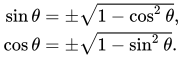


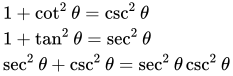


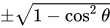
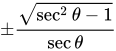
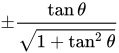


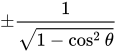
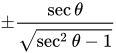
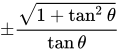
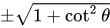

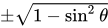
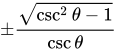

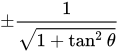
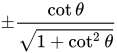

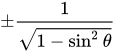
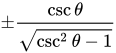

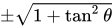
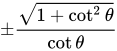

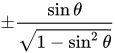
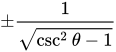
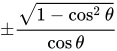
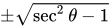


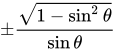
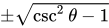
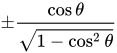
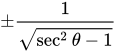





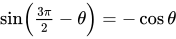




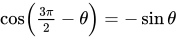




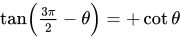




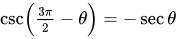




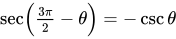




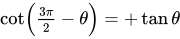



















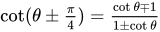



![{\displaystyle {\begin{aligned}\operatorname {sgn} (\sin \theta )=\operatorname {sgn} (\csc \theta )&={\begin{cases}+1&\ 0<\theta <\pi \ {\text{ ise}}\\-1&\ {-\pi }<\theta <0\ {\text{ ise}}\\0&\ \theta \in \{0,\pi \}\ {\text{ ise}}\end{cases}}\\[5mu]\operatorname {sgn} (\cos \theta )=\operatorname {sgn} (\sec \theta )&={\begin{cases}+1&\ {-{\tfrac {1}{2}}\pi }<\theta <{\tfrac {1}{2}}\pi \ {\text{ ise}}\\-1&\ {-\pi }<\theta <-{\tfrac {1}{2}}\pi \ \ {\text{veya}}\ \ {\tfrac {1}{2}}\pi <\theta <\pi \ {\text{ ise}}\\0&\ \theta \in {\bigl \{}{-{\tfrac {1}{2}}\pi },{\tfrac {1}{2}}\pi {\bigr \}}\ {\text{ ise}}\end{cases}}\\[5mu]\operatorname {sgn} (\tan \theta )=\operatorname {sgn} (\cot \theta )&={\begin{cases}+1&\ {-\pi }<\theta <-{\tfrac {1}{2}}\pi \ \ {\text{veya}}\ \ 0<\theta <{\tfrac {1}{2}}\pi \ {\text{ ise}}\\-1&\ {-{\tfrac {1}{2}}\pi }<\theta <0\ \ {\text{veya}}\ \ {\tfrac {1}{2}}\pi <\theta <\pi \ {\text{ ise}}\\0&\ \theta \in {\bigl \{}{-{\tfrac {1}{2}}\pi },0,{\tfrac {1}{2}}\pi ,\pi {\bigr \}}\ {\text{ ise}}\end{cases}}\end{aligned}}}](https://wikimedia.org/api/rest_v1/media/math/render/svg/100bf1f74f64b859146c7a9d5f1ad6ec558191df)

![{\displaystyle (-\pi ,\pi ],}](https://wikimedia.org/api/rest_v1/media/math/render/svg/c73d26a883cb3bac0800037cd3dd9dbd719f9334)
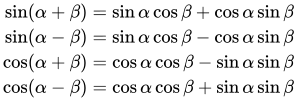










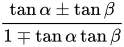

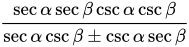

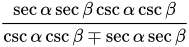

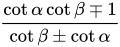





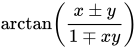

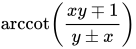





![{\displaystyle {\begin{aligned}e_{0}&=1\\[6pt]e_{1}&=\sum _{i}x_{i}&&=\sum _{i}\tan \theta _{i}\\[6pt]e_{2}&=\sum _{i<j}x_{i}x_{j}&&=\sum _{i<j}\tan \theta _{i}\tan \theta _{j}\\[6pt]e_{3}&=\sum _{i<j<k}x_{i}x_{j}x_{k}&&=\sum _{i<j<k}\tan \theta _{i}\tan \theta _{j}\tan \theta _{k}\\&\ \ \vdots &&\ \ \vdots \end{aligned}}}](https://wikimedia.org/api/rest_v1/media/math/render/svg/cb1927ae2be96f5156e18813a20486fdb0ff72f1)
![{\displaystyle {\begin{aligned}{\tan }{\Bigl (}\sum _{i}\theta _{i}{\Bigr )}&={\frac {{\sin }{\bigl (}\sum _{i}\theta _{i}{\bigr )}/\prod _{i}\cos \theta _{i}}{{\cos }{\bigl (}\sum _{i}\theta _{i}{\bigr )}/\prod _{i}\cos \theta _{i}}}\\[10pt]&={\frac {\displaystyle \sum _{{\text{tek}}\ k\geq 1}(-1)^{\frac {k-1}{2}}\sum _{\begin{smallmatrix}A\subseteq \{1,2,3,\dots \}\\\left|A\right|=k\end{smallmatrix}}\prod _{i\in A}\tan \theta _{i}}{\displaystyle \sum _{{\text{çift}}\ k\geq 0}~(-1)^{\frac {k}{2}}~~\sum _{\begin{smallmatrix}A\subseteq \{1,2,3,\dots \}\\\left|A\right|=k\end{smallmatrix}}\prod _{i\in A}\tan \theta _{i}}}={\frac {e_{1}-e_{3}+e_{5}-\cdots }{e_{0}-e_{2}+e_{4}-\cdots }}\\[10pt]{\cot }{\Bigl (}\sum _{i}\theta _{i}{\Bigr )}&={\frac {e_{0}-e_{2}+e_{4}-\cdots }{e_{1}-e_{3}+e_{5}-\cdots }}\end{aligned}}}](https://wikimedia.org/api/rest_v1/media/math/render/svg/705065cd52a7e0a11c792f2cb1a8de1f78984e29)
![{\displaystyle {\begin{aligned}\tan(\theta _{1}+\theta _{2})&={\frac {e_{1}}{e_{0}-e_{2}}}={\frac {x_{1}+x_{2}}{1\ -\ x_{1}x_{2}}}={\frac {\tan \theta _{1}+\tan \theta _{2}}{1\ -\ \tan \theta _{1}\tan \theta _{2}}},\\[8pt]\tan(\theta _{1}+\theta _{2}+\theta _{3})&={\frac {e_{1}-e_{3}}{e_{0}-e_{2}}}={\frac {(x_{1}+x_{2}+x_{3})\ -\ (x_{1}x_{2}x_{3})}{1\ -\ (x_{1}x_{2}+x_{1}x_{3}+x_{2}x_{3})}},\\[8pt]\tan(\theta _{1}+\theta _{2}+\theta _{3}+\theta _{4})&={\frac {e_{1}-e_{3}}{e_{0}-e_{2}+e_{4}}}\\[8pt]&={\frac {(x_{1}+x_{2}+x_{3}+x_{4})\ -\ (x_{1}x_{2}x_{3}+x_{1}x_{2}x_{4}+x_{1}x_{3}x_{4}+x_{2}x_{3}x_{4})}{1\ -\ (x_{1}x_{2}+x_{1}x_{3}+x_{1}x_{4}+x_{2}x_{3}+x_{2}x_{4}+x_{3}x_{4})\ +\ (x_{1}x_{2}x_{3}x_{4})}},\end{aligned}}}](https://wikimedia.org/api/rest_v1/media/math/render/svg/4c9196b8ab5e0aef6cf7d7fec7d7546f2a6e7d2f)
![{\displaystyle {\begin{aligned}{\sec }{\Bigl (}\sum _{i}\theta _{i}{\Bigr )}&={\frac {\prod _{i}\sec \theta _{i}}{e_{0}-e_{2}+e_{4}-\cdots }}\\[8pt]{\csc }{\Bigl (}\sum _{i}\theta _{i}{\Bigr )}&={\frac {\prod _{i}\sec \theta _{i}}{e_{1}-e_{3}+e_{5}-\cdots }}\end{aligned}}}](https://wikimedia.org/api/rest_v1/media/math/render/svg/b24f2b169fbe11608507c63f5bb728e03b2b4957)


![{\displaystyle {\begin{aligned}\sec(\alpha +\beta +\gamma )&={\frac {\sec \alpha \sec \beta \sec \gamma }{1-\tan \alpha \tan \beta -\tan \alpha \tan \gamma -\tan \beta \tan \gamma }}\\[8pt]\csc(\alpha +\beta +\gamma )&={\frac {\sec \alpha \sec \beta \sec \gamma }{\tan \alpha +\tan \beta +\tan \gamma -\tan \alpha \tan \beta \tan \gamma }}.\end{aligned}}}](https://wikimedia.org/api/rest_v1/media/math/render/svg/e082e69aab7a9c782f590f3a93262ba3101899b7)












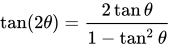






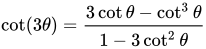
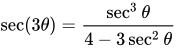
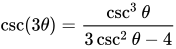






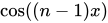
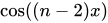





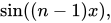
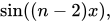





![{\displaystyle {\begin{aligned}\sin {\frac {\theta }{2}}&=\operatorname {sgn} \left(\sin {\frac {\theta }{2}}\right){\sqrt {\frac {1-\cos \theta }{2}}}\\[3pt]\cos {\frac {\theta }{2}}&=\operatorname {sgn} \left(\cos {\frac {\theta }{2}}\right){\sqrt {\frac {1+\cos \theta }{2}}}\\[3pt]\tan {\frac {\theta }{2}}&={\frac {1-\cos \theta }{\sin \theta }}={\frac {\sin \theta }{1+\cos \theta }}=\csc \theta -\cot \theta ={\frac {\tan \theta }{1+\sec {\theta }}}\\[6mu]&=\operatorname {sgn} (\sin \theta ){\sqrt {\frac {1-\cos \theta }{1+\cos \theta }}}={\frac {-1+\operatorname {sgn} (\cos \theta ){\sqrt {1+\tan ^{2}\theta }}}{\tan \theta }}\\[3pt]\cot {\frac {\theta }{2}}&={\frac {1+\cos \theta }{\sin \theta }}={\frac {\sin \theta }{1-\cos \theta }}=\csc \theta +\cot \theta =\operatorname {sgn} (\sin \theta ){\sqrt {\frac {1+\cos \theta }{1-\cos \theta }}}\\\sec {\frac {\theta }{2}}&=\operatorname {sgn} \left(\cos {\frac {\theta }{2}}\right){\sqrt {\frac {2}{1+\cos \theta }}}\\\csc {\frac {\theta }{2}}&=\operatorname {sgn} \left(\sin {\frac {\theta }{2}}\right){\sqrt {\frac {2}{1-\cos \theta }}}\\\end{aligned}}}](https://wikimedia.org/api/rest_v1/media/math/render/svg/d53d104c73c4b28f1dd7bfa5d2b0c7207c68cd87)
![{\displaystyle {\begin{aligned}\tan {\frac {\eta \pm \theta }{2}}&={\frac {\sin \eta \pm \sin \theta }{\cos \eta +\cos \theta }}\\[3pt]\tan \left({\frac {\theta }{2}}+{\frac {\pi }{4}}\right)&=\sec \theta +\tan \theta \\[3pt]{\sqrt {\frac {1-\sin \theta }{1+\sin \theta }}}&={\frac {\left|1-\tan {\frac {\theta }{2}}\right|}{\left|1+\tan {\frac {\theta }{2}}\right|}}\end{aligned}}}](https://wikimedia.org/api/rest_v1/media/math/render/svg/639270245e163f1afa8682ac8aa12086db43dce1)
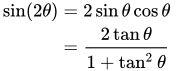
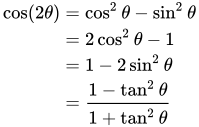
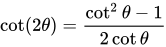


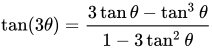
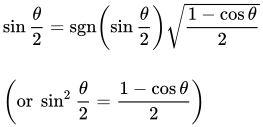
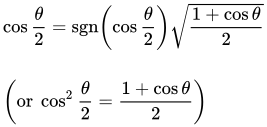
![{\displaystyle {\begin{aligned}\tan {\frac {\theta }{2}}&=\csc \theta -\cot \theta \\&=\pm \,{\sqrt {\frac {1-\cos \theta }{1+\cos \theta }}}\\[3pt]&={\frac {\sin \theta }{1+\cos \theta }}\\[3pt]&={\frac {1-\cos \theta }{\sin \theta }}\\[5pt]\tan {\frac {\eta +\theta }{2}}&={\frac {\sin \eta +\sin \theta }{\cos \eta +\cos \theta }}\\[5pt]\tan \left({\frac {\theta }{2}}+{\frac {\pi }{4}}\right)&=\sec \theta +\tan \theta \\[5pt]{\sqrt {\frac {1-\sin \theta }{1+\sin \theta }}}&={\frac {\left|1-\tan {\frac {\theta }{2}}\right|}{\left|1+\tan {\frac {\theta }{2}}\right|}}\\[5pt]\tan {\frac {\theta }{2}}&={\frac {\tan \theta }{1+{\sqrt {1+\tan ^{2}\theta }}}}\\&{\text{for }}\theta \in \left(-{\tfrac {\pi }{2}},{\tfrac {\pi }{2}}\right)\end{aligned}}}](https://wikimedia.org/api/rest_v1/media/math/render/svg/3cab50a58d64b8c3341fb4f7646888bbbc67ea0c)
![{\displaystyle {\begin{aligned}\cot {\frac {\theta }{2}}&=\csc \theta +\cot \theta \\&=\pm \,{\sqrt {\frac {1+\cos \theta }{1-\cos \theta }}}\\[3pt]&={\frac {\sin \theta }{1-\cos \theta }}\\[4pt]&={\frac {1+\cos \theta }{\sin \theta }}\end{aligned}}}](https://wikimedia.org/api/rest_v1/media/math/render/svg/5c9be831a310f112ffc6e5790bc705dc7b070b87)
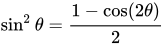
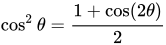
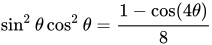
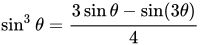
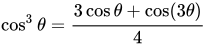








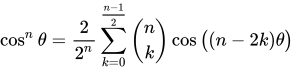










![{\displaystyle {\begin{aligned}\prod _{k=1}^{n}\cos \theta _{k}&={\frac {1}{2^{n}}}\sum _{e\in S}\cos(e_{1}\theta _{1}+\cdots +e_{n}\theta _{n})\\[6pt]&{\text{burada }}e=(e_{1},\ldots ,e_{n})\in S=\{1,-1\}^{n}\end{aligned}}}](https://wikimedia.org/api/rest_v1/media/math/render/svg/43ab464a5d09ae80c48997340721704036836b77)


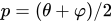
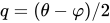






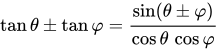

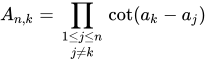




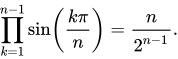

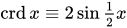
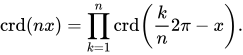




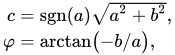

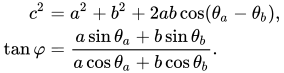

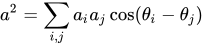
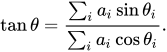
![{\displaystyle {\begin{aligned}\sum _{k=0}^{n}\sin k\theta &={\frac {\cos {\tfrac {1}{2}}\theta -\cos \left(\left(n+{\tfrac {1}{2}}\right)\theta \right)}{2\sin {\tfrac {1}{2}}\theta }}\\[5pt]\sum _{k=0}^{n}\cos k\theta &={\frac {\sin {\tfrac {1}{2}}\theta +\sin \left(\left(n+{\tfrac {1}{2}}\right)\theta \right)}{2\sin {\tfrac {1}{2}}\theta }}\end{aligned}}}](https://wikimedia.org/api/rest_v1/media/math/render/svg/c850aa2dd7cc306d87d5d68d5802cab64f8572a0)


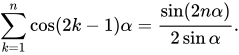


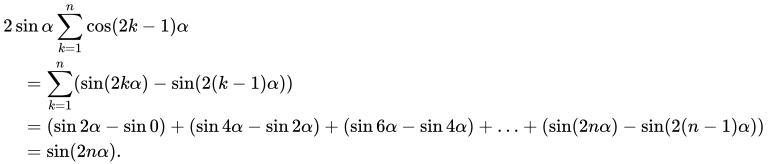


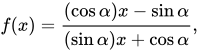
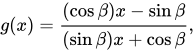





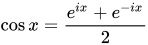
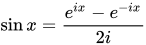
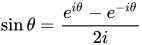

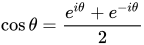

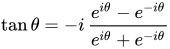
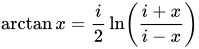
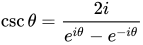

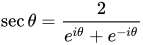

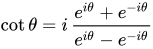
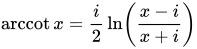




![{\displaystyle {\begin{aligned}\sin x&=x\prod _{n=1}^{\infty }\left(1-{\frac {x^{2}}{\pi ^{2}n^{2}}}\right),&\cos x&=\prod _{n=1}^{\infty }\left(1-{\frac {x^{2}}{\pi ^{2}\left(n-{\frac {1}{2}}\right)\!{\vphantom {)}}^{2}}}\right),\\[10mu]\sinh x&=x\prod _{n=1}^{\infty }\left(1+{\frac {x^{2}}{\pi ^{2}n^{2}}}\right),&\cosh x&=\prod _{n=1}^{\infty }\left(1+{\frac {x^{2}}{\pi ^{2}\left(n-{\frac {1}{2}}\right)\!{\vphantom {)}}^{2}}}\right).\end{aligned}}}](https://wikimedia.org/api/rest_v1/media/math/render/svg/6d43e1176a38b1e6b653837eb782ae79735783ac)
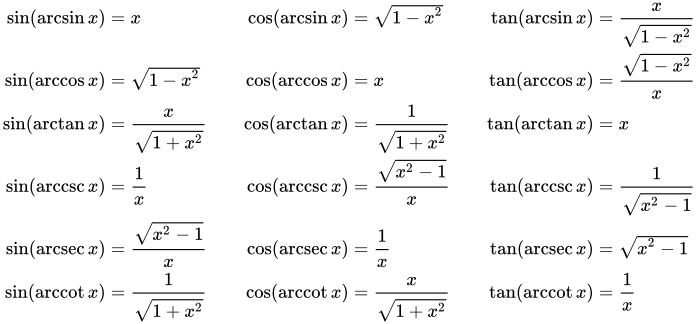

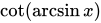

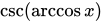
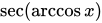


![{\displaystyle {\begin{alignedat}{9}{\frac {\pi }{2}}~&=~\arcsin(x)&&+\arccos(x)~&&=~\arctan(r)&&+\operatorname {arccot} (r)~&&=~\operatorname {arcsec} (s)&&+\operatorname {arccsc} (s)\\[0.4ex]\pi ~&=~\arccos(x)&&+\arccos(-x)~&&=~\operatorname {arccot} (r)&&+\operatorname {arccot} (-r)~&&=~\operatorname {arcsec} (s)&&+\operatorname {arcsec} (-s)\\[0.4ex]0~&=~\arcsin(x)&&+\arcsin(-x)~&&=~\arctan(r)&&+\arctan(-r)~&&=~\operatorname {arccsc} (s)&&+\operatorname {arccsc} (-s)\\[1.0ex]\end{alignedat}}}](https://wikimedia.org/api/rest_v1/media/math/render/svg/839db041f421b4af5890106450e2b4d3e9e183d4)





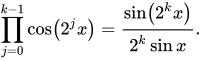




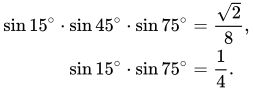



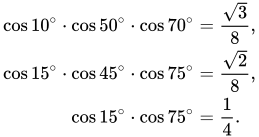



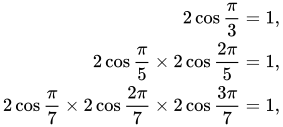

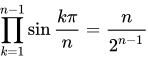
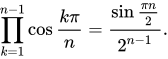
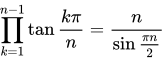

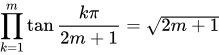







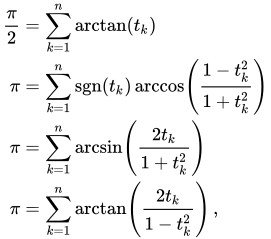








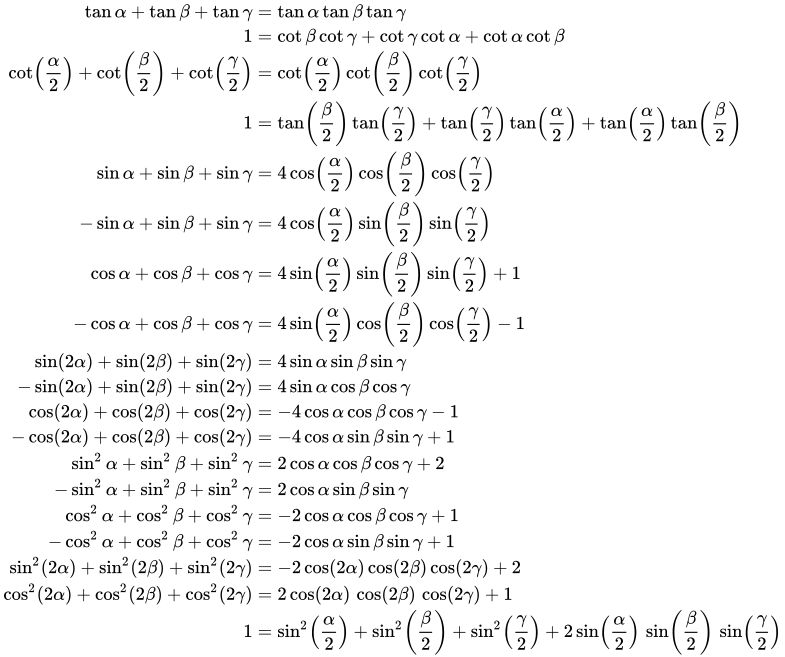







 , doi:10.3390/math9172162
