Trigonometrik fonksiyonları tanımlamanın birkaç eşdeğer yolu vardır ve bunlar arasındaki trigonometrik özdeşliklerin kanıtları seçilen tanıma bağlıdır. En eski ve en temel tanımlar dik üçgenlerin geometrisine ve kenarları arasındaki orana dayanır. Bu makalede verilen kanıtlar bu tanımları kullanır ve dolayısıyla bir dik açıdan büyük olmayan negatif olmayan açılar için geçerlidir. Daha büyük ve negatif açılar için Trigonometrik fonksiyonlar bölümüne bakınız.
Diğer tanımlar ve dolayısıyla diğer kanıtlar sinüs ve kosinüsün Taylor serisine veya
f
″
+
f
=
0
{\displaystyle f''+f=0}
diferansiyel denkleminin çözümlerine dayanır.
Trigonometrik fonksiyonlar, bir dik üçgenin kenar uzunlukları ve iç açıları arasındaki ilişkileri belirtir. Örneğin, θ açısının sinüsü, karşı kenarın uzunluğunun hipotenüsün uzunluğuna bölünmesi olarak tanımlanır.
Altı trigonometrik fonksiyon, bazıları için 0'dan dik açının (90°) katları kadar farklı olan açılar hariç, her gerçel sayı için tanımlanmıştır. Sağdaki diyagrama bakılırsa, θ'nın altı trigonometrik fonksiyonu, dik açıdan daha küçük açılar içindir:
sin
θ
=
karşı kenar
hipotenüs
=
a
h
{\displaystyle \sin \theta ={\frac {\text{karşı kenar}}{\text{hipotenüs}}}={\frac {a}{h}}}
cos
θ
=
komşu kenar
hipotenüs
=
b
h
{\displaystyle \cos \theta ={\frac {\text{komşu kenar}}{\text{hipotenüs}}}={\frac {b}{h}}}
tan
θ
=
karşı kenar
komşu kenar
=
a
b
{\displaystyle \tan \theta ={\frac {\text{karşı kenar}}{\text{komşu kenar}}}={\frac {a}{b}}}
cot
θ
=
komşu kenar
karşı kenar
=
b
a
{\displaystyle \cot \theta ={\frac {\text{komşu kenar}}{\text{karşı kenar}}}={\frac {b}{a}}}
sec
θ
=
hipotenüs
komşu kenar
=
h
b
{\displaystyle \sec \theta ={\frac {\text{hipotenüs}}{\text{komşu kenar}}}={\frac {h}{b}}}
csc
θ
=
hipotenüs
karşı kenar
=
h
a
{\displaystyle \csc \theta ={\frac {\text{hipotenüs}}{\text{karşı kenar}}}={\frac {h}{a}}}
Bir dik açıdan daha küçük açılar söz konusu olduğunda, aşağıdaki özdeşlikler bölme özdeşliği aracılığıyla yukarıdaki tanımların doğrudan sonuçlarıdır
a
b
=
(
a
h
)
(
b
h
)
.
{\displaystyle {\frac {a}{b}}={\frac {\left({\frac {a}{h}}\right)}{\left({\frac {b}{h}}\right)}}.}
90°'den büyük açılar ve negatif açılar için geçerli olmaya devam ederler.
tan
θ
=
karşı kenar
komşu kenar
=
(
karşı kenar
hipotenüs
)
(
komşu kenar
hipotenüs
)
=
sin
θ
cos
θ
{\displaystyle \tan \theta ={\frac {\text{karşı kenar}}{\text{komşu kenar}}}={\frac {\left({\frac {\text{karşı kenar}}{\text{hipotenüs}}}\right)}{\left({\frac {\text{komşu kenar}}{\text{hipotenüs}}}\right)}}={\frac {\sin \theta }{\cos \theta }}}
cot
θ
=
komşu kenar
karşı kenar
=
(
komşu kenar
komşu kenar
)
(
karşı kenar
komşu kenar
)
=
1
tan
θ
=
cos
θ
sin
θ
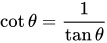
{\displaystyle \cot \theta ={\frac {\text{komşu kenar}}{\text{karşı kenar}}}={\frac {\left({\frac {\text{komşu kenar}}{\text{komşu kenar}}}\right)}{\left({\frac {\text{karşı kenar}}{\text{komşu kenar}}}\right)}}={\frac {1}{\tan \theta }}={\frac {\cos \theta }{\sin \theta }}}
sec
θ
=
1
cos
θ
=
hipotenüs
komşu kenar
{\displaystyle \sec \theta ={\frac {1}{\cos \theta }}={\frac {\text{hipotenüs}}{\text{komşu kenar}}}}
csc
θ
=
1
sin
θ
=
hipotenüs
karşı kenar
{\displaystyle \csc \theta ={\frac {1}{\sin \theta }}={\frac {\text{hipotenüs}}{\text{karşı kenar}}}}
tan
θ
=
karşı kenar
komşu kenar
=
(
karşı kenar
×
hipotenüs
karşı kenar
×
komşu kenar
)
(
komşu kenar
×
hipotenüs
karşı kenar
×
komşu kenar
)
=
(
hipotenüs
komşu kenar
)
(
hipotenüs
karşı kenar
)
=
sec
θ
csc
θ
{\displaystyle \tan \theta ={\frac {\text{karşı kenar}}{\text{komşu kenar}}}={\frac {\left({\frac {{\text{karşı kenar}}\times {\text{hipotenüs}}}{{\text{karşı kenar}}\times {\text{komşu kenar}}}}\right)}{\left({\frac {{\text{komşu kenar}}\times {\text{hipotenüs}}}{{\text{karşı kenar}}\times {\text{komşu kenar}}}}\right)}}={\frac {\left({\frac {\text{hipotenüs}}{\text{komşu kenar}}}\right)}{\left({\frac {\text{hipotenüs}}{\text{karşı kenar}}}\right)}}={\frac {\sec \theta }{\csc \theta }}}
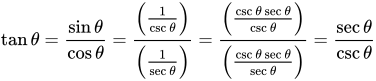
Veya
tan
θ
=
sin
θ
cos
θ
=
(
1
csc
θ
)
(
1
sec
θ
)
=
(
csc
θ
sec
θ
csc
θ
)
(
csc
θ
sec
θ
sec
θ
)
=
sec
θ
csc
θ
{\displaystyle \tan \theta ={\frac {\sin \theta }{\cos \theta }}={\frac {\left({\frac {1}{\csc \theta }}\right)}{\left({\frac {1}{\sec \theta }}\right)}}={\frac {\left({\frac {\csc \theta \sec \theta }{\csc \theta }}\right)}{\left({\frac {\csc \theta \sec \theta }{\sec \theta }}\right)}}={\frac {\sec \theta }{\csc \theta }}}
cot
θ
=
csc
θ
sec
θ
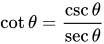
{\displaystyle \cot \theta ={\frac {\csc \theta }{\sec \theta }}}
Toplamı π/2 radyan (90 derece) olan iki açı "tümler (veya tamamlayıcı veya dikler)”dir. Şekilde, A ve B köşelerindeki açılar tümlerdir, bu nedenle a ve b'yi değiştirebilir ve θ'yı π/2 - θ olarak değiştirerek elde edebiliriz:
sin
(
π
/
2
−
θ
)
=
cos
θ
{\displaystyle \sin \left(\pi /2-\theta \right)=\cos \theta }
cos
(
π
/
2
−
θ
)
=
sin
θ
{\displaystyle \cos \left(\pi /2-\theta \right)=\sin \theta }
tan
(
π
/
2
−
θ
)
=
cot
θ
{\displaystyle \tan \left(\pi /2-\theta \right)=\cot \theta }
cot
(
π
/
2
−
θ
)
=
tan
θ
{\displaystyle \cot \left(\pi /2-\theta \right)=\tan \theta }
sec
(
π
/
2
−
θ
)
=
csc
θ
{\displaystyle \sec \left(\pi /2-\theta \right)=\csc \theta }
csc
(
π
/
2
−
θ
)
=
sec
θ
{\displaystyle \csc \left(\pi /2-\theta \right)=\sec \theta }
Özdeşlik 1:
sin
2
θ
+
cos
2
θ
=
1
{\displaystyle \sin ^{2}\theta +\cos ^{2}\theta =1}
Bu ve oran özdeşliklerinden aşağıdaki iki sonuç çıkar. İlkini elde etmek için,
sin
2
θ
+
cos
2
θ
=
1
{\displaystyle \sin ^{2}\theta +\cos ^{2}\theta =1}
cos
2
θ
{\displaystyle \cos ^{2}\theta }
sin
2
θ
{\displaystyle \sin ^{2}\theta }
tan
2
θ
+
1
=
sec
2
θ
{\displaystyle \tan ^{2}\theta +1\ =\sec ^{2}\theta }
sec
2
θ
−
tan
2
θ
=
1
{\displaystyle \sec ^{2}\theta -\tan ^{2}\theta =1}
Benzer şekilde,
1
+
cot
2
θ
=
csc
2
θ
{\displaystyle 1\ +\cot ^{2}\theta =\csc ^{2}\theta }
csc
2
θ
−
cot
2
θ
=
1
{\displaystyle \csc ^{2}\theta -\cot ^{2}\theta =1}
Özdeşlik 2:
Aşağıda her üç ters fonksiyon da açıklanmaktadır.
csc
2
θ
+
sec
2
θ
−
cot
2
θ
=
2
+
tan
2
θ
{\displaystyle \csc ^{2}\theta +\sec ^{2}\theta -\cot ^{2}\theta =2\ +\tan ^{2}\theta }
İspat 2:
Yukarıdaki üçgen şekline bakınız. Pisagor teoremine göre
a
2
+
b
2
=
h
2
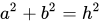
{\displaystyle a^{2}+b^{2}=h^{2}}
csc
2
θ
+
sec
2
θ
=
h
2
a
2
+
h
2
b
2
=
a
2
+
b
2
a
2
+
a
2
+
b
2
b
2
=
2
+
b
2
a
2
+
a
2
b
2
{\displaystyle \csc ^{2}\theta +\sec ^{2}\theta ={\frac {h^{2}}{a^{2}}}+{\frac {h^{2}}{b^{2}}}={\frac {a^{2}+b^{2}}{a^{2}}}+{\frac {a^{2}+b^{2}}{b^{2}}}=2\ +{\frac {b^{2}}{a^{2}}}+{\frac {a^{2}}{b^{2}}}}
Uygun fonksiyonlarla yer değiştirdiğimizde -
2
+
b
2
a
2
+
a
2
b
2
=
2
+
tan
2
θ
+
cot
2
θ
{\displaystyle 2\ +{\frac {b^{2}}{a^{2}}}+{\frac {a^{2}}{b^{2}}}=2\ +\tan ^{2}\theta +\cot ^{2}\theta }
Yeniden düzenlersek:
csc
2
θ
+
sec
2
θ
−
cot
2
θ
=
2
+
tan
2
θ
{\displaystyle \csc ^{2}\theta +\sec ^{2}\theta -\cot ^{2}\theta =2\ +\tan ^{2}\theta }
Toplam formülünün gösterimi.
Yatay bir çizgi (x -ekseni) çizin; bir O orijini işaretleyin. O'dan yatay çizginin üzerinde
α
{\displaystyle \alpha }
β
{\displaystyle \beta }
x -ekseni arasındaki açı
α
+
β
{\displaystyle \alpha +\beta }
P'yi
α
+
β
{\displaystyle \alpha +\beta }
PQ,
α
{\displaystyle \alpha }
∴
{\displaystyle \therefore }
QA, x -ekseni üzerindeki A noktasından Q'ya ve PB, x -ekseni üzerindeki B noktasından P'ye bir dik olsun.
QR x -eksenine paralel olacak şekilde R'yi PB üzerine çizin.
Şimdi
R
P
Q
=
α
{\displaystyle RPQ=\alpha }
O
Q
A
=
π
2
−
α
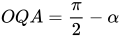
{\displaystyle OQA={\frac {\pi }{2}}-\alpha }
R
Q
O
=
α
,
R
Q
P
=
π
2
−
α
{\displaystyle RQO=\alpha ,RQP={\frac {\pi }{2}}-\alpha }
R
P
Q
=
α
{\displaystyle RPQ=\alpha }
R
P
Q
=
π
2
−
R
Q
P
=
π
2
−
(
π
2
−
R
Q
O
)
=
R
Q
O
=
α
{\displaystyle RPQ={\tfrac {\pi }{2}}-RQP={\tfrac {\pi }{2}}-({\tfrac {\pi }{2}}-RQO)=RQO=\alpha }
O
P
=
1
{\displaystyle OP=1}
P
Q
=
sin
β
{\displaystyle PQ=\sin \beta }
O
Q
=
cos
β
{\displaystyle OQ=\cos \beta }
A
Q
O
Q
=
sin
α
{\displaystyle {\frac {AQ}{OQ}}=\sin \alpha }
A
Q
=
sin
α
cos
β
{\displaystyle AQ=\sin \alpha \cos \beta }
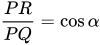
P
R
P
Q
=
cos
α
{\displaystyle {\frac {PR}{PQ}}=\cos \alpha }
P
R
=
cos
α
sin
β
{\displaystyle PR=\cos \alpha \sin \beta }
sin
(
α
+
β
)
=
P
B
=
R
B
+
P
R
=
A
Q
+
P
R
=
sin
α
cos
β
+
cos
α
sin
β
{\displaystyle \sin(\alpha +\beta )=PB=RB+PR=AQ+PR=\sin \alpha \cos \beta +\cos \alpha \sin \beta }
β
{\displaystyle \beta }
−
β
{\displaystyle -\beta }
tek ve çift fonksiyonlar için yansıma özdeşliklerini kullanarak da elde ederiz:
sin
(
α
−
β
)
=
sin
α
cos
(
−
β
)
+
cos
α
sin
(
−
β
)
{\displaystyle \sin(\alpha -\beta )=\sin \alpha \cos(-\beta )+\cos \alpha \sin(-\beta )}
sin
(
α
−
β
)
=
sin
α
cos
β
−
cos
α
sin
β
{\displaystyle \sin(\alpha -\beta )=\sin \alpha \cos \beta -\cos \alpha \sin \beta }
Yukarıdaki şekli kullanarak,
O
P
=
1
{\displaystyle OP=1}
P
Q
=
sin
β
{\displaystyle PQ=\sin \beta }
O
Q
=
cos
β
{\displaystyle OQ=\cos \beta }
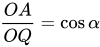
O
A
O
Q
=
cos
α
{\displaystyle {\frac {OA}{OQ}}=\cos \alpha }
O
A
=
cos
α
cos
β
{\displaystyle OA=\cos \alpha \cos \beta }
R
Q
P
Q
=
sin
α
{\displaystyle {\frac {RQ}{PQ}}=\sin \alpha }
R
Q
=
sin
α
sin
β
{\displaystyle RQ=\sin \alpha \sin \beta }
cos
(
α
+
β
)
=
O
B
=
O
A
−
B
A
=
O
A
−
R
Q
=
cos
α
cos
β
−
sin
α
sin
β
{\displaystyle \cos(\alpha +\beta )=OB=OA-BA=OA-RQ=\cos \alpha \cos \beta \ -\sin \alpha \sin \beta }
β
{\displaystyle \beta }
−
β
{\displaystyle -\beta }
tek ve çift fonksiyonlar için yansıma özdeşliklerini kullanarak da elde ederiz:
cos
(
α
−
β
)
=
cos
α
cos
(
−
β
)
−
sin
α
sin
(
−
β
)
,
{\displaystyle \cos(\alpha -\beta )=\cos \alpha \cos(-\beta )-\sin \alpha \sin(-\beta ),}
cos
(
α
−
β
)
=
cos
α
cos
β
+
sin
α
sin
β
{\displaystyle \cos(\alpha -\beta )=\cos \alpha \cos \beta +\sin \alpha \sin \beta }
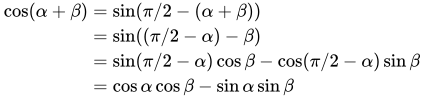
Ayrıca, tümler açı formülleri kullanılarak,
cos
(
α
+
β
)
=
sin
(
π
/
2
−
(
α
+
β
)
)
=
sin
(
(
π
/
2
−
α
)
−
β
)
=
sin
(
π
/
2
−
α
)
cos
β
−
cos
(
π
/
2
−
α
)
sin
β
=
cos
α
cos
β
−
sin
α
sin
β
{\displaystyle {\begin{aligned}\cos(\alpha +\beta )&=\sin \left(\pi /2-(\alpha +\beta )\right)\\&=\sin \left((\pi /2-\alpha )-\beta \right)\\&=\sin \left(\pi /2-\alpha \right)\cos \beta -\cos \left(\pi /2-\alpha \right)\sin \beta \\&=\cos \alpha \cos \beta -\sin \alpha \sin \beta \\\end{aligned}}}
Sinüs ve kosinüs formüllerinden şunu elde ederiz
tan
(
α
+
β
)
=
sin
(
α
+
β
)
cos
(
α
+
β
)
=
sin
α
cos
β
+
cos
α
sin
β
cos
α
cos
β
−
sin
α
sin
β
{\displaystyle \tan(\alpha +\beta )={\frac {\sin(\alpha +\beta )}{\cos(\alpha +\beta )}}={\frac {\sin \alpha \cos \beta +\cos \alpha \sin \beta }{\cos \alpha \cos \beta -\sin \alpha \sin \beta }}}
Hem pay hem de paydayı
cos
α
cos
β
{\displaystyle \cos \alpha \cos \beta }
tan
(
α
+
β
)
=
tan
α
+
tan
β
1
−
tan
α
tan
β
{\displaystyle \tan(\alpha +\beta )={\frac {\tan \alpha +\tan \beta }{1-\tan \alpha \tan \beta }}}
β
{\displaystyle \beta }
α
{\displaystyle \alpha }
tan
(
−
β
)
=
−
tan
β
{\displaystyle \tan(-\beta )=-\tan \beta }
tan
(
α
−
β
)
=
tan
α
+
tan
(
−
β
)
1
−
tan
α
tan
(
−
β
)
=
tan
α
−
tan
β
1
+
tan
α
tan
β
{\displaystyle \tan(\alpha -\beta )={\frac {\tan \alpha +\tan(-\beta )}{1-\tan \alpha \tan(-\beta )}}={\frac {\tan \alpha -\tan \beta }{1+\tan \alpha \tan \beta }}}
Benzer şekilde, sinüs ve kosinüs formüllerinden şunu elde ederiz
cot
(
α
+
β
)
=
cos
(
α
+
β
)
sin
(
α
+
β
)
=
cos
α
cos
β
−
sin
α
sin
β
sin
α
cos
β
+
cos
α
sin
β
{\displaystyle \cot(\alpha +\beta )={\frac {\cos(\alpha +\beta )}{\sin(\alpha +\beta )}}={\frac {\cos \alpha \cos \beta -\sin \alpha \sin \beta }{\sin \alpha \cos \beta +\cos \alpha \sin \beta }}}
Daha sonra hem pay hem de paydayı
sin
α
sin
β
{\displaystyle \sin \alpha \sin \beta }
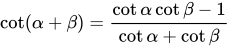
cot
(
α
+
β
)
=
cot
α
cot
β
−
1
cot
α
+
cot
β
{\displaystyle \cot(\alpha +\beta )={\frac {\cot \alpha \cot \beta -1}{\cot \alpha +\cot \beta }}}
Ya da
cot
θ
=
1
tan
θ
{\displaystyle \cot \theta ={\frac {1}{\tan \theta }}}
cot
(
α
+
β
)
=
1
−
tan
α
tan
β
tan
α
+
tan
β
=
1
tan
α
tan
β
−
1
1
tan
α
+
1
tan
β
=
cot
α
cot
β
−
1
cot
α
+
cot
β
{\displaystyle \cot(\alpha +\beta )={\frac {1-\tan \alpha \tan \beta }{\tan \alpha +\tan \beta }}={\frac {{\frac {1}{\tan \alpha \tan \beta }}-1}{{\frac {1}{\tan \alpha }}+{\frac {1}{\tan \beta }}}}={\frac {\cot \alpha \cot \beta -1}{\cot \alpha +\cot \beta }}}
cot
(
−
β
)
=
−
cot
β
{\displaystyle \cot(-\beta )=-\cot \beta }
cot
(
α
−
β
)
=
cot
α
cot
(
−
β
)
−
1
cot
α
+
cot
(
−
β
)
=
cot
α
cot
β
+
1
cot
β
−
cot
α
{\displaystyle \cot(\alpha -\beta )={\frac {\cot \alpha \cot(-\beta )-1}{\cot \alpha +\cot(-\beta )}}={\frac {\cot \alpha \cot \beta +1}{\cot \beta -\cot \alpha }}}
Açı toplam özdeşliklerinden şunu elde ederiz
sin
(
2
θ
)
=
2
sin
θ
cos
θ
{\displaystyle \sin(2\theta )=2\sin \theta \cos \theta }
ve
cos
(
2
θ
)
=
cos
2
θ
−
sin
2
θ
{\displaystyle \cos(2\theta )=\cos ^{2}\theta -\sin ^{2}\theta }
Pisagor özdeşlikleri bunlardan ikincisi için iki alternatif form verir:
cos
(
2
θ
)
=
2
cos
2
θ
−
1
{\displaystyle \cos(2\theta )=2\cos ^{2}\theta -1}
cos
(
2
θ
)
=
1
−
2
sin
2
θ
{\displaystyle \cos(2\theta )=1-2\sin ^{2}\theta }
Açı toplam özdeşlikleri de şunları verir
tan
(
2
θ
)
=
2
tan
θ
1
−
tan
2
θ
=
2
cot
θ
−
tan
θ
{\displaystyle \tan(2\theta )={\frac {2\tan \theta }{1-\tan ^{2}\theta }}={\frac {2}{\cot \theta -\tan \theta }}}
cot
(
2
θ
)
=
cot
2
θ
−
1
2
cot
θ
=
cot
θ
−
tan
θ
2
{\displaystyle \cot(2\theta )={\frac {\cot ^{2}\theta -1}{2\cot \theta }}={\frac {\cot \theta -\tan \theta }{2}}}
Ayrıca Euler formülü kullanılarak da kanıtlanabilir.
e
i
φ
=
cos
φ
+
i
sin
φ
{\displaystyle e^{i\varphi }=\cos \varphi +i\sin \varphi }
Her iki tarafın karesi alındığında
e
i
2
φ
=
(
cos
φ
+
i
sin
φ
)
2
{\displaystyle e^{i2\varphi }=(\cos \varphi +i\sin \varphi )^{2}}
Ancak açıyı, denklemin sol tarafında aynı sonucu veren iki katına çıkarılmış versiyonu ile değiştirirsek
e
i
2
φ
=
cos
2
φ
+
i
sin
2
φ
{\displaystyle e^{i2\varphi }=\cos 2\varphi +i\sin 2\varphi }
Bundan şu sonuç çıkar
(
cos
φ
+
i
sin
φ
)
2
=
cos
2
φ
+
i
sin
2
φ
{\displaystyle (\cos \varphi +i\sin \varphi )^{2}=\cos 2\varphi +i\sin 2\varphi }
Kareyi genişletmek ve denklemin sol tarafını sadeleştirmek şu sonucu verir
i
(
2
sin
φ
cos
φ
)
+
cos
2
φ
−
sin
2
φ
=
cos
2
φ
+
i
sin
2
φ
{\displaystyle i(2\sin \varphi \cos \varphi )+\cos ^{2}\varphi -\sin ^{2}\varphi \ =\cos 2\varphi +i\sin 2\varphi }
Sanal ve gerçek kısımlar aynı olmak zorunda olduğundan, orijinal özdeşliklerle baş başa kalırız
cos
2
φ
−
sin
2
φ
=
cos
2
φ
{\displaystyle \cos ^{2}\varphi -\sin ^{2}\varphi \ =\cos 2\varphi }
ve ayrıca
2
sin
φ
cos
φ
=
sin
2
φ
{\displaystyle 2\sin \varphi \cos \varphi =\sin 2\varphi }
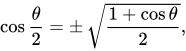
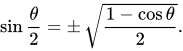
cos 2θ için alternatif formları veren iki özdeşlik aşağıdaki denklemlere yol açar:
cos
θ
2
=
±
1
+
cos
θ
2
,
{\displaystyle \cos {\frac {\theta }{2}}=\pm \,{\sqrt {\frac {1+\cos \theta }{2}}},}
sin
θ
2
=
±
1
−
cos
θ
2
.
{\displaystyle \sin {\frac {\theta }{2}}=\pm \,{\sqrt {\frac {1-\cos \theta }{2}}}.}
Karekök işaretinin doğru seçilmesi gerekir -θ'ya 2π eklenirse, kareköklerin içindeki büyüklüklerin değişmediğini, ancak denklemlerin sol taraflarının işaret değiştirdiğini unutmayın. Bu nedenle, kullanılacak doğru işaret θ değerine bağlıdır.
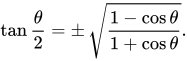
Tan fonksiyonu için denklem şöyledir:
tan
θ
2
=
±
1
−
cos
θ
1
+
cos
θ
.
{\displaystyle \tan {\frac {\theta }{2}}=\pm \,{\sqrt {\frac {1-\cos \theta }{1+\cos \theta }}}.}
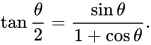
Daha sonra karekök içindeki pay ve paydayı (1 + cos θ) ile çarpmak ve Pisagor özdeşliklerini kullanmak şu sonucu verir:
tan
θ
2
=
sin
θ
1
+
cos
θ
.
{\displaystyle \tan {\frac {\theta }{2}}={\frac {\sin \theta }{1+\cos \theta }}.}
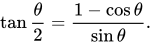
Ayrıca, pay ve paydanın her ikisi de (1 - cos θ) ile çarpılırsa, sonuç şu olur:
tan
θ
2
=
1
−
cos
θ
sin
θ
.
{\displaystyle \tan {\frac {\theta }{2}}={\frac {1-\cos \theta }{\sin \theta }}.}
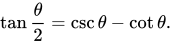
Bu aynı zamanda şunu da verir:
tan
θ
2
=
csc
θ
−
cot
θ
.
{\displaystyle \tan {\frac {\theta }{2}}=\csc \theta -\cot \theta .}
Benzer düzenlemeler cot fonksiyonu için de geçerlidir:
cot
θ
2
=
±
1
+
cos
θ
1
−
cos
θ
=
1
+
cos
θ
sin
θ
=
sin
θ
1
−
cos
θ
=
csc
θ
+
cot
θ
.
{\displaystyle \cot {\frac {\theta }{2}}=\pm \,{\sqrt {\frac {1+\cos \theta }{1-\cos \theta }}}={\frac {1+\cos \theta }{\sin \theta }}={\frac {\sin \theta }{1-\cos \theta }}=\csc \theta +\cot \theta .}
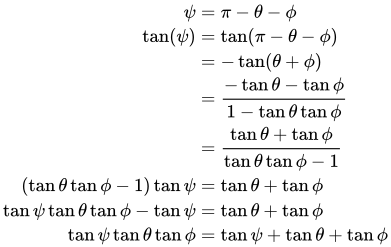
Eğer
ψ
+
θ
+
ϕ
=
π
=
{\displaystyle \psi +\theta +\phi =\pi =}
ψ
{\displaystyle \psi }
θ
{\displaystyle \theta }
ϕ
{\displaystyle \phi }
tan
(
ψ
)
+
tan
(
θ
)
+
tan
(
ϕ
)
=
tan
(
ψ
)
tan
(
θ
)
tan
(
ϕ
)
.
{\displaystyle \tan(\psi )+\tan(\theta )+\tan(\phi )=\tan(\psi )\tan(\theta )\tan(\phi ).}
İspat: [ 1]
ψ
=
π
−
θ
−
ϕ
tan
(
ψ
)
=
tan
(
π
−
θ
−
ϕ
)
=
−
tan
(
θ
+
ϕ
)
=
−
tan
θ
−
tan
ϕ
1
−
tan
θ
tan
ϕ
=
tan
θ
+
tan
ϕ
tan
θ
tan
ϕ
−
1
(
tan
θ
tan
ϕ
−
1
)
tan
ψ
=
tan
θ
+
tan
ϕ
tan
ψ
tan
θ
tan
ϕ
−
tan
ψ
=
tan
θ
+
tan
ϕ
tan
ψ
tan
θ
tan
ϕ
=
tan
ψ
+
tan
θ
+
tan
ϕ
{\displaystyle {\begin{aligned}\psi &=\pi -\theta -\phi \\\tan(\psi )&=\tan(\pi -\theta -\phi )\\&=-\tan(\theta +\phi )\\&={\frac {-\tan \theta -\tan \phi }{1-\tan \theta \tan \phi }}\\&={\frac {\tan \theta +\tan \phi }{\tan \theta \tan \phi -1}}\\(\tan \theta \tan \phi -1)\tan \psi &=\tan \theta +\tan \phi \\\tan \psi \tan \theta \tan \phi -\tan \psi &=\tan \theta +\tan \phi \\\tan \psi \tan \theta \tan \phi &=\tan \psi +\tan \theta +\tan \phi \\\end{aligned}}}
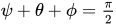
Eğer
ψ
+
θ
+
ϕ
=
π
2
=
{\displaystyle \psi +\theta +\phi ={\tfrac {\pi }{2}}=}
cot
(
ψ
)
+
cot
(
θ
)
+
cot
(
ϕ
)
=
cot
(
ψ
)
cot
(
θ
)
cot
(
ϕ
)
{\displaystyle \cot(\psi )+\cot(\theta )+\cot(\phi )=\cot(\psi )\cot(\theta )\cot(\phi )}
İspat:
ψ
{\displaystyle \psi }
θ
{\displaystyle \theta }
ϕ
{\displaystyle \phi }
ψ
+
θ
+
ϕ
=
π
2
{\displaystyle \psi +\theta +\phi ={\tfrac {\pi }{2}}}
∴
(
π
2
−
ψ
)
+
(
π
2
−
θ
)
+
(
π
2
−
ϕ
)
=
3
π
2
−
(
ψ
+
θ
+
ϕ
)
=
3
π
2
−
π
2
=
π
{\displaystyle \therefore ({\tfrac {\pi }{2}}-\psi )+({\tfrac {\pi }{2}}-\theta )+({\tfrac {\pi }{2}}-\phi )={\tfrac {3\pi }{2}}-(\psi +\theta +\phi )={\tfrac {3\pi }{2}}-{\tfrac {\pi }{2}}=\pi }
verildiğinde sonuç üçlü tanjant özdeşliğinden çıkar.
sin
θ
±
sin
ϕ
=
2
sin
(
θ
±
ϕ
2
)
cos
(
θ
∓
ϕ
2
)
{\displaystyle \sin \theta \pm \sin \phi =2\sin \left({\frac {\theta \pm \phi }{2}}\right)\cos \left({\frac {\theta \mp \phi }{2}}\right)}
cos
θ
+
cos
ϕ
=
2
cos
(
θ
+
ϕ
2
)
cos
(
θ
−
ϕ
2
)
{\displaystyle \cos \theta +\cos \phi =2\cos \left({\frac {\theta +\phi }{2}}\right)\cos \left({\frac {\theta -\phi }{2}}\right)}
cos
θ
−
cos
ϕ
=
−
2
sin
(
θ
+
ϕ
2
)
sin
(
θ
−
ϕ
2
)
{\displaystyle \cos \theta -\cos \phi =-2\sin \left({\frac {\theta +\phi }{2}}\right)\sin \left({\frac {\theta -\phi }{2}}\right)}
İlk olarak, toplam-açı özdeşlikleri ile başlayın:
sin
(
α
+
β
)
=
sin
α
cos
β
+
cos
α
sin
β
{\displaystyle \sin(\alpha +\beta )=\sin \alpha \cos \beta +\cos \alpha \sin \beta }
sin
(
α
−
β
)
=
sin
α
cos
β
−
cos
α
sin
β
{\displaystyle \sin(\alpha -\beta )=\sin \alpha \cos \beta -\cos \alpha \sin \beta }
Bunları toplayarak,
sin
(
α
+
β
)
+
sin
(
α
−
β
)
=
sin
α
cos
β
+
cos
α
sin
β
+
sin
α
cos
β
−
cos
α
sin
β
=
2
sin
α
cos
β
{\displaystyle \sin(\alpha +\beta )+\sin(\alpha -\beta )=\sin \alpha \cos \beta +\cos \alpha \sin \beta +\sin \alpha \cos \beta -\cos \alpha \sin \beta =2\sin \alpha \cos \beta }
Benzer şekilde, iki toplam açı özdeşliğini çıkararak,
sin
(
α
+
β
)
−
sin
(
α
−
β
)
=
sin
α
cos
β
+
cos
α
sin
β
−
sin
α
cos
β
+
cos
α
sin
β
=
2
cos
α
sin
β
{\displaystyle \sin(\alpha +\beta )-\sin(\alpha -\beta )=\sin \alpha \cos \beta +\cos \alpha \sin \beta -\sin \alpha \cos \beta +\cos \alpha \sin \beta =2\cos \alpha \sin \beta }
α
+
β
=
θ
{\displaystyle \alpha +\beta =\theta }
α
−
β
=
ϕ
{\displaystyle \alpha -\beta =\phi }
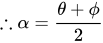
∴
α
=
θ
+
ϕ
2
{\displaystyle \therefore \alpha ={\frac {\theta +\phi }{2}}}
β
=
θ
−
ϕ
2
{\displaystyle \beta ={\frac {\theta -\phi }{2}}}
θ
{\displaystyle \theta }
ϕ
{\displaystyle \phi }
sin
θ
+
sin
ϕ
=
2
sin
(
θ
+
ϕ
2
)
cos
(
θ
−
ϕ
2
)
{\displaystyle \sin \theta +\sin \phi =2\sin \left({\frac {\theta +\phi }{2}}\right)\cos \left({\frac {\theta -\phi }{2}}\right)}
sin
θ
−
sin
ϕ
=
2
cos
(
θ
+
ϕ
2
)
sin
(
θ
−
ϕ
2
)
=
2
sin
(
θ
−
ϕ
2
)
cos
(
θ
+
ϕ
2
)
{\displaystyle \sin \theta -\sin \phi =2\cos \left({\frac {\theta +\phi }{2}}\right)\sin \left({\frac {\theta -\phi }{2}}\right)=2\sin \left({\frac {\theta -\phi }{2}}\right)\cos \left({\frac {\theta +\phi }{2}}\right)}
Dolayısıyla,
sin
θ
±
sin
ϕ
=
2
sin
(
θ
±
ϕ
2
)
cos
(
θ
∓
ϕ
2
)
{\displaystyle \sin \theta \pm \sin \phi =2\sin \left({\frac {\theta \pm \phi }{2}}\right)\cos \left({\frac {\theta \mp \phi }{2}}\right)}
Benzer şekilde kosinüs için de toplam-açı özdeşlikleri ile başlayın:
cos
(
α
+
β
)
=
cos
α
cos
β
−
sin
α
sin
β
{\displaystyle \cos(\alpha +\beta )=\cos \alpha \cos \beta \ -\sin \alpha \sin \beta }
cos
(
α
−
β
)
=
cos
α
cos
β
+
sin
α
sin
β
{\displaystyle \cos(\alpha -\beta )=\cos \alpha \cos \beta +\sin \alpha \sin \beta }
Tekrar, toplama ve çıkarma yaparak
cos
(
α
+
β
)
+
cos
(
α
−
β
)
=
cos
α
cos
β
−
sin
α
sin
β
+
cos
α
cos
β
+
sin
α
sin
β
=
2
cos
α
cos
β
{\displaystyle \cos(\alpha +\beta )+\cos(\alpha -\beta )=\cos \alpha \cos \beta \ -\sin \alpha \sin \beta +\cos \alpha \cos \beta +\sin \alpha \sin \beta =2\cos \alpha \cos \beta }
cos
(
α
+
β
)
−
cos
(
α
−
β
)
=
cos
α
cos
β
−
sin
α
sin
β
−
cos
α
cos
β
−
sin
α
sin
β
=
−
2
sin
α
sin
β
{\displaystyle \cos(\alpha +\beta )-\cos(\alpha -\beta )=\cos \alpha \cos \beta \ -\sin \alpha \sin \beta -\cos \alpha \cos \beta -\sin \alpha \sin \beta =-2\sin \alpha \sin \beta }
θ
{\displaystyle \theta }
ϕ
{\displaystyle \phi }
cos
θ
+
cos
ϕ
=
2
cos
(
θ
+
ϕ
2
)
cos
(
θ
−
ϕ
2
)
{\displaystyle \cos \theta +\cos \phi =2\cos \left({\frac {\theta +\phi }{2}}\right)\cos \left({\frac {\theta -\phi }{2}}\right)}
cos
θ
−
cos
ϕ
=
−
2
sin
(
θ
+
ϕ
2
)
sin
(
θ
−
ϕ
2
)
{\displaystyle \cos \theta -\cos \phi =-2\sin \left({\frac {\theta +\phi }{2}}\right)\sin \left({\frac {\theta -\phi }{2}}\right)}
Sinüs ve tanjant eşitsizliklerinin gösterimi.
Sağdaki şekil, yarıçapı 1 olan bir çemberin bir sektörünü göstermektedir. Sektör tüm çemberin θ /(2π )θ /2θ' < π /2
O
A
=
O
D
=
1
{\displaystyle OA=OD=1}
A
B
=
sin
θ
{\displaystyle AB=\sin \theta }
C
D
=
tan
θ
{\displaystyle CD=\tan \theta }
OAD AB /2sin(θ )/2 'dir. Üçgenin OCD CD /2tan(θ )/2 'dir.
OAD OCD
sin
θ
<
θ
<
tan
θ
.
{\displaystyle \sin \theta <\theta <\tan \theta .}
Bu geometrik argüman, varsayım olarak hareket eden yay uzunluğu ve alan tanımlarına dayanır, bu nedenle kanıtlanabilir bir özellikten ziyade trigonometrik fonksiyonların yapımında dayatılan bir koşuldur.[ 2] θ > π /2 ise, θ > 1sin θ ≤ 1 (Pisagor özdeşliği nedeniyle), bu nedenle sin θ < θ . O halde elimizde,
sin
θ
θ
<
1
0
<
θ
i
s
e
.
{\displaystyle {\frac {\sin \theta }{\theta }}<1\ \ \ \ \ 0<\theta \ \ \ \mathrm {ise} .}
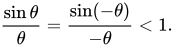
Negatif θ
sin
θ
θ
=
sin
(
−
θ
)
−
θ
<
1.
{\displaystyle {\frac {\sin \theta }{\theta }}={\frac {\sin(-\theta )}{-\theta }}<1.}
Dolayısıyla
sin
θ
θ
<
1
θ
≠
0
ise
,
{\displaystyle {\frac {\sin \theta }{\theta }}<1\quad {\text{ }}\quad \theta \neq 0\quad {\text{ ise}},}
ve
tan
θ
θ
>
1
0
<
θ
<
π
2
ise
.
{\displaystyle {\frac {\tan \theta }{\theta }}>1\quad {\text{ }}\quad 0<\theta <{\frac {\pi }{2}}\quad {\text{ ise}}.}
lim
θ
→
0
sin
θ
=
0
{\displaystyle \lim _{\theta \to 0}{\sin \theta }=0}
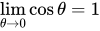
lim
θ
→
0
cos
θ
=
1
{\displaystyle \lim _{\theta \to 0}{\cos \theta }=1}
lim
θ
→
0
sin
θ
θ
=
1
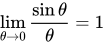
{\displaystyle \lim _{\theta \to 0}{\frac {\sin \theta }{\theta }}=1}
Başka bir deyişle, sinüs fonksiyonu 0'da türevlenebilirdir ve türevi 1'dir.
İspat:
sin
θ
<
θ
<
tan
θ
{\displaystyle \sin \theta <\theta <\tan \theta }
Bu nedenle,
sin
θ
θ
<
1
<
tan
θ
θ
{\displaystyle {\frac {\sin \theta }{\theta }}<1<{\frac {\tan \theta }{\theta }}}
Sağ taraftaki eşitsizliği göz önünde bulundurun. O zaman,
tan
θ
=
sin
θ
cos
θ
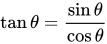
{\displaystyle \tan \theta ={\frac {\sin \theta }{\cos \theta }}}
∴
1
<
sin
θ
θ
cos
θ
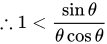
{\displaystyle \therefore 1<{\frac {\sin \theta }{\theta \cos \theta }}}
cos
θ
{\displaystyle \cos \theta }
cos
θ
<
sin
θ
θ
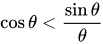
{\displaystyle \cos \theta <{\frac {\sin \theta }{\theta }}}
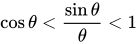
Sol taraftaki eşitsizlik ile birleştirildiğinde:
cos
θ
<
sin
θ
θ
<
1
{\displaystyle \cos \theta <{\frac {\sin \theta }{\theta }}<1}
cos
θ
{\displaystyle \cos \theta }
θ
→
0
{\displaystyle \theta \to 0}
lim
θ
→
0
cos
θ
=
1
{\displaystyle \lim _{\theta \to 0}{\cos \theta }=1}
Böylece,
lim
θ
→
0
sin
θ
θ
=
1
{\displaystyle \lim _{\theta \to 0}{\frac {\sin \theta }{\theta }}=1}
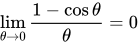
lim
θ
→
0
1
−
cos
θ
θ
=
0
{\displaystyle \lim _{\theta \to 0}{\frac {1-\cos \theta }{\theta }}=0}
İspat:
1
−
cos
θ
θ
=
1
−
cos
2
θ
θ
(
1
+
cos
θ
)
=
sin
2
θ
θ
(
1
+
cos
θ
)
=
(
sin
θ
θ
)
×
sin
θ
×
(
1
1
+
cos
θ
)
{\displaystyle {\begin{aligned}{\frac {1-\cos \theta }{\theta }}&={\frac {1-\cos ^{2}\theta }{\theta (1+\cos \theta )}}\\&={\frac {\sin ^{2}\theta }{\theta (1+\cos \theta )}}\\&=\left({\frac {\sin \theta }{\theta }}\right)\times \sin \theta \times \left({\frac {1}{1+\cos \theta }}\right)\\\end{aligned}}}
Bu üç niceliğin limitleri 1, 0 ve 1/2'dir, dolayısıyla sonuçta elde edilen limit sıfırdır.
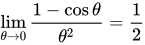
lim
θ
→
0
1
−
cos
θ
θ
2
=
1
2
{\displaystyle \lim _{\theta \to 0}{\frac {1-\cos \theta }{\theta ^{2}}}={\frac {1}{2}}}
İspat:
Önceki kanıtta olduğu gibi,
1
−
cos
θ
θ
2
=
sin
θ
θ
×
sin
θ
θ
×
1
1
+
cos
θ
.
{\displaystyle {\frac {1-\cos \theta }{\theta ^{2}}}={\frac {\sin \theta }{\theta }}\times {\frac {\sin \theta }{\theta }}\times {\frac {1}{1+\cos \theta }}.}
Bu üç niceliğin limitleri 1, 1 ve 1/2'dir, dolayısıyla ortaya çıkan limit 1/2'dir.
Tüm bu fonksiyonlar, Pisagor trigonometrik özdeşliğinden kaynaklanır. Örneğin şu fonksiyonu kanıtlayabiliriz
sin
[
arctan
(
x
)
]
=
x
1
+
x
2
{\displaystyle \sin[\arctan(x)]={\frac {x}{\sqrt {1+x^{2}}}}}
İspat:
Şuradan başlayalım;
sin
2
θ
+
cos
2
θ
=
1
{\displaystyle \sin ^{2}\theta +\cos ^{2}\theta =1}
Daha sonra bu (I) denklemini
cos
2
θ
{\displaystyle \cos ^{2}\theta }
cos
2
θ
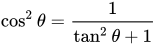
=
1
tan
2
θ
+
1
{\displaystyle \cos ^{2}\theta ={\frac {1}{\tan ^{2}\theta +1}}}
1
−
sin
2
θ
=
1
tan
2
θ
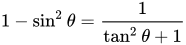
+
1
{\displaystyle 1-\sin ^{2}\theta ={\frac {1}{\tan ^{2}\theta +1}}}
Ardından
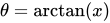
θ
=
arctan
(
x
)
{\displaystyle \theta =\arctan(x)}
1
−
sin
2
[
arctan
(
x
)
]
=
1
tan
2
[
arctan
(
x
)
]
+
1
{\displaystyle 1-\sin ^{2}[\arctan(x)]={\frac {1}{\tan ^{2}[\arctan(x)]+1}}}
sin
2
[
arctan
(
x
)
]
=
tan
2
[
arctan
(
x
)
]
tan
2
[
arctan
(
x
)
]
+
1
{\displaystyle \sin ^{2}[\arctan(x)]={\frac {\tan ^{2}[\arctan(x)]}{\tan ^{2}[\arctan(x)]+1}}}
Daha sonra
tan
[
arctan
(
x
)
]
≡
x
{\displaystyle \tan[\arctan(x)]\equiv x}
sin
[
arctan
(
x
)
]
=
x
x
2
+
1
{\displaystyle \sin[\arctan(x)]={\frac {x}{\sqrt {x^{2}+1}}}}
Ve ilk Pisagor trigonometrik özdeşliği kanıtlandı...
Benzer şekilde bu (I) denklemini
sin
2
θ
{\displaystyle \sin ^{2}\theta }
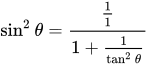
sin
2
θ
=
1
1
1
+
1
tan
2
θ
{\displaystyle \sin ^{2}\theta ={\frac {\frac {1}{1}}{1+{\frac {1}{\tan ^{2}\theta }}}}}
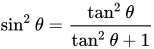
sin
2
θ
=
tan
2
θ
tan
2
θ
+
1
{\displaystyle \sin ^{2}\theta ={\frac {\tan ^{2}\theta }{\tan ^{2}\theta +1}}}
Ardından
θ
=
arctan
(
x
)
{\displaystyle \theta =\arctan(x)}
sin
2
[
arctan
(
x
)
]
=
tan
2
[
arctan
(
x
)
]
tan
2
[
arctan
(
x
)
]
+
1
{\displaystyle \sin ^{2}[\arctan(x)]={\frac {\tan ^{2}[\arctan(x)]}{\tan ^{2}[\arctan(x)]+1}}}
Daha sonra
tan
[
arctan
(
x
)
]
≡
x
{\displaystyle \tan[\arctan(x)]\equiv x}
sin
[
arctan
(
x
)
]
=
x
x
2
+
1
{\displaystyle \sin[\arctan(x)]={\frac {x}{\sqrt {x^{2}+1}}}}
Ve ilk Pisagor trigonometrik özdeşliği kanıtlandı...
[
arctan
(
x
)
]
=
[
arcsin
(
x
x
2
+
1
)
]
{\displaystyle [\arctan(x)]=[\arcsin({\frac {x}{\sqrt {x^{2}+1}}})]}
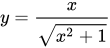
y
=
x
x
2
+
1
{\displaystyle y={\frac {x}{\sqrt {x^{2}+1}}}}
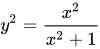
y
2
=
x
2
x
2
+
1
{\displaystyle y^{2}={\frac {x^{2}}{x^{2}+1}}}
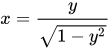
Kanıtlamamız gereken şeyi tahmin edelim:
x
=
y
1
−
y
2
{\displaystyle x={\frac {y}{\sqrt {1-y^{2}}}}}
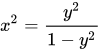
x
2
=
y
2
1
−
y
2
{\displaystyle x^{2}={\frac {y^{2}}{1-y^{2}}}}
(V)'i (IV) ile değiştirirsek:
y
2
=
y
2
(
1
−
y
2
)
y
2
(
1
−
y
2
)
+
1
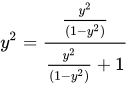
{\displaystyle y^{2}={\frac {\frac {y^{2}}{(1-y^{2})}}{{\frac {y^{2}}{(1-y^{2})}}+1}}}
y
2
=
y
2
(
1
−
y
2
)
1
(
1
−
y
2
)
{\displaystyle y^{2}={\frac {\frac {y^{2}}{(1-y^{2})}}{\frac {1}{(1-y^{2})}}}}
Yani doğrudur:
y
2
=
y
2
{\displaystyle y^{2}=y^{2}}
x
=
y
1
−
y
2
{\displaystyle x={\frac {y}{\sqrt {1-y^{2}}}}}
[
arctan
(
x
)
]
=
[
arcsin
(
x
x
2
+
1
)
]
=
[
arcsin
(
y
)
]
=
[
arctan
(
y
1
−
y
2
)
]
{\displaystyle [\arctan(x)]=[\arcsin({\frac {x}{\sqrt {x^{2}+1}}})]=[\arcsin(y)]=[\arctan({\frac {y}{\sqrt {1-y^{2}}}})]}
Şimdi y , x olarak yazılabilir; ve [arctan] cinsinden ifade edilen [arcsin]'i elde ettik...
[
arcsin
(
x
)
]
=
[
arctan
(
x
1
−
x
2
)
]
{\displaystyle [\arcsin(x)]=[\arctan({\frac {x}{\sqrt {1-x^{2}}}})]}
Benzer şekilde, eğer araştırırsak:
[
arccos
(
x
)
]
{\displaystyle [\arccos(x)]}
cos
[
arccos
(
x
)
]
=
x
{\displaystyle \cos[\arccos(x)]=x}
cos
(
π
2
−
(
π
2
−
[
arccos
(
x
)
]
)
)
=
x
{\displaystyle \cos({\frac {\pi }{2}}-({\frac {\pi }{2}}-[\arccos(x)]))=x}
sin
(
π
2
−
[
arccos
(
x
)
]
)
=
x
{\displaystyle \sin({\frac {\pi }{2}}-[\arccos(x)])=x}
π
2
−
[
arccos
(
x
)
]
=
[
arcsin
(
x
)
]
{\displaystyle {\frac {\pi }{2}}-[\arccos(x)]=[\arcsin(x)]}
[
arccos
(
x
)
]
=
π
2
−
[
arcsin
(
x
)
]
{\displaystyle [\arccos(x)]={\frac {\pi }{2}}-[\arcsin(x)]}
[
arcsin
(
x
)
]
{\displaystyle [\arcsin(x)]}
[
arccos
(
x
)
]
=
π
2
−
[
arctan
(
x
1
−
x
2
)
]
{\displaystyle [\arccos(x)]={\frac {\pi }{2}}-[\arctan({\frac {x}{\sqrt {1-x^{2}}}})]}
[
arccos
(
x
)
]
=
π
2
−
[
arccot
(
1
−
x
2
x
)
]
{\displaystyle [\arccos(x)]={\frac {\pi }{2}}-[\operatorname {arccot}({\frac {\sqrt {1-x^{2}}}{x}})]}
Ve son olarak [arctan] cindsinden ifade edilen [arccos]'u elde ettik...
[
arccos
(
x
)
]
=
[
arctan
(
1
−
x
2
x
)
]
{\displaystyle [\arccos(x)]=[\arctan({\frac {\sqrt {1-x^{2}}}{x}})]}


































































































![{\displaystyle \sin[\arctan(x)]={\frac {x}{\sqrt {1+x^{2}}}}}](https://wikimedia.org/api/rest_v1/media/math/render/svg/7d3ed8cedb4c73b01b65314a15152647c9000086)
![{\displaystyle 1-\sin ^{2}[\arctan(x)]={\frac {1}{\tan ^{2}[\arctan(x)]+1}}}](https://wikimedia.org/api/rest_v1/media/math/render/svg/d0bb45d076e27715801c0437e364d4b1f45dfb1a)
![{\displaystyle \sin ^{2}[\arctan(x)]={\frac {\tan ^{2}[\arctan(x)]}{\tan ^{2}[\arctan(x)]+1}}}](https://wikimedia.org/api/rest_v1/media/math/render/svg/31457873262613ebf792de2499d564919e4d18c9)
![{\displaystyle \tan[\arctan(x)]\equiv x}](https://wikimedia.org/api/rest_v1/media/math/render/svg/49ce3dc146ff12eb2efb89a4388afcb984b7da8e)
![{\displaystyle \sin[\arctan(x)]={\frac {x}{\sqrt {x^{2}+1}}}}](https://wikimedia.org/api/rest_v1/media/math/render/svg/5c5222bb21dc2d342d1363c855694bae8b967914)
![{\displaystyle [\arctan(x)]=[\arcsin({\frac {x}{\sqrt {x^{2}+1}}})]}](https://wikimedia.org/api/rest_v1/media/math/render/svg/dbc17437ca395ab8ec9e04f2d21096288df5b9a2)


![{\displaystyle [\arctan(x)]=[\arcsin({\frac {x}{\sqrt {x^{2}+1}}})]=[\arcsin(y)]=[\arctan({\frac {y}{\sqrt {1-y^{2}}}})]}](https://wikimedia.org/api/rest_v1/media/math/render/svg/7fbaafc98c5960a737537039cff02fdd72be65da)
![{\displaystyle [\arcsin(x)]=[\arctan({\frac {x}{\sqrt {1-x^{2}}}})]}](https://wikimedia.org/api/rest_v1/media/math/render/svg/552a4ab628e13245dc277ab57029427f50ee8ebd)
![{\displaystyle [\arccos(x)]}](https://wikimedia.org/api/rest_v1/media/math/render/svg/4f61004b1d4ad7ff39f9a7ee50976ec672d2c198)
![{\displaystyle \cos[\arccos(x)]=x}](https://wikimedia.org/api/rest_v1/media/math/render/svg/d9d5691af1ed2de3248e08dbaf90a24a80c1c816)
![{\displaystyle \cos({\frac {\pi }{2}}-({\frac {\pi }{2}}-[\arccos(x)]))=x}](https://wikimedia.org/api/rest_v1/media/math/render/svg/7562bfeec9737b56e7affe3409239315302693c3)
![{\displaystyle \sin({\frac {\pi }{2}}-[\arccos(x)])=x}](https://wikimedia.org/api/rest_v1/media/math/render/svg/5ad20b817a17336b1fc1af8c339a3d7e4cf111f6)
![{\displaystyle {\frac {\pi }{2}}-[\arccos(x)]=[\arcsin(x)]}](https://wikimedia.org/api/rest_v1/media/math/render/svg/20f54833eb7dbe561e4cb31e51453ebd14a5cc51)
![{\displaystyle [\arccos(x)]={\frac {\pi }{2}}-[\arcsin(x)]}](https://wikimedia.org/api/rest_v1/media/math/render/svg/dfc6a970c74fe335d2b0684f23027e6ca255a9cc)
![{\displaystyle [\arcsin(x)]}](https://wikimedia.org/api/rest_v1/media/math/render/svg/ef6f2837ad8f82968478d6c5e93863549f833207)
![{\displaystyle [\arccos(x)]={\frac {\pi }{2}}-[\arctan({\frac {x}{\sqrt {1-x^{2}}}})]}](https://wikimedia.org/api/rest_v1/media/math/render/svg/e6675d621ebaf7c4c4b10adbee9a1fd4b6f1d6eb)
![{\displaystyle [\arccos(x)]={\frac {\pi }{2}}-[\operatorname {arccot} ({\frac {\sqrt {1-x^{2}}}{x}})]}](https://wikimedia.org/api/rest_v1/media/math/render/svg/a4fe5f411d564cd54abb12c188ca5885150f1949)
![{\displaystyle [\arccos(x)]=[\arctan({\frac {\sqrt {1-x^{2}}}{x}})]}](https://wikimedia.org/api/rest_v1/media/math/render/svg/13428b7bd426702f18227deb2d8da5f116c16db4)