Fonksiyon
Türev
sin
(
x
)
{\displaystyle \sin(x)}
cos
(
x
)
{\displaystyle \cos(x)}
cos
(
x
)
{\displaystyle \cos(x)}
−
sin
(
x
)
{\displaystyle -\sin(x)}
tan
(
x
)
{\displaystyle \tan(x)}
sec
2
(
x
)
{\displaystyle \sec ^{2}(x)}
cot
(
x
)
{\displaystyle \cot(x)}
−
csc
2
(
x
)
{\displaystyle -\csc ^{2}(x)}
sec
(
x
)
{\displaystyle \sec(x)}
sec
(
x
)
tan
(
x
)
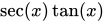
{\displaystyle \sec(x)\tan(x)}
csc
(
x
)
{\displaystyle \csc(x)}
−
csc
(
x
)
cot
(
x
)
{\displaystyle -\csc(x)\cot(x)}
arcsin
(
x
)
{\displaystyle \arcsin(x)}
1
1
−
x
2
{\displaystyle {\frac {1}{\sqrt {1-x^{2}}}}}
arccos
(
x
)
{\displaystyle \arccos(x)}
−
1
1
−
x
2
{\displaystyle -{\frac {1}{\sqrt {1-x^{2}}}}}
arctan
(
x
)
{\displaystyle \arctan(x)}
1
x
2
+
1
{\displaystyle {\frac {1}{x^{2}+1}}}
arccot
(
x
)
{\displaystyle \operatorname {arccot}(x)}
−
1
x
2
+
1
{\displaystyle -{\frac {1}{x^{2}+1}}}
arcsec
(
x
)
{\displaystyle \operatorname {arcsec}(x)}
1
|
x
|
x
2
−
1
{\displaystyle {\frac {1}{|x|{\sqrt {x^{2}-1}}}}}
arccsc
(
x
)
{\displaystyle \operatorname {arccsc}(x)}
−
1
|
x
|
x
2
−
1
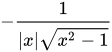
{\displaystyle -{\frac {1}{|x|{\sqrt {x^{2}-1}}}}}
Trigonometrik fonksiyonların türevleri , trigonometrik bir fonksiyonun türevini yani bir değişkene göre değişim oranını bulmanın matematiksel sürecidir. Örneğin, sinüs fonksiyonunun türevi
s
i
n
′
(
a
)
=
c
o
s
(
a
)
{\displaystyle sin'(a)=cos(a)}
x ) fonksiyonunun belirli bir açı x = a için değişim oranının o açının kosinüsü ile verildiği anlamına gelir.
Dairesel trigonometrik fonksiyonların tüm türevleri, tan(x ) = sin(x )/cos(x ) gibi fonksiyonlara uygulanan bölme kuralı ile sin(x ) ve cos(x ) türevlerinden elde edilebilir. Bu türevleri bildiğimizde, ters trigonometrik fonksiyonların türevleri örtük türev alma ile bulunur.
Merkezi O olan, yarıçapı 1 olan bir daire
Sağdaki diyagramda, merkezi O olan ve yarıçapı r = 1 olan bir daire gösterilmektedir. İki yarıçap OA ve OB θ radyanlık bir yay oluşturur. θ' nın 0 < θ < 1 / 2
Diyagramda, R 1 OAB üçgeni, R 2 daire dilimi OAB ve R 3 OAC üçgenidir.
OAB üçgeninin alanı:
A
l
a
n
(
R
1
)
=
1
2
|
O
A
|
|
O
B
|
sin
θ
=
1
2
sin
θ
.
{\displaystyle \mathrm {Alan} (R_{1})={\tfrac {1}{2}}\ |OA|\ |OB|\sin \theta ={\tfrac {1}{2}}\sin \theta \,.}
OAB daire diliminin alanı:
A
l
a
n
(
R
2
)
=
1
2
θ
.
{\displaystyle \mathrm {Alan} (R_{2})={\tfrac {1}{2}}\theta \,.}
OAC üçgeninin alanı:
A
l
a
n
(
R
3
)
=
1
2
|
O
A
|
|
A
C
|
=
1
2
tan
θ
.
{\displaystyle \mathrm {Alan} (R_{3})={\tfrac {1}{2}}\ |OA|\ |AC|={\tfrac {1}{2}}\tan \theta \,.}
Her alan, bir sonrakinin içindedir, bu nedenle:
Alan
(
R
1
)
<
Alan
(
R
2
)
<
Alan
(
R
3
)
⟹
1
2
sin
θ
<
1
2
θ
<
1
2
tan
θ
.
{\displaystyle {\text{Alan}}(R_{1})<{\text{Alan}}(R_{2})<{\text{Alan}}(R_{3})\implies {\tfrac {1}{2}}\sin \theta <{\tfrac {1}{2}}\theta <{\tfrac {1}{2}}\tan \theta \,.}
Ayrıca, birinci çeyrekte sin θ > 0 olduğu için, her iki tarafı 1 / 2 sin θ ile bölebiliriz:
1
<
θ
sin
θ
<
1
cos
θ
⟹
1
>
sin
θ
θ
>
cos
θ
.
{\displaystyle 1<{\frac {\theta }{\sin \theta }}<{\frac {1}{\cos \theta }}\implies 1>{\frac {\sin \theta }{\theta }}>\cos \theta \,.}
Son adımda, üç pozitif terimin tersini aldığımız için eşitsizlikler tersine döner.
Sıkıştırma: Kırmızı ile gösterilen eğriler y = 1y = cos θ y = sin(θ )/θ
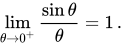
Sonuç olarak, 0 < θ < 1 / 2 sin(θ )/θ her zaman 1'den küçük ve her zaman cos(θ)'dan büyüktür. Dolayısıyla, θ sıfıra yaklaştıkça sin(θ )/θ 1 yüksekliğindeki bir tavanda ve cos θ yüksekliğindeki bir tabanda "sıkıştırılmıştır " ve bu yükseklik 1'e doğru yükselir; bu nedenle sin(θ )/θ sıfıra yaklaşırken:
lim
θ
→
0
+
sin
θ
θ
=
1
.
{\displaystyle \lim _{\theta \to 0^{+}}{\frac {\sin \theta }{\theta }}=1\,.}
θ küçük bir negatif sayı olduğunda –1 / 2 tek fonksiyon olduğunu kullanırız:
lim
θ
→
0
−
sin
θ
θ
=
lim
θ
→
0
+
sin
(
−
θ
)
−
θ
=
lim
θ
→
0
+
−
sin
θ
−
θ
=
lim
θ
→
0
+
sin
θ
θ
=
1
.
{\displaystyle \lim _{\theta \to 0^{-}}\!{\frac {\sin \theta }{\theta }}=\lim _{\theta \to 0^{+}}\!{\frac {\sin(-\theta )}{-\theta }}=\lim _{\theta \to 0^{+}}\!{\frac {-\sin \theta }{-\theta }}=\lim _{\theta \to 0^{+}}\!{\frac {\sin \theta }{\theta }}=1\,.}
Son bölüm, bu yeni limiti görecek kadar kolay bir şekilde hesaplamamızı sağlar. Bu hesaplamada θ' nın işareti önemsizdir.
lim
θ
→
0
cos
θ
−
1
θ
=
lim
θ
→
0
(
cos
θ
−
1
θ
)
(
cos
θ
+
1
cos
θ
+
1
)
=
lim
θ
→
0
cos
2
θ
−
1
θ
(
cos
θ
+
1
)
.
{\displaystyle \lim _{\theta \to 0}\,{\frac {\cos \theta -1}{\theta }}=\lim _{\theta \to 0}\left({\frac {\cos \theta -1}{\theta }}\right)\!\!\left({\frac {\cos \theta +1}{\cos \theta +1}}\right)=\lim _{\theta \to 0}\,{\frac {\cos ^{2}\!\theta -1}{\theta \,(\cos \theta +1)}}.}
cos2 θ – 1 = –sin2 θ ve bir çarpımın limitinin, limitlerin çarpımına eşit olduğu gerçeğini kullanarak, bir önceki bölümden elde ettiğimiz limiti buluyoruz:
lim
θ
→
0
cos
θ
−
1
θ
=
lim
θ
→
0
−
sin
2
θ
θ
(
cos
θ
+
1
)
=
(
−
lim
θ
→
0
sin
θ
θ
)
(
lim
θ
→
0
sin
θ
cos
θ
+
1
)
=
(
−
1
)
(
0
2
)
=
0
.
{\displaystyle \lim _{\theta \to 0}\,{\frac {\cos \theta -1}{\theta }}=\lim _{\theta \to 0}\,{\frac {-\sin ^{2}\theta }{\theta (\cos \theta +1)}}=\left(-\lim _{\theta \to 0}{\frac {\sin \theta }{\theta }}\right)\!\left(\lim _{\theta \to 0}\,{\frac {\sin \theta }{\cos \theta +1}}\right)=(-1)\left({\frac {0}{2}}\right)=0\,.}
Sinüs fonksiyonu için limit, tanjant fonksiyonunun tek işlevsel olması ve bir çarpımın limitinin çarpımlarının limitleri olduğunu göz önünde bulundurarak şunu buluruz:
lim
θ
→
0
tan
θ
θ
=
(
lim
θ
→
0
sin
θ
θ
)
(
lim
θ
→
0
1
cos
θ
)
=
(
1
)
(
1
)
=
1
.
{\displaystyle \lim _{\theta \to 0}{\frac {\tan \theta }{\theta }}\ =\ \left(\lim _{\theta \to 0}{\frac {\sin \theta }{\theta }}\right)\!\left(\lim _{\theta \to 0}{\frac {1}{\cos \theta }}\right)\ =\ (1)(1)\ =\ 1\,.}
Limit tanımını kullanarak sinüs fonksiyonunun türevini hesaplayalım:
d
d
θ
sin
θ
=
lim
δ
→
0
sin
(
θ
+
δ
)
−
sin
θ
δ
.
{\displaystyle {\frac {\operatorname {d} }{\operatorname {d} \!\theta }}\,\sin \theta =\lim _{\delta \to 0}{\frac {\sin(\theta +\delta )-\sin \theta }{\delta }}.}
Açı toplam formülünü kullanarak sin(α+β) = sin α cos β + sin β cos α , şunu elde ederiz:
d
d
θ
sin
θ
=
lim
δ
→
0
sin
θ
cos
δ
+
sin
δ
cos
θ
−
sin
θ
δ
=
lim
δ
→
0
(
sin
δ
δ
cos
θ
+
cos
δ
−
1
δ
sin
θ
)
.
{\displaystyle {\frac {\operatorname {d} }{\operatorname {d} \!\theta }}\,\sin \theta =\lim _{\delta \to 0}{\frac {\sin \theta \cos \delta +\sin \delta \cos \theta -\sin \theta }{\delta }}=\lim _{\delta \to 0}\left({\frac {\sin \delta }{\delta }}\cos \theta +{\frac {\cos \delta -1}{\delta }}\sin \theta \right).}
Sinüs ve kosinüs fonksiyonlarının limitlerini kullanarak:
d
d
θ
sin
θ
=
(
1
)
cos
θ
+
(
0
)
sin
θ
=
cos
θ
.
{\displaystyle {\frac {\operatorname {d} }{\operatorname {d} \!\theta }}\,\sin \theta =(1)\cos \theta +(0)\sin \theta =\cos \theta \,.}
Kosinüs fonksiyonunun türevini limit tanımından tekrar hesaplayalım:
d
d
θ
cos
θ
=
lim
δ
→
0
cos
(
θ
+
δ
)
−
cos
θ
δ
.
{\displaystyle {\frac {\operatorname {d} }{\operatorname {d} \theta }}\,\cos \theta =\lim _{\delta \to 0}{\frac {\cos(\theta +\delta )-\cos \theta }{\delta }}.}
Açı toplam formülünü kullanarak cos(α+β) = cos α cos β – sin α sin β , şunu elde ederiz:
d
d
θ
cos
θ
=
lim
δ
→
0
cos
θ
cos
δ
−
sin
θ
sin
δ
−
cos
θ
δ
=
lim
δ
→
0
(
cos
δ
−
1
δ
cos
θ
−
sin
δ
δ
sin
θ
)
.
{\displaystyle {\frac {\operatorname {d} }{\operatorname {d} \!\theta }}\,\cos \theta =\lim _{\delta \to 0}{\frac {\cos \theta \cos \delta -\sin \theta \sin \delta -\cos \theta }{\delta }}=\lim _{\delta \to 0}\left({\frac {\cos \delta -1}{\delta }}\cos \theta \,-\,{\frac {\sin \delta }{\delta }}\sin \theta \right).}
Sinüs ve kosinüs fonksiyonlarının limitlerini kullanarak:
d
d
θ
cos
θ
=
(
0
)
cos
θ
−
(
1
)
sin
θ
=
−
sin
θ
.
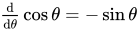
{\displaystyle {\frac {\operatorname {d} }{\operatorname {d} \!\theta }}\,\cos \theta =(0)\cos \theta -(1)\sin \theta =-\sin \theta \,.}
Kosinüs fonksiyonunun türevini zincir kuralından hesaplamak için şu üç eşitliği gözlemleyelim:
cos
θ
=
sin
(
π
2
−
θ
)
{\displaystyle \cos \theta =\sin \left({\tfrac {\pi }{2}}-\theta \right)}
sin
θ
=
cos
(
π
2
−
θ
)
{\displaystyle \sin \theta =\cos \left({\tfrac {\pi }{2}}-\theta \right)}
d
d
θ
sin
θ
=
cos
θ
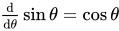
{\displaystyle {\tfrac {\operatorname {d} }{\operatorname {d} \!\theta }}\sin \theta =\cos \theta }
İlk iki eşitlik bir trigonometrik özdeşliktir , üçüncüsü ise yukarıda kanıtlanmıştır. Bu üç eşitliği kullanarak aşağıdaki gibi yazabiliriz:
d
d
θ
cos
θ
=
d
d
θ
sin
(
π
2
−
θ
)
{\displaystyle {\tfrac {\operatorname {d} }{\operatorname {d} \!\theta }}\cos \theta ={\tfrac {\operatorname {d} }{\operatorname {d} \!\theta }}\sin \left({\tfrac {\pi }{2}}-\theta \right)}
Bunu zincir kuralını kullanarak türevini alabiliriz.
f
(
x
)
=
sin
x
,
g
(
θ
)
=
π
2
−
θ
{\displaystyle f(x)=\sin x,\ \ g(\theta )={\tfrac {\pi }{2}}-\theta }
d
d
θ
f
(
g
(
θ
)
)
=
f
′
(
g
(
θ
)
)
⋅
g
′
(
θ
)
=
cos
(
π
2
−
θ
)
⋅
(
0
−
1
)
=
−
sin
θ
{\displaystyle {\tfrac {\operatorname {d} }{\operatorname {d} \!\theta }}f\!\left(g\!\left(\theta \right)\right)=f^{\prime }\!\left(g\!\left(\theta \right)\right)\cdot g^{\prime }\!\left(\theta \right)=\cos \left({\tfrac {\pi }{2}}-\theta \right)\cdot (0-1)=-\sin \theta }
Dolayısıyla, şunu kanıtlamış olduk:
d
d
θ
cos
θ
=
−
sin
θ
{\displaystyle {\tfrac {\operatorname {d} }{\operatorname {d} \!\theta }}\cos \theta =-\sin \theta }
Tanjant fonksiyonunun türevini ilk prensiplerden hesaplayalım. Tanıma göre:
d
d
θ
tan
θ
=
lim
δ
→
0
(
tan
(
θ
+
δ
)
−
tan
θ
δ
)
.
{\displaystyle {\frac {\operatorname {d} }{\operatorname {d} \!\theta }}\,\tan \theta =\lim _{\delta \to 0}\left({\frac {\tan(\theta +\delta )-\tan \theta }{\delta }}\right).}
Açı toplam formülünü kullanarak tan(α+β) = (tan α + tan β) / (1 - tan α tan β) :
d
d
θ
tan
θ
=
lim
δ
→
0
[
tan
θ
+
tan
δ
1
−
tan
θ
tan
δ
−
tan
θ
δ
]
=
lim
δ
→
0
[
tan
θ
+
tan
δ
−
tan
θ
+
tan
2
θ
tan
δ
δ
(
1
−
tan
θ
tan
δ
)
]
.
{\displaystyle {\frac {\operatorname {d} }{\operatorname {d} \!\theta }}\,\tan \theta =\lim _{\delta \to 0}\left[{\frac {{\frac {\tan \theta +\tan \delta }{1-\tan \theta \tan \delta }}-\tan \theta }{\delta }}\right]=\lim _{\delta \to 0}\left[{\frac {\tan \theta +\tan \delta -\tan \theta +\tan ^{2}\theta \tan \delta }{\delta \left(1-\tan \theta \tan \delta \right)}}\right].}
Bir çarpımın limitinin, limitlerinin çarpımına eşit olduğunu göz önünde bulundurarak:
d
d
θ
tan
θ
=
lim
δ
→
0
tan
δ
δ
×
lim
δ
→
0
(
1
+
tan
2
θ
1
−
tan
θ
tan
δ
)
.
{\displaystyle {\frac {\operatorname {d} }{\operatorname {d} \!\theta }}\,\tan \theta =\lim _{\delta \to 0}{\frac {\tan \delta }{\delta }}\times \lim _{\delta \to 0}\left({\frac {1+\tan ^{2}\theta }{1-\tan \theta \tan \delta }}\right).}
Tanjant fonksiyonu için limitleri kullanarak ve tan δ 'nin 0'a yaklaştığını göz önünde bulundurarak:
d
d
θ
tan
θ
=
1
×
1
+
tan
2
θ
1
−
0
=
1
+
tan
2
θ
.
{\displaystyle {\frac {\operatorname {d} }{\operatorname {d} \!\theta }}\,\tan \theta =1\times {\frac {1+\tan ^{2}\theta }{1-0}}=1+\tan ^{2}\theta .}
Hemen şunu görüyoruz:
d
d
θ
tan
θ
=
1
+
sin
2
θ
cos
2
θ
=
cos
2
θ
+
sin
2
θ
cos
2
θ
=
1
cos
2
θ
=
sec
2
θ
.
{\displaystyle {\frac {\operatorname {d} }{\operatorname {d} \!\theta }}\,\tan \theta =1+{\frac {\sin ^{2}\theta }{\cos ^{2}\theta }}={\frac {\cos ^{2}\theta +\sin ^{2}\theta }{\cos ^{2}\theta }}={\frac {1}{\cos ^{2}\theta }}=\sec ^{2}\theta \,.}
Tanjant fonksiyonunun türevini bölme kuralı kullanarak hesaplayabiliriz:
d
d
θ
tan
θ
=
d
d
θ
sin
θ
cos
θ
=
(
sin
θ
)
′
⋅
cos
θ
−
sin
θ
⋅
(
cos
θ
)
′
cos
2
θ
=
cos
2
θ
+
sin
2
θ
cos
2
θ
{\displaystyle {\frac {d}{d\theta }}\tan \theta ={\frac {d}{d\theta }}{\frac {\sin \theta }{\cos \theta }}={\frac {\left(\sin \theta \right)^{\prime }\cdot \cos \theta -\sin \theta \cdot \left(\cos \theta \right)^{\prime }}{\cos ^{2}\theta }}={\frac {\cos ^{2}\theta +\sin ^{2}\theta }{\cos ^{2}\theta }}}
Pay Pisagor özdeşliği ile 1 olarak sadeleştirilebilir, bu da bize:
1
cos
2
θ
=
sec
2
θ
{\displaystyle {\frac {1}{\cos ^{2}\theta }}=\sec ^{2}\theta }
Sonuç olarak:
d
d
θ
tan
θ
=
sec
2
θ
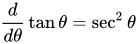
{\displaystyle {\frac {d}{d\theta }}\tan \theta =\sec ^{2}\theta }
Aşağıdaki türevler, türevini almak istediğimiz ters trigonometrik fonksiyon için bir değişken y belirleyerek bulunur. Örtük türevleme kullanarak, ardından dy /dx için çözümleyerek, ters fonksiyonun türevini y cinsinden buluruz. dy /dx' yi tekrar x cinsine çevirmek için, bir referans üçgeni çizebiliriz. Bunun için birim çember üzerinde θ'yi y olarak alırız. Pisagor teoremi ve normal trigonometrik fonksiyonların tanımı kullanılarak, nihayetinde dy/ dx'yi x cinsinden ifade edebiliriz.
Şunu alıyoruz:
y
=
arcsin
x
{\displaystyle y=\arcsin x\,\!}
Burada:
−
π
2
≤
y
≤
π
2
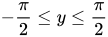
{\displaystyle -{\frac {\pi }{2}}\leq y\leq {\frac {\pi }{2}}}
O halde:
sin
y
=
x
{\displaystyle \sin y=x\,\!}
Her iki tarafta türev alıyoruz ve dy /dx için çözümleyerek:
d
d
x
sin
y
=
d
d
x
x
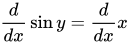
{\displaystyle {d \over dx}\sin y={d \over dx}x}
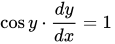
cos
y
⋅
d
y
d
x
=
1
{\displaystyle \cos y\cdot {dy \over dx}=1\,\!}
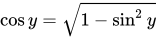
Yukarıdan
cos
y
=
1
−
sin
2
y
{\displaystyle \cos y={\sqrt {1-\sin ^{2}y}}}
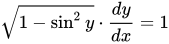
1
−
sin
2
y
⋅
d
y
d
x
=
1
{\displaystyle {\sqrt {1-\sin ^{2}y}}\cdot {dy \over dx}=1}
Yukarıdan
x
=
sin
y
{\displaystyle x=\sin y}
1
−
x
2
⋅
d
y
d
x
=
1
{\displaystyle {\sqrt {1-x^{2}}}\cdot {dy \over dx}=1}
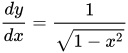
Sonuç olarak:
d
y
d
x
=
1
1
−
x
2
{\displaystyle {dy \over dx}={\frac {1}{\sqrt {1-x^{2}}}}}
Şunu alıyoruz:
y
=
arccos
x
{\displaystyle y=\arccos x\,\!}
Burada:
0
≤
y
≤
π
{\displaystyle 0\leq y\leq \pi }
O halde:
cos
y
=
x
{\displaystyle \cos y=x\,\!}
Her iki tarafta türev alıyoruz ve dy /dx için çözümleyerek:
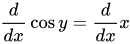
d
d
x
cos
y
=
d
d
x
x
{\displaystyle {d \over dx}\cos y={d \over dx}x}
−
sin
y
⋅
d
y
d
x
=
1
{\displaystyle -\sin y\cdot {dy \over dx}=1\,\!}
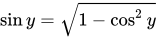
Yukarıdan
sin
y
=
1
−
cos
2
y
{\displaystyle \sin y={\sqrt {1-\cos ^{2}y}}\,\!}
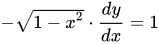
−
1
−
cos
2
y
⋅
d
y
d
x
=
1
{\displaystyle -{\sqrt {1-\cos ^{2}y}}\cdot {dy \over dx}=1}
Yukarıdan
x
=
cos
y
{\displaystyle x=\cos y\,\!}
−
1
−
x
2
⋅
d
y
d
x
=
1
{\displaystyle -{\sqrt {1-x^{2}}}\cdot {dy \over dx}=1}
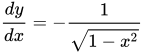
Sonuç olarak:
d
y
d
x
=
−
1
1
−
x
2
{\displaystyle {dy \over dx}=-{\frac {1}{\sqrt {1-x^{2}}}}}
Alternatif olarak,
arcsin
x
{\displaystyle \arcsin x}
arccos
x
{\displaystyle \arccos x}
arcsin
x
+
arccos
x
=
π
/
2
{\displaystyle \arcsin x+\arccos x=\pi /2}
(
arccos
x
)
′
=
−
(
arcsin
x
)
′
{\displaystyle (\arccos x)'=-(\arcsin x)'}
Şunu alıyoruz:
y
=
arctan
x
{\displaystyle y=\arctan x\,\!}
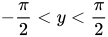
Burada:
−
π
2
<
y
<
π
2
{\displaystyle -{\frac {\pi }{2}}<y<{\frac {\pi }{2}}}
O halde:
tan
y
=
x
{\displaystyle \tan y=x\,\!}
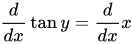
Her iki tarafta türev alıyoruz ve dy /dx için çözümleyerek:
d
d
x
tan
y
=
d
d
x
x
{\displaystyle {d \over dx}\tan y={d \over dx}x}
Sol taraf:
d
d
x
tan
y
=
sec
2
y
⋅
d
y
d
x
=
(
1
+
tan
2
y
)
d
y
d
x
{\displaystyle {d \over dx}\tan y=\sec ^{2}y\cdot {dy \over dx}=(1+\tan ^{2}y){dy \over dx}}
Sağ taraf:
d
d
x
x
=
1
{\displaystyle {d \over dx}x=1}
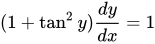
Sonuç olarak:
(
1
+
tan
2
y
)
d
y
d
x
=
1
{\displaystyle (1+\tan ^{2}y){dy \over dx}=1}
Yukarıdan
x
=
tan
y
{\displaystyle x=\tan y\,\!}
(
1
+
x
2
)
d
y
d
x
=
1
{\displaystyle (1+x^{2}){dy \over dx}=1}
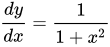
Sonuç olarak:
d
y
d
x
=
1
1
+
x
2
{\displaystyle {dy \over dx}={\frac {1}{1+x^{2}}}}
Şunu alıyoruz:
y
=
arccot
x
{\displaystyle y=\operatorname {arccot} x}
Burada:
0
<
y
<
π
{\displaystyle 0<y<\pi }
cot
y
=
x
{\displaystyle \cot y=x}
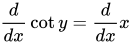
Her iki tarafta türev alıyoruz ve dy /dx için çözümleyerek:
d
d
x
cot
y
=
d
d
x
x
{\displaystyle {\frac {d}{dx}}\cot y={\frac {d}{dx}}x}
Sol taraf:
d
d
x
cot
y
=
−
csc
2
y
⋅
d
y
d
x
=
−
(
1
+
cot
2
y
)
d
y
d
x
{\displaystyle {d \over dx}\cot y=-\csc ^{2}y\cdot {dy \over dx}=-(1+\cot ^{2}y){dy \over dx}}
Sağ taraf:
d
d
x
x
=
1
{\displaystyle {d \over dx}x=1}
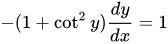
Sonuç olarak:
−
(
1
+
cot
2
y
)
d
y
d
x
=
1
{\displaystyle -(1+\cot ^{2}y){\frac {dy}{dx}}=1}
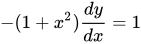
Yukarıdan
x
=
cot
y
{\displaystyle x=\cot y}
−
(
1
+
x
2
)
d
y
d
x
=
1
{\displaystyle -(1+x^{2}){\frac {dy}{dx}}=1}
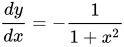
Sonuç olarak:
d
y
d
x
=
−
1
1
+
x
2
{\displaystyle {\frac {dy}{dx}}=-{\frac {1}{1+x^{2}}}}
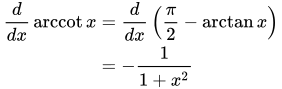
Alternatif olarak,
arctan
x
{\displaystyle \arctan x}
arctan
x
+
arccot
x
=
π
2
{\displaystyle \arctan x+\operatorname {arccot} x={\dfrac {\pi }{2}}}
d
d
x
arccot
x
=
d
d
x
(
π
2
−
arctan
x
)
=
−
1
1
+
x
2
{\displaystyle {\begin{aligned}{\dfrac {d}{dx}}\operatorname {arccot} x&={\dfrac {d}{dx}}\left({\dfrac {\pi }{2}}-\arctan x\right)\\&=-{\dfrac {1}{1+x^{2}}}\end{aligned}}}
Şunu alıyoruz:
y
=
arcsec
x
∣
|
x
|
≥
1
{\displaystyle y=\operatorname {arcsec} x\ \mid |x|\geq 1}
O halde:
x
=
sec
y
∣
y
∈
[
0
,
π
2
)
∪
(
π
2
,
π
]
{\displaystyle x=\sec y\mid \ y\in \left[0,{\frac {\pi }{2}}\right)\cup \left({\frac {\pi }{2}},\pi \right]}
d
x
d
y
=
sec
y
tan
y
=
|
x
|
x
2
−
1
{\displaystyle {\frac {dx}{dy}}=\sec y\tan y=|x|{\sqrt {x^{2}-1}}}
(İfadedeki mutlak değer gereklidir çünkü sekant ve tanjant çarpımı y aralığında her zaman pozitifken, kök
x
2
−
1
{\displaystyle {\sqrt {x^{2}-1}}}
d
y
d
x
=
1
|
x
|
x
2
−
1
{\displaystyle {\frac {dy}{dx}}={\frac {1}{|x|{\sqrt {x^{2}-1}}}}}
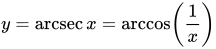
Alternatif olarak, ters sekantın türevi, ters kosinüsün türevinden zincir kuralı kullanılarak elde edilebilir.
Şunu alıyoruz:
y
=
arcsec
x
=
arccos
(
1
x
)
{\displaystyle y=\operatorname {arcsec} x=\arccos \left({\frac {1}{x}}\right)}
Burada
|
x
|
≥
1
{\displaystyle |x|\geq 1}
y
∈
[
0
,
π
2
)
∪
(
π
2
,
π
]
{\displaystyle y\in \left[0,{\frac {\pi }{2}}\right)\cup \left({\frac {\pi }{2}},\pi \right]}
O halde,
arccos
(
1
x
)
{\displaystyle \arccos \left({\frac {1}{x}}\right)}
d
y
d
x
=
−
1
1
−
(
1
x
)
2
⋅
(
−
1
x
2
)
=
1
x
2
1
−
1
x
2
=
1
x
2
x
2
−
1
x
2
=
1
x
2
x
2
−
1
=
1
|
x
|
x
2
−
1
{\displaystyle {\frac {dy}{dx}}=-{\frac {1}{\sqrt {1-({\frac {1}{x}})^{2}}}}\cdot \left(-{\frac {1}{x^{2}}}\right)={\frac {1}{x^{2}{\sqrt {1-{\frac {1}{x^{2}}}}}}}={\frac {1}{x^{2}{\frac {\sqrt {x^{2}-1}}{\sqrt {x^{2}}}}}}={\frac {1}{{\sqrt {x^{2}}}{\sqrt {x^{2}-1}}}}={\frac {1}{|x|{\sqrt {x^{2}-1}}}}}
Şunu alıyoruz:
y
=
arccsc
x
∣
|
x
|
≥
1
{\displaystyle y=\operatorname {arccsc} x\ \mid |x|\geq 1}
O halde
x
=
csc
y
∣
y
∈
[
−
π
2
,
0
)
∪
(
0
,
π
2
]
{\displaystyle x=\csc y\ \mid \ y\in \left[-{\frac {\pi }{2}},0\right)\cup \left(0,{\frac {\pi }{2}}\right]}
d
x
d
y
=
−
csc
y
cot
y
=
−
|
x
|
x
2
−
1
{\displaystyle {\frac {dx}{dy}}=-\csc y\cot y=-|x|{\sqrt {x^{2}-1}}}
(İfadedeki mutlak değer gereklidir çünkü kosekant ve kotanjant çarpımı y aralığında her zaman pozitifken, kök
x
2
−
1
{\displaystyle {\sqrt {x^{2}-1}}}
d
y
d
x
=
−
1
|
x
|
x
2
−
1
{\displaystyle {\frac {dy}{dx}}={\frac {-1}{|x|{\sqrt {x^{2}-1}}}}}
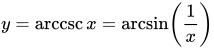
Alternatif olarak, ters kosekantın türevi, ters sinüsün türevinden zincir kuralı kullanılarak elde edilebilir.
Şunu alıyoruz:
y
=
arccsc
x
=
arcsin
(
1
x
)
{\displaystyle y=\operatorname {arccsc} x=\arcsin \left({\frac {1}{x}}\right)}
Burada
|
x
|
≥
1
{\displaystyle |x|\geq 1}
y
∈
[
−
π
2
,
0
)
∪
(
0
,
π
2
]
{\displaystyle y\in \left[-{\frac {\pi }{2}},0\right)\cup \left(0,{\frac {\pi }{2}}\right]}
O halde,
arcsin
(
1
x
)
{\displaystyle \arcsin \left({\frac {1}{x}}\right)}
d
y
d
x
=
1
1
−
(
1
x
)
2
⋅
(
−
1
x
2
)
=
−
1
x
2
1
−
1
x
2
=
−
1
x
2
x
2
−
1
x
2
=
−
1
x
2
x
2
−
1
=
−
1
|
x
|
x
2
−
1
{\displaystyle {\frac {dy}{dx}}={\frac {1}{\sqrt {1-({\frac {1}{x}})^{2}}}}\cdot \left(-{\frac {1}{x^{2}}}\right)=-{\frac {1}{x^{2}{\sqrt {1-{\frac {1}{x^{2}}}}}}}=-{\frac {1}{x^{2}{\frac {\sqrt {x^{2}-1}}{\sqrt {x^{2}}}}}}=-{\frac {1}{{\sqrt {x^{2}}}{\sqrt {x^{2}-1}}}}=-{\frac {1}{|x|{\sqrt {x^{2}-1}}}}}
Matematiksel Fonksiyonlar El Kitabı , Editörler: Abramowitz ve Stegun, Ulusal Standartlar Bürosu, Uygulamalı Matematik Serisi, 55 (1964)

























![{\displaystyle {\frac {\operatorname {d} }{\operatorname {d} \!\theta }}\,\tan \theta =\lim _{\delta \to 0}\left[{\frac {{\frac {\tan \theta +\tan \delta }{1-\tan \theta \tan \delta }}-\tan \theta }{\delta }}\right]=\lim _{\delta \to 0}\left[{\frac {\tan \theta +\tan \delta -\tan \theta +\tan ^{2}\theta \tan \delta }{\delta \left(1-\tan \theta \tan \delta \right)}}\right].}](https://wikimedia.org/api/rest_v1/media/math/render/svg/d296903d5dd1325c753b9fd893df4f3bbc34aaf1)
































![{\displaystyle x=\sec y\mid \ y\in \left[0,{\frac {\pi }{2}}\right)\cup \left({\frac {\pi }{2}},\pi \right]}](https://wikimedia.org/api/rest_v1/media/math/render/svg/c08c19df3baea48546feb573858808d249f80cfa)




![{\displaystyle y\in \left[0,{\frac {\pi }{2}}\right)\cup \left({\frac {\pi }{2}},\pi \right]}](https://wikimedia.org/api/rest_v1/media/math/render/svg/9bf2556cec37bbe40f88711c88fe51fe767cb390)



![{\displaystyle x=\csc y\ \mid \ y\in \left[-{\frac {\pi }{2}},0\right)\cup \left(0,{\frac {\pi }{2}}\right]}](https://wikimedia.org/api/rest_v1/media/math/render/svg/7dc85733e54dce8ba132748ebc4652ee62d65ce7)


![{\displaystyle y\in \left[-{\frac {\pi }{2}},0\right)\cup \left(0,{\frac {\pi }{2}}\right]}](https://wikimedia.org/api/rest_v1/media/math/render/svg/867819ffe66500464361cfb300742fe12940cd6c)


