Lisanslama
Ben, bu işin telif sahibi, burada işi aşağıdaki lisans altında yayımlıyorum:
Şu seçeneklerde özgürsünüz:
paylaşım – eser paylaşımı, dağıtımı ve iletimiiçeriği değiştirip uyarlama – eser adaptasyonu
Aşağıdaki koşullar geçerli olacaktır:
atıf – Esere yazar veya lisans sahibi tarafından belirtilen (ancak sizi ya da eseri kullanımınızı desteklediklerini ileri sürmeyecek bir) şekilde atıfta bulunmalısınız.benzer paylaşım – Maddeyi yeniden düzenler, dönüştürür veya inşa ederseniz, katkılarınızı özgünüyle aynı veya uyumlu lisans altında dağıtmanız gerekir. https://creativecommons.org/licenses/by-sa/4.0 CC BY-SA 4.0 Creative Commons Attribution-Share Alike 4.0 true true
Overview
The Kerr–Newman–de–Sitter metric (KNdS)[ 1] [ 2] stationary solutions of the Einstein–Maxwell equations in [1] that describes the spacetime geometry in the region surrounding an electrically charged, rotating mass embedded in an expanding universe. It generalizes the Kerr–Newman metric by taking into account the cosmological constant
Λ
{\displaystyle \Lambda }
In (+, −, −, −) signature and in natural units of
G
=
M
=
c
=
k
e
=
1
{\displaystyle {\rm {G=M=c=k_{e}=1}}}
[ 3] [ 4] [ 5] [ 6]
g
t
t
=
−
3
[
a
2
sin
2
θ
(
a
2
Λ
cos
2
θ
+
3
)
+
a
2
(
Λ
r
2
−
3
)
+
Λ
r
4
−
3
r
2
+
6
r
−
3
℧
2
]
(
a
2
Λ
+
3
)
2
(
a
2
cos
2
θ
+
r
2
)
{\displaystyle g_{\rm {tt}}={\rm {-{\frac {3\ [a^{2}\ \sin ^{2}\theta \left(a^{2}\ \Lambda \ \cos ^{2}\theta +3\right)+a^{2}\left(\Lambda \ r^{2}-3\right)+\Lambda \ r^{4}-3\ r^{2}+6\ r-3\mho ^{2}]}{\left(a^{2}\ \Lambda +3\right)^{2}\left(a^{2}\cos ^{2}\theta +r^{2}\right)}}}}}
g
r
r
=
−
a
2
cos
2
θ
+
r
2
(
a
2
+
r
2
)
(
1
−
Λ
r
2
3
)
−
2
r
+
℧
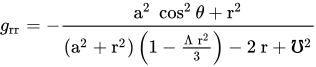
2
{\displaystyle g_{\rm {rr}}={\rm {-{\frac {a^{2}\ \cos ^{2}\theta +r^{2}}{\left(a^{2}+r^{2}\right)\left(1-{\frac {\Lambda \ r^{2}}{3}}\right)-2\ r+\mho ^{2}}}}}}
g
θ
θ
=
−
3
(
a
2
cos
2
θ
+
r
2
)
a
2
Λ
cos
2
θ
+
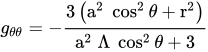
3
{\displaystyle g_{\rm {\theta \theta }}={\rm {-{\frac {3\left(a^{2}\ \cos ^{2}\theta +r^{2}\right)}{a^{2}\ \Lambda \ \cos ^{2}\theta +3}}}}}
g
ϕ
ϕ
=
9
{
1
3
(
a
2
+
r
2
)
2
sin
2
θ
(
a
2
Λ
cos
2
θ
+
3
)
−
a
2
sin
4
θ
[
(
a
2
+
r
2
)
(
1
−
Λ
r
2
/
3
)
−
2
r
+
℧
2
]
}
−
(
a
2
Λ
+
3
)
2
(
a
2
cos
2
θ
+
r
2
)
{\displaystyle g_{\rm {\phi \phi }}={\rm {\frac {9\ \{{\frac {1}{3}}\left(a^{2}+r^{2}\right)^{2}\sin ^{2}\theta \left(a^{2}\ \Lambda \cos ^{2}\theta +3\right)-a^{2}\sin ^{4}\theta \ [\left(a^{2}+r^{2}\right)\left(1-\Lambda \ r^{2}/3\right)-2\ r+\mho ^{2}]\}}{-\left(a^{2}\ \Lambda +3\right)^{2}\left(a^{2}\cos ^{2}\theta +r^{2}\right)}}}}
g
t
ϕ
=
3
a
sin
2
θ
[
a
2
Λ
(
a
2
+
r
2
)
cos
2
θ
+
a
2
Λ
r
2
+
Λ
r
4
+
6
r
−
3
℧
2
]
(
a
2
Λ
+
3
)
2
(
a
2
cos
2
θ
+
r
2
)
{\displaystyle g_{\rm {t\phi }}={\rm {\frac {3\ a\ \sin ^{2}\theta \ [a^{2}\ \Lambda \left(a^{2}+r^{2}\right)\cos ^{2}\theta +a^{2}\ \Lambda \ r^{2}+\Lambda \ r^{4}+6\ r-3\ \mho ^{2}]}{\left(a^{2}\ \Lambda +3\right)^{2}\left(a^{2}\ \cos ^{2}\theta +r^{2}\right)}}}}
with all the other
g
μ
ν
=
0
{\displaystyle g_{\mu \nu }=0}
a
{\displaystyle {\rm {a}}}
℧
{\displaystyle {\rm {\mho }}}
Λ
=
3
H
2
{\displaystyle {\rm {\Lambda =3H^{2}}}}
[ 7]
H
{\displaystyle {\rm {H}}}
Sitter universe#Mathematical expression Hubble parameter . The electromagnetic 4-potential is
A
μ
=
{
3
r
℧
(
a
2
Λ
+
3
)
(
a
2
cos
2
θ
+
r
2
)
,
0
,
0
,
−
3
a
r
℧
sin
2
θ
(
a
2
Λ
+
3
)
(
a
2
cos
2
θ
+
r
2
)
}
{\displaystyle {\rm {A_{\mu }=\left\{{\frac {3\ r\ \mho }{\left(a^{2}\ \Lambda +3\right)\left(a^{2}\ \cos ^{2}\theta +r^{2}\right)}},\ 0,\ 0,\ -{\frac {3\ a\ r\ \mho \ \sin ^{2}\theta }{\left(a^{2}\ \Lambda +3\right)\left(a^{2}\ \cos ^{2}\theta +r^{2}\right)}}\right\}}}}
frame-dragging angular velocity is
ω
=
d
ϕ
d
t
=
−
g
t
ϕ
g
ϕ
ϕ
=
a
[
a
2
Λ
(
a
2
+
r
2
)
cos
2
θ
+
a
2
Λ
r
2
+
6
r
+
Λ
r
4
−
3
℧
2
]
a
2
sin
2
θ
[
a
2
(
Λ
r
2
−
3
)
+
6
r
+
Λ
r
4
−
3
r
2
−
3
℧
2
]
+
a
2
Λ
(
a
2
+
r
2
)
2
cos
2
θ
+
3
(
a
2
+
r
2
)
2
{\displaystyle \omega ={\frac {\rm {d\phi }}{\rm {dt}}}=-{\frac {g_{\rm {t\phi }}}{g_{\rm {\phi \phi }}}}={\rm {\frac {a\ [a^{2}\ \Lambda \left(a^{2}+r^{2}\right)\cos ^{2}\theta +a^{2}\ \Lambda \ r^{2}+6\ r+\Lambda \ r^{4}-3\ \mho ^{2}]}{a^{2}\ \sin ^{2}\theta \ [a^{2}\left(\Lambda \ r^{2}-3\right)+6\ r+\Lambda \ r^{4}-3\ r^{2}-3\ \mho ^{2}]+a^{2}\ \Lambda \ \left(a^{2}+r^{2}\right)^{2}\cos ^{2}\theta +3\ \left(a^{2}+r^{2}\right)^{2}}}}}
{
r
,
θ
,
ϕ
}
{\displaystyle {\rm {\{r,\theta ,\phi \}}}}
ergosphere )
ν
=
g
t
ϕ
g
t
ϕ
=
−
a
2
sin
2
θ
[
a
2
Λ
(
a
2
+
r
2
)
cos
2
θ
+
a
2
Λ
r
2
+
6
r
+
Λ
r
4
−
3
℧
2
]
2
(
a
2
Λ
cos
2
θ
+
3
)
(
a
2
+
r
2
−
a
2
sin
2
θ
)
2
[
a
2
(
Λ
r
2
−
3
)
+
6
r
+
Λ
r
4
−
3
r
2
−
3
℧
2
]
{\displaystyle \nu ={\sqrt {g_{\rm {t\phi }}\ g^{\rm {t\phi }}}}={\rm {\sqrt {-{\frac {a^{2}\ \sin ^{2}\theta \ [a^{2}\ \Lambda \left(a^{2}+r^{2}\right)\cos ^{2}\theta +a^{2}\Lambda \ r^{2}+6\ r+\Lambda \ r^{4}-3\ \mho ^{2}]^{2}}{\left(a^{2}\ \Lambda \ \cos ^{2}\theta +3\right)\left(a^{2}+r^{2}-a^{2}\sin ^{2}\theta \right)^{2}[a^{2}\left(\Lambda \ r^{2}-3\right)+6\ r+\Lambda \ r^{4}-3\ r^{2}-3\ \mho ^{2}]}}}}}}
v
=
1
−
1
/
g
t
t
=
3
(
a
2
Λ
cos
2
θ
+
3
)
(
a
2
+
r
2
−
a
2
sin
2
θ
)
2
[
a
2
(
Λ
r
2
−
3
)
+
Λ
r
4
−
3
r
2
+
6
r
−
3
℧
2
]
(
a
2
Λ
+
3
)
2
(
a
2
cos
2
θ
+
r
2
)
{
a
2
Λ
(
a
2
+
r
2
)
2
cos
2
θ
+
3
(
a
2
+
r
2
)
2
+
a
2
sin
2
θ
[
a
2
(
Λ
r
2
−
3
)
+
Λ
r
4
−
3
r
2
+
6
r
−
3
℧
2
]
}
+
1
{\displaystyle {\rm {v}}={\sqrt {1-1/g^{\rm {tt}}}}={\rm {\sqrt {{\frac {3\left(a^{2}\Lambda \cos ^{2}\theta +3\right)\left(a^{2}+r^{2}-a^{2}\sin ^{2}\theta \right)^{2}\left[a^{2}\left(\Lambda r^{2}-3\right)+\Lambda r^{4}-3r^{2}+6r-3\mho ^{2}\right]}{\left(a^{2}\Lambda +3\right)^{2}\left(a^{2}\cos ^{2}\theta +r^{2}\right)\{a^{2}\Lambda \left(a^{2}+r^{2}\right)^{2}\cos ^{2}\theta +3\left(a^{2}+r^{2}\right)^{2}+a^{2}\sin ^{2}\theta \left[a^{2}\left(\Lambda r^{2}-3\right)+\Lambda r^{4}-3r^{2}+6r-3\mho ^{2}\right]\}}}+1}}}}
x
¨
μ
=
−
∑
α
,
β
(
Γ
α
β
μ
x
˙
α
x
˙
β
+
q
F
μ
β
x
˙
α
g
α
β
)
{\displaystyle {\rm {{\ddot {x}}^{\mu }=-\sum _{\alpha ,\beta }\ (\Gamma _{\alpha \beta }^{\mu }\ {\dot {x}}^{\alpha }\ {\dot {x}}^{\beta }+q\ {\rm {F}}^{\mu \beta }\ {\rm {\dot {x}}}^{\alpha }}}\ g_{\alpha \beta })}
x
˙
{\displaystyle {\rm {\dot {x}}}}
four velocity ,
q
{\displaystyle {\rm {q}}}
specific charge and
F
{\displaystyle {\rm {F}}}
Maxwell–Faraday tensor
F
μ
ν
=
∂
A
μ
∂
x
ν
−
∂
A
ν
∂
x
μ
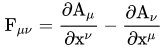
{\displaystyle {\rm {{\ F}_{\mu \nu }={\frac {\partial A_{\mu }}{\partial x^{\nu }}}-{\frac {\partial A_{\nu }}{\partial x^{\mu }}}}}}
E
=
−
p
t
=
g
t
t
t
˙
+
g
t
ϕ
ϕ
˙
+
q
A
t
{\displaystyle {\rm {E=-p_{t}}}=g_{\rm {tt}}{\rm {\dot {t}}}+g_{\rm {t\phi }}{\rm {\dot {\phi }}}+{\rm {q\ A_{t}}}}
angular momentum
L
z
=
p
ϕ
=
−
g
ϕ
ϕ
ϕ
˙
−
g
t
ϕ
t
˙
−
q
A
ϕ
{\displaystyle {\rm {L_{z}=p_{\phi }}}=-g_{\rm {\phi \phi }}{\rm {\dot {\phi }}}-g_{\rm {t\phi }}{\rm {\dot {t}}}-{\rm {q\ A_{\phi }}}}
for differentiation overdot stands for differentiation by the testparticle's proper time
τ
{\displaystyle \tau }
affine parameter , so
x
˙
=
d
x
/
d
τ
,
x
¨
=
d
2
x
/
d
τ
2
{\displaystyle {\rm {{\dot {x}}=dx/d\tau ,\ {\ddot {x}}=d^{2}x/d\tau ^{2}}}}
To get
g
r
r
=
0
{\displaystyle g_{\rm {rr}}=0}
d
t
=
d
u
−
d
r
(
a
2
Λ
/
3
+
1
)
(
a
2
+
r
2
)
(
a
2
+
r
2
)
(
1
−
Λ
r
2
/
3
)
−
2
r
+
℧
2
{\displaystyle {\rm {dt=du-{\frac {dr\left(a^{2}\ \Lambda /3+1\right)\left(a^{2}+r^{2}\right)}{\left(a^{2}+r^{2}\right)\left(1-\Lambda \ r^{2}/3\right)-2\ r+\mho ^{2}}}}}}
d
ϕ
=
d
φ
−
a
d
r
(
a
2
Λ
/
3
+
1
)
(
a
2
+
r
2
)
(
1
−
Λ
r
2
/
3
)
−
2
r
+
℧
2
{\displaystyle {\rm {d\phi =d\varphi -{\frac {a\ dr\left(a^{2}\ \Lambda /3+1\right)}{\left(a^{2}+r^{2}\right)\left(1-\Lambda \ r^{2}/3\right)-2\ r+\mho ^{2}}}}}}
g
u
r
=
−
3
a
2
Λ
+
3
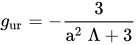
{\displaystyle g_{\rm {ur}}={\rm {-{\frac {3}{a^{2}\ \Lambda +3}}}}}
g
r
φ
=
3
a
sin
2
θ
a
2
Λ
+
3
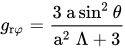
{\displaystyle g_{\rm {r\varphi }}={\rm {\frac {3\ a\sin ^{2}\theta }{a^{2}\ \Lambda +3}}}}
g
u
u
=
g
t
t
,
g
θ
θ
=
g
θ
θ
,
g
φ
φ
=
g
ϕ
ϕ
,
g
u
φ
=
g
t
ϕ
{\displaystyle g_{\rm {uu}}=g_{\rm {tt}}\ ,\ \ g_{\theta \theta }=g_{\theta \theta }\ ,\ \ g_{\rm {\varphi \varphi }}=g_{\rm {\phi \phi }}\ ,\ \ g_{\rm {u\varphi }}=g_{\rm {t\phi }}}
g
μ
ν
=
0
{\displaystyle g_{\mu \nu }=0}
vector potential
A
μ
=
{
3
r
℧
(
a
2
Λ
+
3
)
(
a
2
cos
2
θ
+
r
2
)
,
3
r
℧
a
2
(
Λ
r
2
−
3
)
+
6
r
+
Λ
r
4
−
3
(
r
2
+
℧
2
)
,
0
,
−
3
a
r
℧
sin
2
θ
(
a
2
Λ
+
3
)
(
a
2
cos
2
θ
+
r
2
)
}
{\displaystyle {\rm {A_{\mu }=\left\{{\frac {3\ r\ \mho }{\left(a^{2}\ \Lambda +3\right)\left(a^{2}\cos ^{2}\theta +r^{2}\right)}},{\frac {3\ r\ \mho }{a^{2}\left(\Lambda \ r^{2}-3\right)+6\ r+\Lambda \ r^{4}-3\left(r^{2}+\mho ^{2}\right)}},\ 0,\ -{\frac {3\ a\ r\ \mho \sin ^{2}\theta }{\left(a^{2}\ \Lambda +3\right)\left(a^{2}\cos ^{2}\theta +r^{2}\right)}}\right\}}}}
t
¯
=
u
−
r
{\displaystyle {\rm {{\bar {t}}=u-r}}}
45
∘
{\displaystyle 45^{\circ }}
{
t
¯
,
r
}
{\displaystyle \{{\rm {{\bar {t}},\ r\}}}}
spacetime diagram .
The horizons are at
g
r
r
=
0
{\displaystyle g^{\rm {rr}}=0}
g
t
t
|
|
g
u
u
=
0
{\displaystyle g_{\rm {tt}}||g_{\rm {uu}}=0}
Kerr and Kerr–Newman metrics the horizons have constant Boyer-Lindquist
r
{\displaystyle {\rm {r}}}
θ
{\displaystyle \theta }
This gives 3 positive solutions each (including the black hole's inner and outer horizons and ergospheres as well as the cosmic ones) and a negative solution for the space at
r
<
0
{\displaystyle {\rm {r<0}}}
antiverse [ 8] [ 9] ring singularity , which is part of the probably unphysical extended solution of the metric.
With a negative
Λ
{\displaystyle \Lambda }
Anti–de–Sitter variant with an attractive cosmological constant) there are no cosmic horizon and ergosphere, only the black hole related ones.
In the Nariai limit[ 10] Schwarzschild–de–Sitter metric to which the KNdS reduces with
a
=
℧
=
0
{\displaystyle {\rm {a=\mho =0}}}
Λ
=
1
/
9
{\displaystyle \Lambda =1/9}
The Ricci scalar for the KNdS metric is
R
=
−
4
Λ
{\displaystyle {\rm {R=-4\Lambda }}}
Kretschmann scalar
K
=
{
220
a
12
Λ
2
cos
(
6
θ
)
+
66
a
12
Λ
2
cos
(
8
θ
)
+
12
a
12
Λ
2
cos
(
10
θ
)
+
a
12
Λ
2
cos
(
12
θ
)
+
{\displaystyle {\rm {K=\{220a^{12}\Lambda ^{2}\cos(6\theta )+66a^{12}\Lambda ^{2}\cos(8\theta )+12a^{12}\Lambda ^{2}\cos(10\theta )+a^{12}\Lambda ^{2}\cos(12\theta )+}}}
462
a
12
Λ
2
+
1080
a
10
Λ
2
r
2
cos
(
6
θ
)
+
240
a
10
Λ
2
r
2
cos
(
8
θ
)
+
24
a
10
Λ
2
r
2
cos
(
10
θ
)
+
{\displaystyle {\rm {462a^{12}\Lambda ^{2}+1080a^{10}\Lambda ^{2}r^{2}\cos(6\theta )+240a^{10}\Lambda ^{2}r^{2}\cos(8\theta )+24a^{10}\Lambda ^{2}r^{2}\cos(10\theta )+}}}
3024
a
10
Λ
2
r
2
+
1920
a
8
Λ
2
r
4
cos
(
6
θ
)
+
240
a
8
Λ
2
r
4
cos
(
8
θ
)
+
8400
a
8
Λ
2
r
4
−
{\displaystyle {\rm {3024a^{10}\Lambda ^{2}r^{2}+1920a^{8}\Lambda ^{2}r^{4}\cos(6\theta )+240a^{8}\Lambda ^{2}r^{4}\cos(8\theta )+8400a^{8}\Lambda ^{2}r^{4}-}}}
1152
a
6
cos
(
6
θ
)
−
11520
a
6
+
1280
a
6
Λ
2
r
6
cos
(
6
θ
)
+
12800
a
6
Λ
2
r
6
+
207360
a
4
r
2
−
{\displaystyle {\rm {1152a^{6}\cos(6\theta )-11520a^{6}+1280a^{6}\Lambda ^{2}r^{6}\cos(6\theta )+12800a^{6}\Lambda ^{2}r^{6}+207360a^{4}r^{2}-}}}
138240
a
4
r
℧
2
+
11520
a
4
Λ
2
r
8
+
16128
a
4
℧
4
−
276480
a
2
r
4
+
368640
a
2
r
3
℧
2
+
{\displaystyle {\rm {138240a^{4}r\mho ^{2}+11520a^{4}\Lambda ^{2}r^{8}+16128a^{4}\mho ^{4}-276480a^{2}r^{4}+368640a^{2}r^{3}\mho ^{2}+}}}
6144
a
2
Λ
2
r
10
−
104448
a
2
r
2
℧
4
+
3
a
4
cos
(
4
θ
)
[
165
a
8
Λ
2
+
960
a
6
Λ
2
r
2
+
2240
a
4
Λ
2
r
4
−
{\displaystyle {\rm {6144a^{2}\Lambda ^{2}r^{10}-104448a^{2}r^{2}\mho ^{4}+3a^{4}\cos(4\theta )[165a^{8}\Lambda ^{2}+960a^{6}\Lambda ^{2}r^{2}+2240a^{4}\Lambda ^{2}r^{4}-}}}
256
a
2
(
9
−
10
Λ
2
r
6
)
+
256
(
90
r
2
−
60
r
℧
2
+
5
Λ
2
r
8
+
7
℧
4
)
]
+
24
a
2
cos
(
2
θ
)
[
33
a
10
Λ
2
+
{\displaystyle {\rm {256a^{2}(9-10\Lambda ^{2}r^{6})+256(90r^{2}-60r\mho ^{2}+5\Lambda ^{2}r^{8}+7\mho ^{4})]+24a^{2}\cos(2\theta )[33a^{10}\Lambda ^{2}+}}}
210
a
8
Λ
2
r
2
+
560
a
6
Λ
2
r
4
−
80
a
4
(
9
−
10
Λ
2
r
6
)
+
128
a
2
(
90
r
2
−
60
r
℧
2
+
5
Λ
2
r
8
+
{\displaystyle {\rm {210a^{8}\Lambda ^{2}r^{2}+560a^{6}\Lambda ^{2}r^{4}-80a^{4}(9-10\Lambda ^{2}r^{6})+128a^{2}(90r^{2}-60r\mho ^{2}+5\Lambda ^{2}r^{8}+}}}
7
℧
4
)
+
256
r
2
(
−
45
r
2
+
60
r
℧
2
+
Λ
2
r
8
−
17
℧
4
)
]
+
36864
r
6
−
73728
r
5
℧
2
+
{\displaystyle {\rm {7\mho ^{4})+256r^{2}(-45r^{2}+60r\mho ^{2}+\Lambda ^{2}r^{8}-17\mho ^{4})]+36864r^{6}-73728r^{5}\mho ^{2}+}}}
2048
Λ
2
r
12
+
43008
r
4
℧
4
}
÷
{
12
[
a
2
cos
(
2
θ
)
+
a
2
+
2
r
2
]
6
}
{\displaystyle {\rm {2048\Lambda ^{2}r^{12}+43008r^{4}\mho ^{4}\}\div \{12[a^{2}\cos(2\theta )+a^{2}+2r^{2}]^{6}\}}}}
Further reading
For the transformation see here and the links therein. More tensors and scalars for the KNdS metric: in Boyer Lindquist and Null coordinates , higher resolution: video , advised references: arxiv:1710.00997 & arxiv:2007.04354 . More snapshots of this series can be found here , those are also under the creative commons license.
References
↑ (2008). "Kerr-Newman-de Sitter black holes with a restricted repulsive barrier of equatorial photon motion". Physical Review D 58 : 084003. DOI 10.1088/0264-9381/17/21/312 . ↑ (2009). "Exact spacetimes in Einstein's General Relativity". Cambridge University Press, Cambridge Monographs in Mathematical Physics . DOI 10.1017/CBO9780511635397 . ↑ (2023). "Motion equations in a Kerr-Newman-de Sitter spacetime". Classical and Quantum Gravity 40 (13). DOI 10.1088/1361-6382/accbfe . ↑ (2014). "Gravitational lensing and frame-dragging of light in the Kerr–Newman and the Kerr–Newman (anti) de Sitter black hole spacetimes". General Relativity and Gravitation 46 (11): 1818. DOI 10.1007/s10714-014-1818-8 . ↑ (2018). "Kerr-de Sitter spacetime, Penrose process and the generalized area theorem". Physical Review D 97 (8): 084049. DOI 10.1103/PhysRevD.97.084049 . ↑ (2021). "Null Hypersurfaces in Kerr-Newman-AdS Black Hole and Super-Entropic Black Hole Spacetimes". Classical and Quantum Gravity 38 (4): 045018. DOI 10.1088/1361-6382/abd3e0 . ↑ Gaur & Visser: Black holes embedded in FLRW cosmologies (2023) class=gr-qc, arxiv eprint=2308.07374
↑ Andrew Hamilton: Black hole Penrose diagrams (JILA Colorado)
↑ Figure 2 in (2020). "Influence of Cosmic Repulsion and Magnetic Fields on Accretion Disks Rotating around Kerr Black Holes". Universe . DOI 10.3390/universe6020026 . ↑ Leonard Susskind: Aspects of de Sitter Holography , timestamp 38:27: video of the online seminar on de Sitter space and Holography, Sept 14, 2021
Türkçe Bu dosyanın temsil ettiği şeyin tek satırlık açıklamasını ekleyin.





_Horizons_%26_Ergospheres.gif)
_Horizons_vs_Ergospheres.png)



![{\displaystyle g_{\rm {tt}}={\rm {-{\frac {3\ [a^{2}\ \sin ^{2}\theta \left(a^{2}\ \Lambda \ \cos ^{2}\theta +3\right)+a^{2}\left(\Lambda \ r^{2}-3\right)+\Lambda \ r^{4}-3\ r^{2}+6\ r-3\mho ^{2}]}{\left(a^{2}\ \Lambda +3\right)^{2}\left(a^{2}\cos ^{2}\theta +r^{2}\right)}}}}}](https://wikimedia.org/api/rest_v1/media/math/render/svg/f2b5b59138ef22eecb2c6c151fd5c5d8ebbd28de)
![{\displaystyle g_{\rm {\phi \phi }}={\rm {\frac {9\ \{{\frac {1}{3}}\left(a^{2}+r^{2}\right)^{2}\sin ^{2}\theta \left(a^{2}\ \Lambda \cos ^{2}\theta +3\right)-a^{2}\sin ^{4}\theta \ [\left(a^{2}+r^{2}\right)\left(1-\Lambda \ r^{2}/3\right)-2\ r+\mho ^{2}]\}}{-\left(a^{2}\ \Lambda +3\right)^{2}\left(a^{2}\cos ^{2}\theta +r^{2}\right)}}}}](https://wikimedia.org/api/rest_v1/media/math/render/svg/07ebc2bba7c71aa235ff94d29110470feb661727)
![{\displaystyle g_{\rm {t\phi }}={\rm {\frac {3\ a\ \sin ^{2}\theta \ [a^{2}\ \Lambda \left(a^{2}+r^{2}\right)\cos ^{2}\theta +a^{2}\ \Lambda \ r^{2}+\Lambda \ r^{4}+6\ r-3\ \mho ^{2}]}{\left(a^{2}\ \Lambda +3\right)^{2}\left(a^{2}\ \cos ^{2}\theta +r^{2}\right)}}}}](https://wikimedia.org/api/rest_v1/media/math/render/svg/92a804c925442fcf46553ca63a60b8b0a57f75d0)



![{\displaystyle \omega ={\frac {\rm {d\phi }}{\rm {dt}}}=-{\frac {g_{\rm {t\phi }}}{g_{\rm {\phi \phi }}}}={\rm {\frac {a\ [a^{2}\ \Lambda \left(a^{2}+r^{2}\right)\cos ^{2}\theta +a^{2}\ \Lambda \ r^{2}+6\ r+\Lambda \ r^{4}-3\ \mho ^{2}]}{a^{2}\ \sin ^{2}\theta \ [a^{2}\left(\Lambda \ r^{2}-3\right)+6\ r+\Lambda \ r^{4}-3\ r^{2}-3\ \mho ^{2}]+a^{2}\ \Lambda \ \left(a^{2}+r^{2}\right)^{2}\cos ^{2}\theta +3\ \left(a^{2}+r^{2}\right)^{2}}}}}](https://wikimedia.org/api/rest_v1/media/math/render/svg/dda8e28849c12cda4142724ba3596931fa5020ad)

![{\displaystyle \nu ={\sqrt {g_{\rm {t\phi }}\ g^{\rm {t\phi }}}}={\rm {\sqrt {-{\frac {a^{2}\ \sin ^{2}\theta \ [a^{2}\ \Lambda \left(a^{2}+r^{2}\right)\cos ^{2}\theta +a^{2}\Lambda \ r^{2}+6\ r+\Lambda \ r^{4}-3\ \mho ^{2}]^{2}}{\left(a^{2}\ \Lambda \ \cos ^{2}\theta +3\right)\left(a^{2}+r^{2}-a^{2}\sin ^{2}\theta \right)^{2}[a^{2}\left(\Lambda \ r^{2}-3\right)+6\ r+\Lambda \ r^{4}-3\ r^{2}-3\ \mho ^{2}]}}}}}}](https://wikimedia.org/api/rest_v1/media/math/render/svg/4081e3f031366394e1b09362e3ee4f8c725527b8)
![{\displaystyle {\rm {v}}={\sqrt {1-1/g^{\rm {tt}}}}={\rm {\sqrt {{\frac {3\left(a^{2}\Lambda \cos ^{2}\theta +3\right)\left(a^{2}+r^{2}-a^{2}\sin ^{2}\theta \right)^{2}\left[a^{2}\left(\Lambda r^{2}-3\right)+\Lambda r^{4}-3r^{2}+6r-3\mho ^{2}\right]}{\left(a^{2}\Lambda +3\right)^{2}\left(a^{2}\cos ^{2}\theta +r^{2}\right)\{a^{2}\Lambda \left(a^{2}+r^{2}\right)^{2}\cos ^{2}\theta +3\left(a^{2}+r^{2}\right)^{2}+a^{2}\sin ^{2}\theta \left[a^{2}\left(\Lambda r^{2}-3\right)+\Lambda r^{4}-3r^{2}+6r-3\mho ^{2}\right]\}}}+1}}}}](https://wikimedia.org/api/rest_v1/media/math/render/svg/9147e151af87916136f383850ec6704aead3b6a9)




















![{\displaystyle {\rm {256a^{2}(9-10\Lambda ^{2}r^{6})+256(90r^{2}-60r\mho ^{2}+5\Lambda ^{2}r^{8}+7\mho ^{4})]+24a^{2}\cos(2\theta )[33a^{10}\Lambda ^{2}+}}}](https://wikimedia.org/api/rest_v1/media/math/render/svg/18d96d215a7193f2d8796b38933f32365b103d18)

![{\displaystyle {\rm {7\mho ^{4})+256r^{2}(-45r^{2}+60r\mho ^{2}+\Lambda ^{2}r^{8}-17\mho ^{4})]+36864r^{6}-73728r^{5}\mho ^{2}+}}}](https://wikimedia.org/api/rest_v1/media/math/render/svg/bf4ad3936d29159700186fadd9df4023f331b3ff)
![{\displaystyle {\rm {2048\Lambda ^{2}r^{12}+43008r^{4}\mho ^{4}\}\div \{12[a^{2}\cos(2\theta )+a^{2}+2r^{2}]^{6}\}}}}](https://wikimedia.org/api/rest_v1/media/math/render/svg/fd27cd946b07641ac3de74685f6e56455299641a)


