Dosya:Newton versus Schwarzschild trajectories.gif - Vikipedi
İçeriğe atla
Ana menü
Gezinti
  • Anasayfa
  • Hakkımızda
  • İçindekiler
  • Rastgele madde
  • Seçkin içerik
  • Yakınımdakiler
Katılım
  • Deneme tahtası
  • Köy çeşmesi
  • Son değişiklikler
  • Dosya yükle
  • Topluluk portalı
  • Wikimedia dükkânı
  • Yardım
  • Özel sayfalar
Vikipedi Özgür Ansiklopedi
Ara
  • Bağış yapın
  • Hesap oluştur
  • Oturum aç
  • Bağış yapın
  • Hesap oluştur
  • Oturum aç

Dosya:Newton versus Schwarzschild trajectories.gif
Sayfa içeriği diğer dillerde desteklenmemektedir.
  • Dosya
  • Tartışma
  • Oku
  • Wikimedia Commons üzerinde gör
  • Yerel açıklama ekle
  • Yerel açıklama kaynağı ekle
Araçlar
Eylemler
  • Oku
  • Wikimedia Commons üzerinde gör
  • Yerel açıklama ekle
  • Yerel açıklama kaynağı ekle
Genel
  • Sayfaya bağlantılar
  • Basılmaya uygun görünüm
  • Sayfa bilgisi
  • Kısaltılmış URL'yi al
  • Karekodu indir
Diğer projelerde
Görünüm
Vikipedi, özgür ansiklopedi
  • Dosya
  • Dosya geçmişi
  • Dosya kullanımı
  • Küresel dosya kullanımı
  • Üstveri
Dosya:Newton versus Schwarzschild trajectories.gif
Daha yüksek çözünürlüğe sahip sürüm bulunmamaktadır.
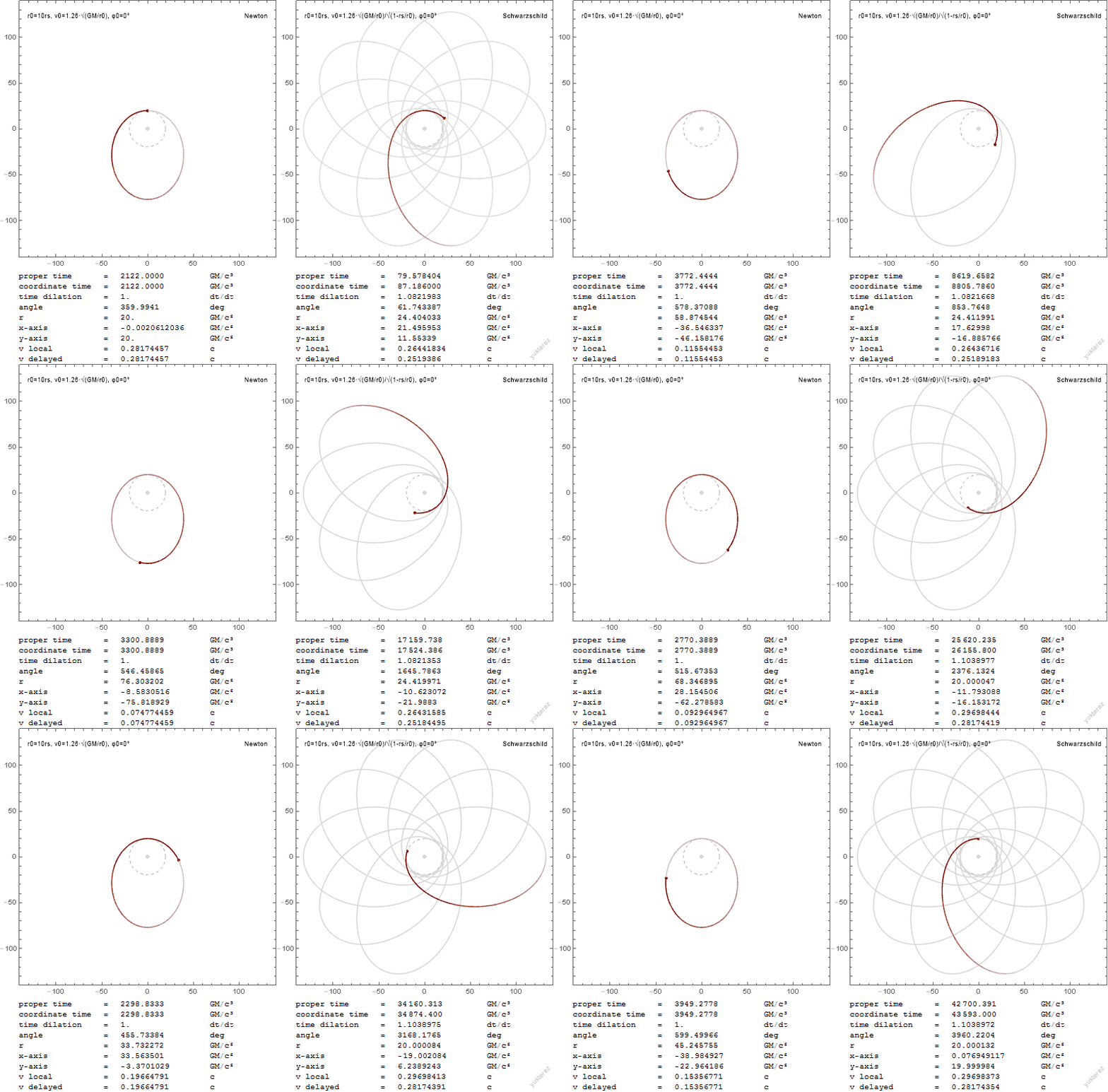
Newton_versus_Schwarzschild_trajectories.gif ((800 × 526 piksel, dosya boyutu: 2,17 MB, MIME tipi: image/gif), döngüye girdi, 500 kare, 15 sn)
Not: Teknik sınırlamalar nedeniyle, bu gibi yüksek çözünürlüklü GIF resimlerinin küçük resimlerinde animasyon yoktur.
Bu dosya Wikimedia Commons'ta bulunmaktadır. Dosyanın açıklaması aşağıda gösterilmiştir.
Commons, serbest/özgür telifli medya dosyalarının bulundurulduğu depodur. Siz de yardım edebilirsiniz.
Bu dosya Wikimedia Commons'ta bulunmaktadır.

Özet

AçıklamaNewton versus Schwarzschild trajectories.gif
English: Comparison of a testparticle's trajectory in Newtonian and Schwarzschild spacetime in the strong gravitational field (r0=10rs=20GM/c²). The initial velocity in both cases is 126% of the circular orbital velocity. φ0 is the launching angle (0° is a horizontal shot, and 90° a radially upward shot). Since the metric is spherically symmetric the frame of reference can be rotated so that Φ is constant and the motion of the test-particle is confined to the r,θ-plane (or vice versa).
Tarih 21 Mayıs 2016
Kaynak Yükleyenin kendi çalışması - Mathematica Code
Yazar Yukterez (Simon Tyran, Vienna)
Diğer sürümler Kerr orbit, a=0.9

Equations of motion

Newton

In spherical coordinates and natural units of G=M=c=1 {\displaystyle {\text{G=M=c=1}}} {\displaystyle {\text{G=M=c=1}}}, where lengths are measured in GM/c 2 {\displaystyle {\text{GM/c}}^{2}} {\displaystyle {\text{GM/c}}^{2}} and times in GM/c 3 {\displaystyle {\text{GM/c}}^{3}} {\displaystyle {\text{GM/c}}^{3}}, the motion of a testparticle in the presence of a dominant mass is defined by

r ¨ = − 1 r 2 + r   ϕ ˙ 2   ,     ϕ ¨ = − 2   r ˙   ϕ ˙ r {\displaystyle {\ddot {\text{r}}}=-{\frac {1}{{\text{r}}^{2}}}+{\text{r}}\ {\dot {\phi }}^{2}\ ,\ \ {\ddot {\phi }}=-{\frac {2\ {\dot {\text{r}}}\ {\dot {\phi }}}{\text{r}}}} {\displaystyle {\ddot {\text{r}}}=-{\frac {1}{{\text{r}}^{2}}}+{\text{r}}\ {\dot {\phi }}^{2}\ ,\ \ {\ddot {\phi }}=-{\frac {2\ {\dot {\text{r}}}\ {\dot {\phi }}}{\text{r}}}}

The initial conditions are

r ˙ 0 = v 0 sin ⁡ ( φ 0 )   ,     ϕ ˙ 0 = v 0 r 0 cos ⁡ ( φ 0 ) {\displaystyle {\dot {\text{r}}}_{0}=v_{0}\sin(\varphi _{0})\ ,\ \ {\dot {\phi }}_{0}={\frac {v_{0}}{{\text{r}}_{0}}}\cos(\varphi _{0})} {\displaystyle {\dot {\text{r}}}_{0}=v_{0}\sin(\varphi _{0})\ ,\ \ {\dot {\phi }}_{0}={\frac {v_{0}}{{\text{r}}_{0}}}\cos(\varphi _{0})}

The overdot stands for the time-derivative. ϕ {\displaystyle \phi } {\displaystyle \phi } is the angular coordinate, φ {\displaystyle \varphi } {\displaystyle \varphi } the local elevation angle archive copy at the Wayback Machine of the test particle, and v {\displaystyle v} {\displaystyle v} it's velocity.

E {\displaystyle {\rm {E}}} {\displaystyle {\rm {E}}} and L {\displaystyle {\rm {L}}} {\displaystyle {\rm {L}}}, where the kinetic E k i n = v 2 / 2 {\displaystyle {\text{E}}_{\rm {kin}}=v^{2}/2} {\displaystyle {\text{E}}_{\rm {kin}}=v^{2}/2} and potential E p o t = − 1 / r {\displaystyle {\text{E}}_{\rm {pot}}=-1/{\rm {r}}} {\displaystyle {\text{E}}_{\rm {pot}}=-1/{\rm {r}}} component (all in units of m c 2 {\displaystyle {\rm {mc}}^{2}} {\displaystyle {\rm {mc}}^{2}}) give the total energy E = E k i n + E p o t {\displaystyle {\rm {E}}={\text{E}}_{\rm {kin}}+{\text{E}}_{\rm {pot}}} {\displaystyle {\rm {E}}={\text{E}}_{\rm {kin}}+{\text{E}}_{\rm {pot}}}, and the angular momentum, which is given by L = v ⊥   r {\displaystyle {\rm {L}}=v_{\perp }\ {\rm {r}}} {\displaystyle {\rm {L}}=v_{\perp }\ {\rm {r}}} (in units of m {\displaystyle {\rm {m}}} {\displaystyle {\rm {m}}}) where v ⊥ = ϕ ˙   r {\displaystyle v_{\perp }={\dot {\phi }}\ {\text{r}}} {\displaystyle v_{\perp }={\dot {\phi }}\ {\text{r}}} is the transverse and v ∥ = r ˙ {\displaystyle v_{\parallel }={\dot {\text{r}}}} {\displaystyle v_{\parallel }={\dot {\text{r}}}} the radial velocity component, are conserved quantities.

Schwarzschild

The equations of motion [1] in Schwarzschild-coordinates are

r ¨ = − 1 r 2 + r   ϕ ˙ 2 − 3   ϕ ˙ 2   ,     ϕ ¨ = − 2   r ˙   ϕ ˙ r {\displaystyle {\ddot {\text{r}}}=-{\frac {1}{{\text{r}}^{2}}}+{\text{r}}\ {\dot {\phi }}^{2}-3\ {\dot {\phi }}^{2}\ ,\ \ {\ddot {\phi }}=-{\frac {2\ {\dot {\text{r}}}\ {\dot {\phi }}}{\text{r}}}} {\displaystyle {\ddot {\text{r}}}=-{\frac {1}{{\text{r}}^{2}}}+{\text{r}}\ {\dot {\phi }}^{2}-3\ {\dot {\phi }}^{2}\ ,\ \ {\ddot {\phi }}=-{\frac {2\ {\dot {\text{r}}}\ {\dot {\phi }}}{\text{r}}}}

which is except for the − 3   ϕ ˙ 2 {\displaystyle -3\ {\dot {\phi }}^{2}} {\displaystyle -3\ {\dot {\phi }}^{2}} term identical with Newton, although the radial coordinate has a different meaning (see farther below). The time dilation is


t ˙ = 1 + r ˙ 2   r / ( r − 2 ) + r 2   ϕ ˙ 2 1 − 2 / r = 1 1 − 2 / r 1 − v 2 {\displaystyle {\dot {\text{t}}}={\frac {\sqrt {1+{\dot {\text{r}}}^{2}\ {\text{r}}/({\text{r}}-2)+{\text{r}}^{2}\ {\dot {\phi }}^{2}}}{\sqrt {1-2/{\text{r}}}}}={\frac {1}{{\sqrt {1-2/{\text{r}}}}{\sqrt {1-v^{2}}}}}} {\displaystyle {\dot {\text{t}}}={\frac {\sqrt {1+{\dot {\text{r}}}^{2}\ {\text{r}}/({\text{r}}-2)+{\text{r}}^{2}\ {\dot {\phi }}^{2}}}{\sqrt {1-2/{\text{r}}}}}={\frac {1}{{\sqrt {1-2/{\text{r}}}}{\sqrt {1-v^{2}}}}}}

The coordinates are differentiated by the test particle's proper time τ {\displaystyle \tau } {\displaystyle \tau }, while t {\displaystyle {\text{t}}} {\displaystyle {\text{t}}} is the coordinate time of the bookkeeper at infinity. So the total coordinate time ellapsed between the proper time interval

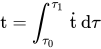
τ 0 . . τ 1 {\displaystyle \tau _{0}..\tau _{1}} {\displaystyle \tau _{0}..\tau _{1}} is t = ∫ τ 0 τ 1 t ˙ d τ {\displaystyle {\text{t}}=\int _{\tau _{0}}^{\tau _{1}}{\dot {\text{t}}}\,\mathrm {d} \tau } {\displaystyle {\text{t}}=\int _{\tau _{0}}^{\tau _{1}}{\dot {\text{t}}}\,\mathrm {d} \tau }

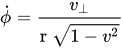
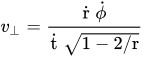
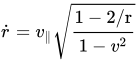
The local velocity v {\displaystyle v} {\displaystyle v} (relative to the main mass) and the coordinate celerity are related by

ϕ ˙ = v ⊥ r   1 − v 2 {\displaystyle {\dot {\phi }}={\frac {v_{\perp }}{{\text{r}}\ {\sqrt {1-v^{2}}}}}} {\displaystyle {\dot {\phi }}={\frac {v_{\perp }}{{\text{r}}\ {\sqrt {1-v^{2}}}}}} for the input and v ⊥ = r ˙   ϕ ˙ t ˙   1 − 2 / r {\displaystyle v_{\perp }={\frac {{\dot {\text{r}}}\ {\dot {\phi }}}{{\dot {\text{t}}}\ {\sqrt {1-2/{\text{r}}}}}}} {\displaystyle v_{\perp }={\frac {{\dot {\text{r}}}\ {\dot {\phi }}}{{\dot {\text{t}}}\ {\sqrt {1-2/{\text{r}}}}}}} for the output of the transverse ( ⊥ ) {\displaystyle (\perp )} {\displaystyle (\perp )} and

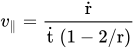
r ˙ = v ∥ 1 − 2 / r 1 − v 2 {\displaystyle {\dot {r}}=v_{\parallel }{\sqrt {\frac {1-2/{\text{r}}}{1-v^{2}}}}} {\displaystyle {\dot {r}}=v_{\parallel }{\sqrt {\frac {1-2/{\text{r}}}{1-v^{2}}}}} or the other way around v ∥ = r ˙ t ˙   ( 1 − 2 / r ) {\displaystyle v_{\parallel }={\frac {\dot {\text{r}}}{{\dot {\text{t}}}\ (1-2/{\text{r}})}}} {\displaystyle v_{\parallel }={\frac {\dot {\text{r}}}{{\dot {\text{t}}}\ (1-2/{\text{r}})}}} for the radial ( ∥ ) {\displaystyle (\parallel )} {\displaystyle (\parallel )} component of motion.

The shapiro-delayed velocity v {\displaystyle {\text{v}}} {\displaystyle {\text{v}}} in the bookeeper's frame of reference is

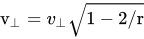
v ⊥ = v ⊥ 1 − 2 / r {\displaystyle {\text{v}}_{\perp }=v_{\perp }{\sqrt {1-2/{\text{r}}}}} {\displaystyle {\text{v}}_{\perp }=v_{\perp }{\sqrt {1-2/{\text{r}}}}} and v ∥ = v ∥ ( 1 − 2 / r ) {\displaystyle {\text{v}}_{\parallel }=v_{\parallel }(1-2/{\text{r}})} {\displaystyle {\text{v}}_{\parallel }=v_{\parallel }(1-2/{\text{r}})}

The initial conditions in terms of the local physical velocity v {\displaystyle v} {\displaystyle v} are therefore

r ˙ 0 = v 0 1 − 2 / r 0 sin ⁡ ( φ 0 ) 1 − v 0 2   ,     ϕ ˙ 0 = v 0 cos ⁡ ( φ 0 ) r 0 1 − v 0 2 {\displaystyle {\dot {\text{r}}}_{0}={\frac {v_{0}{\sqrt {1-2/{\text{r}}_{0}}}\sin(\varphi _{0})}{\sqrt {1-v_{0}^{2}}}}\ ,\ \ {\dot {\phi }}_{0}={\frac {v_{0}\cos(\varphi _{0})}{{\text{r}}_{0}{\sqrt {1-v_{0}^{2}}}}}} {\displaystyle {\dot {\text{r}}}_{0}={\frac {v_{0}{\sqrt {1-2/{\text{r}}_{0}}}\sin(\varphi _{0})}{\sqrt {1-v_{0}^{2}}}}\ ,\ \ {\dot {\phi }}_{0}={\frac {v_{0}\cos(\varphi _{0})}{{\text{r}}_{0}{\sqrt {1-v_{0}^{2}}}}}}

The horizontal and vertical components differ by a factor of 1 − 2 / r {\displaystyle {\sqrt {1-2/{\text{r}}}}} {\displaystyle {\sqrt {1-2/{\text{r}}}}}

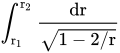
because additional to the gravitational time dilation there is also a radial length contraction of the same factor, which means that the physical distance between

r 1 {\displaystyle {\text{r}}_{1}} {\displaystyle {\text{r}}_{1}} and r 2 {\displaystyle {\text{r}}_{2}} {\displaystyle {\text{r}}_{2}} is not r 2 − r 1 {\displaystyle {\text{r}}_{2}-{\text{r}}_{1}} {\displaystyle {\text{r}}_{2}-{\text{r}}_{1}} but ∫ r 1 r 2 d r 1 − 2 / r {\displaystyle \int _{{\text{r}}_{1}}^{{\text{r}}_{2}}{\frac {\mathrm {d} {\text{r}}}{\sqrt {1-2/{\text{r}}}}}} {\displaystyle \int _{{\text{r}}_{1}}^{{\text{r}}_{2}}{\frac {\mathrm {d} {\text{r}}}{\sqrt {1-2/{\text{r}}}}}}

due to the fact that space around a mass is not euclidean, and a shell of a given diameter contains more volume when a central mass is present than in the absence of a such.

The angular momentum

L = r 2   ϕ ˙ = v ⊥   r / 1 − v 2 {\displaystyle {\text{L}}={\text{r}}^{2}\ {\dot {\phi }}=v_{\perp }\ {\rm {r}}/{\sqrt {1-v^{2}}}} {\displaystyle {\text{L}}={\text{r}}^{2}\ {\dot {\phi }}=v_{\perp }\ {\rm {r}}/{\sqrt {1-v^{2}}}}

in units of m {\displaystyle {\text{m}}} {\displaystyle {\text{m}}} and the total energy as the sum of rest-, kinetic- and potential energy

E = 1 + E k i n + E p o t = t ˙   ( 1 − 2 r ) = 1 − 2 / r 1 − v 2 {\displaystyle {\text{E}}=1+{\text{E}}_{\rm {kin}}+{\text{E}}_{\rm {pot}}={\dot {\text{t}}}\ \left(1-{\frac {2}{\text{r}}}\right)={\frac {\sqrt {1-2/{\text{r}}}}{\sqrt {1-v^{2}}}}} {\displaystyle {\text{E}}=1+{\text{E}}_{\rm {kin}}+{\text{E}}_{\rm {pot}}={\dot {\text{t}}}\ \left(1-{\frac {2}{\text{r}}}\right)={\frac {\sqrt {1-2/{\text{r}}}}{\sqrt {1-v^{2}}}}}

in units of mc 2 {\displaystyle {\text{mc}}^{2}} {\displaystyle {\text{mc}}^{2}}, where m {\displaystyle {\text{m}}} {\displaystyle {\text{m}}} is the test particle's restmass, are the constants of motion. The components of the total energy are

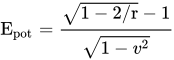
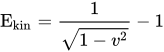
E k i n = 1 1 − v 2 − 1 {\displaystyle {\text{E}}_{\rm {kin}}={\frac {1}{\sqrt {1-v^{2}}}}-1} {\displaystyle {\text{E}}_{\rm {kin}}={\frac {1}{\sqrt {1-v^{2}}}}-1} for the kinetic plus E p o t = 1 − 2 / r − 1 1 − v 2 {\displaystyle {\text{E}}_{\rm {pot}}={\frac {{\sqrt {1-2/{\text{r}}}}-1}{\sqrt {1-v^{2}}}}} {\displaystyle {\text{E}}_{\rm {pot}}={\frac {{\sqrt {1-2/{\text{r}}}}-1}{\sqrt {1-v^{2}}}}} for the potential energy plus m = 1 {\displaystyle {\text{m}}=1} {\displaystyle {\text{m}}=1}, the test particle's invariant rest mass.
The equations of motion in terms of E {\displaystyle {\text{E}}} {\displaystyle {\text{E}}} and L {\displaystyle {\text{L}}} {\displaystyle {\text{L}}} are

r ˙ = ξ   ,     ϕ ˙ = L m   r 2   ,     t ˙ = E m   ( 1 − 2 / r ) {\displaystyle {\dot {\rm {r}}}=\xi \ ,\ \ {\dot {\phi }}={\frac {\text{L}}{{\text{m}}\ {\text{r}}^{2}}}\ ,\ \ {\dot {\text{t}}}={\frac {\text{E}}{{\text{m}}\ (1-2/{\text{r}})}}} {\displaystyle {\dot {\rm {r}}}=\xi \ ,\ \ {\dot {\phi }}={\frac {\text{L}}{{\text{m}}\ {\text{r}}^{2}}}\ ,\ \ {\dot {\text{t}}}={\frac {\text{E}}{{\text{m}}\ (1-2/{\text{r}})}}}

or, differentiated by the coordinate time t {\displaystyle {\text{t}}} {\displaystyle {\text{t}}}

r ¯ = ξ   ,     ϕ ¯ = ( 1 − 2 / r )   L E   r 2   ,     τ ¯ = 1 / t ˙ {\displaystyle {\bar {\text{r}}}=\xi \ ,\ \ {\bar {\phi }}={\frac {(1-2/{\text{r}})\ {\text{L}}}{{\text{E}}\ {\text{r}}^{2}}}\ ,\ \ {\bar {\tau }}=1/{\dot {\text{t}}}} {\displaystyle {\bar {\text{r}}}=\xi \ ,\ \ {\bar {\phi }}={\frac {(1-2/{\text{r}})\ {\text{L}}}{{\text{E}}\ {\text{r}}^{2}}}\ ,\ \ {\bar {\tau }}=1/{\dot {\text{t}}}}

with

ξ = ± E 2   r 4 L 2 − ( 1 − 2 r ) ( m 2   r 4 L 2 + r 2 ) {\displaystyle \xi =\pm {\sqrt {{\frac {{\text{E}}^{2}\ {\text{r}}^{4}}{{\text{L}}^{2}}}-\left(1-{\frac {2}{\text{r}}}\right)\left({\frac {{\text{m}}^{2}\ {\text{r}}^{4}}{{\text{L}}^{2}}}+{\text{r}}^{2}\right)}}} {\displaystyle \xi =\pm {\sqrt {{\frac {{\text{E}}^{2}\ {\text{r}}^{4}}{{\text{L}}^{2}}}-\left(1-{\frac {2}{\text{r}}}\right)\left({\frac {{\text{m}}^{2}\ {\text{r}}^{4}}{{\text{L}}^{2}}}+{\text{r}}^{2}\right)}}}

where in contrast to the overdot, which stands for x ˙ = d x / d τ {\displaystyle {\dot {x}}={\rm {d}}x/{\rm {d}}{\tau }} {\displaystyle {\dot {x}}={\rm {d}}x/{\rm {d}}{\tau }}, the overbar denotes x ¯ = d x / d t {\displaystyle {\bar {x}}={\rm {d}}x/{\rm {d}}{\text{t}}} {\displaystyle {\bar {x}}={\rm {d}}x/{\rm {d}}{\text{t}}}.

For massless particles like photons m / 1 − v 2 {\displaystyle {\rm {m}}/{\sqrt {1-v^{2}}}} {\displaystyle {\rm {m}}/{\sqrt {1-v^{2}}}} in the formula for E {\displaystyle {\rm {E}}} {\displaystyle {\rm {E}}} and L {\displaystyle {\rm {L}}} {\displaystyle {\rm {L}}} is replaced with h   f {\displaystyle {\rm {h\ f}}} {\displaystyle {\rm {h\ f}}} and the m {\displaystyle {\rm {m}}} {\displaystyle {\rm {m}}} in the equations of motion set to 1 {\displaystyle 1} {\displaystyle 1}, with h {\displaystyle {\rm {h}}} {\displaystyle {\rm {h}}} as Planck's constant and f {\displaystyle {\rm {f}}} {\displaystyle {\rm {f}}} for the photon's frequency.

Lisanslama

Ben, bu işin telif sahibi, burada işi aşağıdaki lisans altında yayımlıyorum:
w:tr:Creative Commons
atıf benzer paylaşım
Bu dosya, Creative Commons Atıf-Benzer Paylaşım 4.0 Uluslararası lisansı ile lisanslanmıştır.
Şu seçeneklerde özgürsünüz:
  • paylaşım – eser paylaşımı, dağıtımı ve iletimi
  • içeriği değiştirip uyarlama – eser adaptasyonu
Aşağıdaki koşullar geçerli olacaktır:
  • atıf – Esere yazar veya lisans sahibi tarafından belirtilen (ancak sizi ya da eseri kullanımınızı desteklediklerini ileri sürmeyecek bir) şekilde atıfta bulunmalısınız.
  • benzer paylaşım – Maddeyi yeniden düzenler, dönüştürür veya inşa ederseniz, katkılarınızı özgünüyle aynı veya uyumlu lisans altında dağıtmanız gerekir.
https://creativecommons.org/licenses/by-sa/4.0CC BY-SA 4.0 Creative Commons Attribution-Share Alike 4.0 truetrue

References

  1. ↑ Cole Miller for the Department of Astronomy, University of Maryland: ASTR 498, High Energy Astrophysics

Usage in Wikipedia Articles

en.wikipedia.org

  • Schwarzschild metric
  • Schwarzschild geodesics
  • Two-body problem in general relativity

de.wikipedia.org

  • Apsidendrehung
  • Schwarzschild-Metrik

ru.wikipedia.org

  • Метрика Шварцшильда
  • Задача Кеплера в относительности

es.wikipedia.org

  • La relatividad general

zh.wikipedia.org

  • 史瓦西度規

Altyazılar

Bu dosyanın temsil ettiği şeyin tek satırlık açıklamasını ekleyin.
orbit aroud a central mass, comparison Newton vs Einstein

Bu dosyada gösterilen öğeler

betimlenen

yaratıcı

Vikiveri ögesi olmayan bir değer

Wikimedia kullanıcı adı: Yukterez
bağlantısı olmayan yazarı: Yukterez (Simon Tyran, Vienna)
URL: https://commons.wikimedia.org/wiki/user:Yukterez

telif hakkı durumu

telif hakkı alınmış

telif hakkı lisansı

Creative Commons Atıf-BenzerPaylaşım 4.0 Uluslararası

kuruluşu

21 Mayıs 2016

dosya kaynağı

yükleyicinin orijinal eseri

ortam türü

image/gif

Dosya geçmişi

Dosyanın herhangi bir zamandaki hâli için ilgili tarih/saat kısmına tıklayın.

Tarih/SaatKüçük resimBoyutlarKullanıcıYorum
güncel18.47, 30 Eylül 202118.47, 30 Eylül 2021 tarihindeki sürümün küçültülmüş hâli800 × 526 (2,17 MB)Yukterezrevert vandalism
15.03, 14 Mart 202015.03, 14 Mart 2020 tarihindeki sürümün küçültülmüş hâli777 × 514 (7,97 MB)Bürgerentscheidframes reduced and slightly resized to fit 100 MP limit
19.36, 11 Temmuz 201819.36, 11 Temmuz 2018 tarihindeki sürümün küçültülmüş hâli800 × 526 (2,17 MB)Yukterezchoosing dt/dτ instead of dτ/dt for the time dilation factor to fit existing conventions
08.31, 13 Şubat 201708.31, 13 Şubat 2017 tarihindeki sürümün küçültülmüş hâli800 × 526 (2,17 MB)Yukterezreduced filesize by 1MB by reducing the colors
08.15, 13 Şubat 201708.15, 13 Şubat 2017 tarihindeki sürümün küçültülmüş hâli800 × 526 (3,1 MB)YukterezUser created page with UploadWizard

Dosya kullanımı

Bu görüntü dosyasına bağlanan sayfa yok.

Küresel dosya kullanımı

Aşağıdaki diğer vikiler bu dosyayı kullanmaktadır:

  • ca.wikipedia.org üzerinde kullanımı
    • Geodèsica de Schwarzschild
  • de.wikipedia.org üzerinde kullanımı
    • Schwarzschild-Metrik
    • Zweikörperproblem in der Allgemeinen Relativitätstheorie
  • en.wikipedia.org üzerinde kullanımı
    • Schwarzschild metric
    • Schwarzschild geodesics
    • Two-body problem in general relativity
  • ko.wikipedia.org üzerinde kullanımı
    • 일반 상대성이론의 이체 문제
    • 슈바르츠실트 측지선
  • pt.wikipedia.org üzerinde kullanımı
    • Problema de dois corpos em relatividade geral

Üstveri

Bu dosyada, muhtemelen fotoğraf makinesi ya da tarayıcı tarafından eklenmiş ek bilgiler mevcuttur. Eğer dosyada sonradan değişiklik yapıldıysa, bazı bilgiler yeni değişikliğe göre eski kalmış olabilir.

Kullanılan yazılımAdobe Photoshop CC (Windows)
"https://tr.wikipedia.org/wiki/Dosya:Newton_versus_Schwarzschild_trajectories.gif" sayfasından alınmıştır
  • Gizlilik politikası
  • Vikipedi hakkında
  • Sorumluluk reddi
  • Davranış Kuralları
  • Geliştiriciler
  • İstatistikler
  • Çerez politikası
  • Mobil görünüm
  • Wikimedia Foundation
  • Powered by MediaWiki
Dosya:Newton versus Schwarzschild trajectories.gif
Konu ekle