Equations
Line-element in Boyer-Lindquist-coordinates:
d
τ
2
=
(
1
−
2
r
−
℧
2
Σ
)
d
t
2
−
Σ
Δ
d
r
2
−
Σ
d
θ
2
−
χ
Σ
sin
2
θ
d
ϕ
2
+
2
Λ
Σ
d
t
d
ϕ
{\displaystyle {\rm {d\tau ^{2}\ =\ \left(1-{\frac {2r-\mho ^{2}}{\Sigma }}\right)\mathrm {d} t^{2}\ -\ {\frac {\Sigma }{\Delta }}\ \mathrm {d} r^{2}\ -\ \Sigma \ d\theta ^{2}\ -\ {\frac {\chi }{\Sigma }}\ \sin ^{2}\theta \ d\phi ^{2}\ +\ 2\ {\frac {\Lambda }{\Sigma }}\ dt\ d\phi }}}
Shorthand terms:
Δ
=
r
2
−
2
r
+
a
2
+
℧
2
,
Σ
=
r
2
+
a
2
cos
2
θ
,
χ
=
(
a
2
+
r
2
)
2
−
a
2
sin
2
θ
Δ
,
Λ
=
a
(
2
r
−
℧
2
)
sin
2
θ
{\displaystyle {\rm {\Delta =r^{2}-2r+a^{2}+\mho ^{2}\ ,\ \Sigma =r^{2}+a^{2}\ \cos ^{2}\theta \ ,\ \chi =(a^{2}+r^{2})^{2}-a^{2}\ \sin ^{2}\theta \ \Delta \ ,\ \ \Lambda =a\ (2r-\mho ^{2})\ \sin ^{2}\theta }}}
with the dimensionless spin parameter a=Jc/G/M² and the dimensionless electric charge parameter ℧=Q ₑ/M·√(K/G). Here G=M=c=K=1 so that a=J und ℧=Q ₑ, with lengths in GM/c² and times in GM/c³.
Co- and contravariant metric:
g
μ
ν
=
(
1
−
2
r
−
℧
2
Σ
0
0
Λ
Σ
0
−
Σ
Δ
0
0
0
0
−
Σ
0
Λ
Σ
0
0
−
χ
sin
2
θ
Σ
)
→
g
μ
ν
=
(
χ
Δ
Σ
0
0
−
a
(
℧
2
−
2
r
)
Σ
(
℧
2
−
2
r
+
Σ
)
χ
−
a
Λ
0
−
Δ
Σ
0
0
0
0
−
1
Σ
0
−
a
(
℧
2
−
2
r
)
Σ
(
℧
2
−
2
r
+
Σ
)
χ
−
a
Λ
0
0
−
Δ
−
a
2
sin
2
θ
Δ
Σ
sin
2
θ
)
{\displaystyle {g_{\mu \nu }={\rm {\left({\begin{array}{cccc}{\rm {1-{\frac {2r-\mho ^{2}}{\Sigma }}}}&0&0&{\frac {\Lambda }{\Sigma }}\\0&{\rm {-{\frac {\Sigma }{\Delta }}}}&0&0\\0&0&{\rm {-\Sigma }}&0\\{\frac {\Lambda }{\Sigma }}&0&0&-{\frac {\chi \sin ^{2}\theta }{\Sigma }}\ \end{array}}\right)}}\ \to \ g^{\mu \nu }={\rm {\left({\begin{array}{cccc}{\rm {\frac {\chi }{\Delta \Sigma }}}&0&0&{\rm {-{\frac {a\left({\rm {\mho ^{2}-2r}}\right)\Sigma }{\rm {\left({\rm {\mho ^{2}-2r+\Sigma }}\right)\chi -a\Lambda }}}}}\\0&{\rm {-{\frac {\Delta }{\Sigma }}}}&0&0\\0&0&{\rm {-{\frac {1}{\Sigma }}}}&0\\{\rm {-{\frac {a\left({\rm {\mho ^{2}-2r}}\right)\Sigma }{\rm {\left({\rm {\mho ^{2}-2r+\Sigma }}\right)\chi -a\Lambda }}}}}&0&0&{\rm {-{\frac {\Delta -a^{2}\sin ^{2}\theta }{\Delta \Sigma \sin ^{2}\theta }}}}\\\end{array}}\right)}}}}
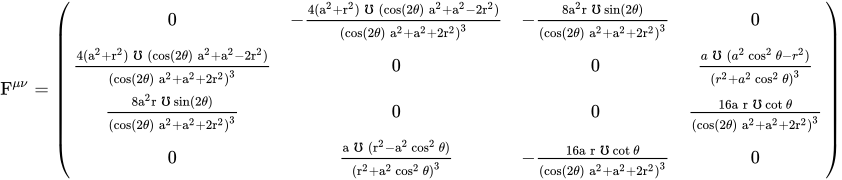
Contravariant Maxwell tensor:
F
μ
ν
=
(
0
−
4
(
a
2
+
r
2
)
℧
(
cos
(
2
θ
)
a
2
+
a
2
−
2
r
2
)
(
cos
(
2
θ
)
a
2
+
a
2
+
2
r
2
)
3
−
8
a
2
r
℧
sin
(
2
θ
)
(
cos
(
2
θ
)
a
2
+
a
2
+
2
r
2
)
3
0
4
(
a
2
+
r
2
)
℧
(
cos
(
2
θ
)
a
2
+
a
2
−
2
r
2
)
(
cos
(
2
θ
)
a
2
+
a
2
+
2
r
2
)
3
0
0
a
℧
(
a
2
cos
2
θ
−
r
2
)
(
r
2
+
a
2
cos
2
θ
)
3
8
a
2
r
℧
sin
(
2
θ
)
(
cos
(
2
θ
)
a
2
+
a
2
+
2
r
2
)
3
0
0
16
a
r
℧
cot
θ
(
cos
(
2
θ
)
a
2
+
a
2
+
2
r
2
)
3
0
a
℧
(
r
2
−
a
2
cos
2
θ
)
(
r
2
+
a
2
cos
2
θ
)
3
−
16
a
r
℧
cot
θ
(
cos
(
2
θ
)
a
2
+
a
2
+
2
r
2
)
3
0
)
{\displaystyle {\rm {F}}^{\mu \nu }=\left({\begin{array}{cccc}0&-{\frac {\rm {4(a^{2}+r^{2})\ \mho \ (\cos(2\theta )\ a^{2}+a^{2}-2r^{2})}}{\rm {(\cos(2\theta )\ a^{2}+a^{2}+2r^{2})^{3}}}}&-{\frac {\rm {8a^{2}r\ \mho \sin(2\theta )}}{\rm {(\cos(2\theta )\ a^{2}+a^{2}+2r^{2})^{3}}}}&0\\{\frac {\rm {4(a^{2}+r^{2})\ \mho \ (\cos(2\theta )\ a^{2}+a^{2}-2r^{2})}}{\rm {(\cos(2\theta )\ a^{2}+a^{2}+2r^{2})^{3}}}}&0&0&{\frac {a\ \mho \ (a^{2}\cos ^{2}\theta -r^{2})}{(r^{2}+a^{2}\cos ^{2}\theta )^{3}}}\\{\frac {\rm {8a^{2}r\ \mho \sin(2\theta )}}{\rm {(\cos(2\theta )\ a^{2}+a^{2}+2r^{2})^{3}}}}&0&0&{\frac {\rm {16a\ r\ \mho \cot \theta }}{\rm {(\cos(2\theta )\ a^{2}+a^{2}+2r^{2})^{3}}}}\\0&{\frac {\rm {a\ \mho \ (r^{2}-a^{2}\cos ^{2}\theta )}}{\rm {(r^{2}+a^{2}\cos ^{2}\theta )^{3}}}}&-{\frac {\rm {16a\ r\ \mho \cot \theta }}{\rm {(\cos(2\theta )\ a^{2}+a^{2}+2r^{2})^{3}}}}&0\\\end{array}}\right)}
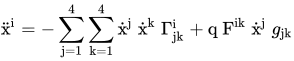
The coordinate acceleration of a test-particle with the specific charge q is given by
x
¨
i
=
−
∑
j
=
1
4
∑
k
=
1
4
x
˙
j
x
˙
k
Γ
j
k
i
+
q
F
i
k
x
˙
j
g
j
k
{\displaystyle {\rm {{\ddot {x}}^{i}=-\sum _{j=1}^{4}\sum _{k=1}^{4}{\dot {x}}^{j}\ {\dot {x}}^{k}\ \Gamma _{jk}^{i}+q\ {F^{ik}}\ {{\dot {x}}^{j}}}}\ {g_{\rm {jk}}}}
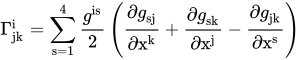
with the Christoffel-symbols
Γ
j
k
i
=
∑
s
=
1
4
g
i
s
2
(
∂
g
s
j
∂
x
k
+
∂
g
s
k
∂
x
j
−
∂
g
j
k
∂
x
s
)
{\displaystyle \Gamma _{\rm {jk}}^{\rm {i}}=\sum _{\rm {s=1}}^{4}{\frac {g^{\rm {is}}}{2}}\left({\frac {\partial {g}_{\rm {sj}}}{\partial {\rm {x^{k}}}}}+{\frac {\partial {g}_{\rm {sk}}}{\partial {\rm {x^{j}}}}}-{\frac {\partial {g}_{\rm {jk}}}{\partial {\rm {x^{s}}}}}\right)}
So the second proper time derivatives are
t
¨
=
−
(
a
2
θ
˙
(
sin
(
2
θ
)
(
q
℧
r
+
(
℧
2
−
2
r
)
t
˙
)
−
2
a
sin
3
θ
cos
θ
(
℧
2
−
2
r
)
ϕ
˙
)
+
{\displaystyle {\rm {{\ddot {t}}=-(a^{2}\ {\dot {\theta }}\ (\sin(2\theta )(q\ \mho \ r+(\mho ^{2}-2r)\ {\dot {t}})-2a\sin ^{3}\theta \cos \theta \ (\mho ^{2}-2r)\ {\dot {\phi }})+}}}
(
r
˙
(
(
a
2
+
r
2
)
(
a
2
cos
2
θ
(
q
℧
−
2
t
˙
)
+
r
(
2
(
r
−
℧
2
)
t
˙
−
q
℧
r
)
)
+
a
sin
2
θ
ϕ
˙
(
2
a
4
cos
2
θ
+
{\displaystyle {\rm {({\dot {r}}\ ((a^{2}+r^{2})(a^{2}\cos ^{2}\theta \ (q\mho -2{\dot {t}})+r(2\ (r-\mho ^{2}){\dot {t}}-q\ \mho \ r))+a\sin ^{2}\theta \ {\dot {\phi }}\ (2a^{4}\cos ^{2}\theta +}}}
a
2
℧
2
r
(
cos
(
2
θ
)
+
3
)
−
a
2
r
2
(
cos
(
2
θ
)
+
3
)
+
4
℧
2
r
3
−
6
r
4
)
)
)
/
(
a
2
+
(
r
−
2
)
r
+
℧
2
)
)
/
(
(
a
2
cos
2
θ
+
r
2
)
2
)
{\displaystyle {\rm {a^{2}\mho ^{2}r\ (\cos(2\theta )+3)-a^{2}r^{2}(\cos(2\theta )+3)+4\mho ^{2}r^{3}-6r^{4})))/(a^{2}+(r-2)r+\mho ^{2}))/((a^{2}\cos ^{2}\theta +r^{2})^{2})}}}
for the time component,
r
¨
=
(
a
2
θ
˙
sin
(
2
θ
)
r
˙
)
/
(
a
2
cos
2
θ
+
r
2
)
+
r
˙
2
(
(
r
−
1
)
/
(
a
2
+
(
r
−
2
)
r
+
℧
2
)
−
r
/
(
a
2
cos
2
θ
+
r
2
)
)
+
{\displaystyle {\rm {{\ddot {r}}=(a^{2}{\dot {\theta }}\sin(2\theta )\ {\dot {r}})/(a^{2}\cos ^{2}\theta +r^{2})+{\dot {r}}^{2}((r-1)/(a^{2}+(r-2)\ r+\mho ^{2})-r/(a^{2}\cos ^{2}\theta +r^{2}))+}}}
(
(
a
2
+
(
r
−
2
)
r
+
℧
2
)
(
8
a
sin
2
θ
ϕ
˙
(
a
2
cos
2
θ
(
q
℧
−
2
t
˙
)
+
r
(
2
(
r
−
℧
2
)
t
˙
−
q
℧
r
)
)
+
{\displaystyle {\rm {((a^{2}+(r-2)\ r+\mho ^{2})(8a\sin ^{2}\theta \ {\dot {\phi }}\ (a^{2}\cos ^{2}\theta \ (q\ \mho -2{\dot {t}})+r(2(r-\mho ^{2}){\dot {t}}-q\ \mho \ r))+}}}
8
t
˙
(
a
2
cos
2
θ
(
t
˙
−
q
℧
)
+
r
(
q
℧
r
+
(
℧
2
−
r
)
t
˙
)
)
+
8
r
θ
˙
2
(
a
2
cos
2
θ
+
r
2
)
2
+
{\displaystyle {\rm {8{\dot {t}}\ (a^{2}\cos ^{2}\theta \ ({\dot {t}}-q\ \mho )+r\ (q\ \mho \ r+(\mho ^{2}-r)\ {\dot {t}}))+8r\ {\dot {\theta }}^{2}\ (a^{2}\cos ^{2}\theta +r^{2})^{2}+}}}
sin
2
θ
ϕ
˙
2
(
2
a
4
sin
2
(
2
θ
)
+
r
(
a
2
(
a
2
cos
(
4
θ
)
+
3
a
2
+
4
(
a
−
℧
)
(
a
+
℧
)
cos
(
2
θ
)
+
4
℧
2
)
+
{\displaystyle {\rm {\sin ^{2}\theta \ {\dot {\phi }}^{2}\ (2a^{4}\sin ^{2}(2\theta )+r\ (a^{2}(a^{2}\cos(4\theta )+3a^{2}+4\ (a-\mho )(a+\mho )\cos(2\theta )+4\mho ^{2})+}}}
8
r
(
−
a
2
sin
2
θ
+
2
a
2
r
cos
2
θ
+
r
3
)
)
)
)
)
/
(
8
(
a
2
cos
2
θ
+
r
2
)
3
)
{\displaystyle {\rm {8r\ (-a^{2}\sin ^{2}\theta +2a^{2}r\cos ^{2}\theta +r^{3})))))/(8\ (a^{2}\cos ^{2}\theta +r^{2})^{3})}}}
for the radial component,
θ
¨
=
−
(
2
r
θ
˙
r
˙
)
/
(
a
2
cos
2
θ
+
r
2
)
−
(
a
2
sin
θ
cos
θ
r
˙
2
)
/
(
(
a
2
+
(
r
−
2
)
r
+
{\displaystyle {\rm {{\ddot {\theta }}=-(2r\ {\dot {\theta }}\ {\dot {r}})/(a^{2}\cos ^{2}\theta +r^{2})-(a^{2}\sin \theta \cos \theta \ {\dot {r}}^{2})/((a^{2}+(r-2)\ r+}}}
℧
2
)
(
a
2
cos
2
θ
+
r
2
)
)
+
(
sin
(
2
θ
)
(
a
2
(
8
θ
˙
2
(
a
2
cos
2
θ
+
r
2
)
2
−
8
t
˙
(
2
q
℧
r
+
{\displaystyle {\rm {\mho ^{2})(a^{2}\cos ^{2}\theta +r^{2}))+(\sin(2\theta )(a^{2}(8{\dot {\theta }}^{2}(a^{2}\cos ^{2}\theta +r^{2})^{2}-8{\dot {t}}(2q\ \mho \ r+}}}
(
℧
2
−
2
r
)
t
˙
)
)
+
16
a
(
a
2
+
r
2
)
ϕ
˙
(
q
℧
r
+
(
℧
2
−
2
r
)
t
˙
)
+
ϕ
˙
2
(
3
a
6
+
11
a
4
r
2
+
10
a
4
r
−
{\displaystyle {\rm {(\mho ^{2}-2r)\ {\dot {t}}))+16a\ (a^{2}+r^{2})\ {\dot {\phi }}(q\ \mho \ r+(\mho ^{2}-2r)\ {\dot {t}})+{\dot {\phi }}^{2}(3a^{6}+11a^{4}r^{2}+10a^{4}r-}}}
5
a
4
℧
2
+
4
a
2
(
a
2
+
2
r
2
)
cos
(
2
θ
)
(
a
2
+
(
r
−
2
)
r
+
℧
2
)
−
8
a
2
℧
2
r
2
+
16
a
2
r
4
+
16
a
2
r
3
+
a
4
cos
(
4
θ
)
(
a
2
+
{\displaystyle {\rm {5a^{4}\mho ^{2}+4a^{2}(a^{2}+2r^{2})\cos(2\theta )(a^{2}+(r-2)r+\mho ^{2})-8a^{2}\mho ^{2}r^{2}+16a^{2}r^{4}+16a^{2}r^{3}+a^{4}\cos(4\theta )(a^{2}+}}}
(
r
−
2
)
r
+
℧
2
)
+
8
r
6
)
)
)
/
(
16
(
a
2
cos
2
θ
+
r
2
)
3
)
{\displaystyle {\rm {(r-2)r+\mho ^{2})+8r^{6})))/(16(a^{2}\cos ^{2}\theta +r^{2})^{3})}}}
the poloidial component and
ϕ
¨
=
−
(
(
r
˙
(
4
a
q
℧
(
a
2
cos
2
θ
−
r
2
)
−
8
a
t
˙
(
a
2
cos
2
θ
+
r
(
℧
2
−
r
)
)
+
ϕ
˙
(
2
a
4
sin
2
(
2
θ
)
+
{\displaystyle {\rm {{\ddot {\phi }}=-(({\dot {r}}(4a\ q\ \mho \ (a^{2}\cos ^{2}\theta -r^{2})-8a\ {\dot {t}}(a^{2}\cos ^{2}\theta +r\ (\mho ^{2}-r))+{\dot {\phi }}\ (2a^{4}\sin ^{2}(2\theta )+}}}
8
r
3
(
a
2
cos
(
2
θ
)
+
a
2
+
℧
2
)
+
a
2
r
(
a
2
(
4
cos
(
2
θ
)
+
cos
(
4
θ
)
)
+
3
a
2
+
8
℧
2
)
−
4
a
2
r
2
(
cos
(
2
θ
)
+
3
)
+
8
r
5
−
16
r
4
)
)
)
/
(
a
2
+
{\displaystyle {\rm {8r^{3}(a^{2}\cos(2\theta )+a^{2}+\mho ^{2})+a^{2}r\ (a^{2}(4\cos(2\theta )+\cos(4\theta ))+3a^{2}+8\mho ^{2})-4a^{2}r^{2}(\cos(2\theta )+3)+8r^{5}-16r^{4})))/(a^{2}+}}}
(
r
−
2
)
r
+
℧
2
)
+
θ
˙
(
ϕ
˙
(
a
4
(
−
sin
(
4
θ
)
)
−
2
a
2
sin
(
2
θ
)
(
3
a
2
+
4
(
r
−
1
)
r
+
2
℧
2
)
+
8
(
a
2
+
r
2
)
2
cot
θ
)
+
{\displaystyle {\rm {(r-2)\ r+\mho ^{2})+{\dot {\theta }}\ ({\dot {\phi }}\ (a^{4}(-\sin(4\theta ))-2a^{2}\sin(2\theta )(3a^{2}+4(r-1)r+2\mho ^{2})+8\ (a^{2}+r^{2})^{2}\cot \theta )+}}}
8
a
cot
θ
(
q
℧
r
+
(
℧
2
−
2
r
)
t
˙
)
)
)
/
(
4
(
a
2
cos
2
θ
+
r
2
)
2
)
{\displaystyle {\rm {8a\cot \theta \ (q\ \mho \ r+(\mho ^{2}-2r)\ {\dot {t}})))/(4(a^{2}\cos ^{2}\theta +r^{2})^{2})}}}
for the axial component of the 4-acceleration. The total time dilation is
t
˙
{\displaystyle {\rm {\dot {t}}}}
=
csc
2
θ
(
L
z
(
a
Δ
sin
2
θ
−
a
(
a
2
+
r
2
)
sin
2
θ
)
−
q
℧
r
(
a
2
+
r
2
)
sin
2
θ
+
E
(
(
a
2
+
r
2
)
2
sin
2
θ
−
a
2
Δ
sin
4
θ
)
)
Δ
Σ
{\displaystyle {\rm {={\frac {\csc ^{2}\theta \ ({L_{z}}(a\ \Delta \sin ^{2}\theta -a\ (a^{2}+r^{2})\sin ^{2}\theta )-q\ \mho \ r\ (a^{2}+r^{2})\sin ^{2}\theta +E((a^{2}+r^{2})^{2}\sin ^{2}\theta -a^{2}\Delta \sin ^{4}\theta ))}{\Delta \Sigma }}}}}
=
a
(
L
z
−
a
E
sin
2
θ
)
+
(
r
2
+
a
2
)
P
/
Δ
Σ
{\displaystyle {\rm {={\frac {a(L_{z}-aE\sin ^{2}\theta )+(r^{2}+a^{2})P/\Delta }{\Sigma }}}}}
where the differentiation goes by the proper time τ for charged (q≠0) and neutral (q=0) particles (μ=-1, v<1), and for massless particles (μ=0, v=1) by the spatial affine parameter ŝ. The relation between the first proper time derivatives and the local three-velocity components relative to a ZAMO is
r
˙
=
v
r
Δ
Σ
(
1
−
μ
2
v
2
)
=
S
i
g
n
(
v
r
)
V
r
Σ
θ
˙
=
v
θ
Σ
(
1
−
μ
2
v
2
)
=
S
i
g
n
(
v
θ
)
V
θ
Σ
{\displaystyle {\rm {{\dot {r}}={\frac {v_{r}{\sqrt {\Delta }}}{\sqrt {\Sigma (1-\mu ^{2}v^{2})}}}}}={\frac {{\rm {Sign}}({\rm {v_{r}){\sqrt {\rm {V_{r}}}}}}}{\Sigma }}\ \ \ \ \ \ \ \ {\rm {{\dot {\theta }}={\frac {v_{\theta }}{\sqrt {\Sigma (1-\mu ^{2}v^{2})}}}={\frac {\rm {Sign(v_{\theta }){\sqrt {\rm {V_{\theta }}}}}}{\Sigma }}}}}
ϕ
˙
=
a
(
a
2
E
−
a
L
z
−
Δ
E
−
q
r
℧
+
E
r
2
)
+
Δ
L
z
csc
2
θ
Δ
Σ
{\displaystyle {\dot {\phi }}{\rm {={\frac {a\left(a^{2}E-aL_{z}-\Delta E-qr\mho +Er^{2}\right)+\Delta L_{z}\csc ^{2}\theta }{\Delta \Sigma }}}}}
The local three-velocity in terms of the position and the constants of motion is
v
=
|
−
a
2
L
z
2
Σ
2
(
℧
2
−
2
r
)
2
+
2
a
L
z
Σ
χ
(
2
r
−
℧
2
)
(
E
Σ
−
q
r
℧
)
+
χ
(
Δ
Σ
3
−
χ
(
E
Σ
−
q
r
℧
)
2
)
a
L
z
Σ
(
℧
2
−
2
r
)
+
χ
(
E
Σ
−
q
r
℧
)
|
{\displaystyle {\rm {v=\left|{\frac {\sqrt {-a^{2}L_{z}^{2}\Sigma ^{2}\left(\mho ^{2}-2r\right)^{2}+2aL_{z}\Sigma \chi \left(2r-\mho ^{2}\right)(E\Sigma -qr\mho )+\chi \left(\Delta \Sigma ^{3}-\chi (E\Sigma -qr\mho )^{2}\right)}}{aL_{z}\Sigma \left(\mho ^{2}-2r\right)+\chi (E\Sigma -qr\mho )}}\right|}}}
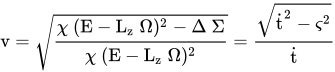
which reduces to
v
=
χ
(
E
−
L
z
Ω
)
2
−
Δ
Σ
χ
(
E
−
L
z
Ω
)
2
=
t
˙
2
−
ς
2
t
˙
{\displaystyle {\rm {v={\sqrt {\frac {\chi \ (E-L_{z}\ \Omega )^{2}-\Delta \ \Sigma }{\chi \ (E-L_{z}\ \Omega )^{2}}}}={\frac {\sqrt {{\dot {t}}^{2}-\varsigma ^{2}}}{\dot {t}}}}}}
if the charge of the test particle is q=0. The escape velocity of a charged particle with zero orbital angular momentum is
v
e
s
c
=
|
a
4
cos
4
θ
(
Δ
Σ
−
χ
)
+
2
a
2
r
cos
2
θ
(
q
χ
℧
+
Δ
r
Σ
−
r
χ
)
+
r
2
(
−
q
2
χ
℧
2
+
2
q
r
χ
℧
+
r
2
(
Δ
Σ
−
χ
)
)
χ
(
a
2
cos
2
θ
+
r
(
r
−
q
℧
)
)
|
{\displaystyle {\rm {v_{esc}=\left|{\frac {\sqrt {a^{4}\cos ^{4}\theta (\Delta \Sigma -\chi )+2a^{2}r\cos ^{2}\theta (q\chi \mho +\Delta r\Sigma -r\chi )+r^{2}\left(-q^{2}\chi \mho ^{2}+2qr\chi \mho +r^{2}(\Delta \Sigma -\chi )\right)}}{{\sqrt {\chi }}\left(a^{2}\cos ^{2}\theta +r(r-q\mho )\right)}}\right|}}}
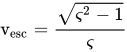
which for a neutral test particle with q=0 reduces to
v
e
s
c
=
ς
2
−
1
ς
{\displaystyle {\rm {v_{esc}}}={\frac {\sqrt {\varsigma ^{2}-1}}{\varsigma }}}
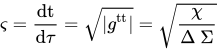
with the gravitational time dilation of a locally stationary ZAMO
ς
=
d
t
d
τ
=
|
g
t
t
|
=
χ
Δ
Σ
{\displaystyle \varsigma ={\frac {\rm {dt}}{\rm {d\tau }}}={\sqrt {|g^{\rm {tt}}|}}={\sqrt {\frac {\chi }{\Delta \ \Sigma }}}}
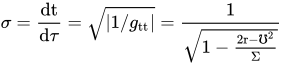
which is infinite at the horizon. The time dilation of a globally stationary particle (with respect to the fixed stars) is
σ
=
d
t
d
τ
=
|
1
/
g
t
t
|
=
1
1
−
2
r
−
℧
2
Σ
{\displaystyle \sigma ={\frac {\rm {dt}}{\rm {d\tau }}}={\sqrt {|1/g_{\rm {tt}}|}}={\frac {1}{\sqrt {1-{\frac {\rm {2r-\mho ^{2}}}{\Sigma }}}}}}
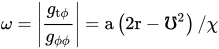
which is infinite at the ergosphere. The Frame-Dragging angular velocity observed at infinity is
ω
=
|
g
t
ϕ
g
ϕ
ϕ
|
=
a
(
2
r
−
℧
2
)
/
χ
{\displaystyle \omega =\left|{\frac {g_{\rm {t\phi }}}{g_{\phi \phi }}}\right|={\rm {a\left(2r-\mho ^{2}\right)/\chi }}}
The local frame dragging velocity with respect to the fixed stars is therefore
v
ϕ
=
g
t
ϕ
g
t
ϕ
=
1
−
g
t
t
g
t
t
=
|
g
t
ϕ
g
ϕ
ϕ
g
t
t
g
ϕ
ϕ
|
=
ω
R
¯
ϕ
ς
{\displaystyle v_{\phi }={\sqrt {g_{\rm {t\phi }}\ g^{\rm {t\phi }}}}={\sqrt {1-g_{\rm {tt}}\ g^{\rm {tt}}}}=|{\frac {g_{\rm {t\phi }}}{g_{\rm {\phi \phi }}}}{\sqrt {g^{\rm {tt}}}}\ {\sqrt {g_{\rm {\phi \phi }}}}|=\omega {\bar {\rm {R}}}_{\phi }\varsigma }
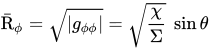
which is c at the ergosphere. The axial radius of gyration is
R
¯
ϕ
=
|
g
ϕ
ϕ
|
=
χ
Σ
sin
θ
{\displaystyle {\bar {\rm {R}}}_{\phi }={\sqrt {|g_{\phi \phi }|}}={\sqrt {\frac {\chi }{\Sigma }}}\ \sin \theta }
The 3 conserved quantities are 1) the total energy:
E
=
g
t
t
t
˙
+
g
t
ϕ
ϕ
˙
+
q
A
t
=
t
˙
(
1
−
2
r
−
℧
2
Σ
)
+
ϕ
˙
a
sin
2
θ
(
2
r
−
℧
2
)
Σ
+
℧
q
r
Σ
=
Δ
Σ
(
1
−
μ
2
v
2
)
χ
+
ω
L
z
+
℧
q
r
Σ
{\displaystyle {{\rm {E}}=g_{\rm {tt}}\ {\dot {\rm {t}}}+g_{\rm {t\phi }}\ {\rm {{\dot {\phi }}+{\rm {q\ A_{t}={\dot {t}}\left(1-{\frac {2r-\mho ^{2}}{\Sigma }}\right)+{\dot {\phi }}{\frac {a\sin ^{2}\theta \left(2r-\mho ^{2}\right)}{\Sigma }}+{\frac {\mho \ q\ r}{\Sigma }}={\rm {{\sqrt {\frac {\Delta \ \Sigma }{(1-\mu ^{2}v^{2})\ \chi }}}+\omega \ L_{z}+{\frac {\mho \ q\ r}{\Sigma }}}}}}}}}}
2) the axial angular momentum:
L
z
=
−
g
ϕ
ϕ
ϕ
˙
−
g
t
ϕ
t
˙
−
q
A
ϕ
=
ϕ
˙
χ
sin
2
θ
Σ
−
t
˙
a
sin
2
θ
(
2
r
−
Q
2
)
Σ
+
a
r
℧
q
sin
2
θ
Σ
=
v
ϕ
R
¯
ϕ
1
−
μ
2
v
2
+
(
1
−
μ
2
v
2
)
a
r
℧
q
sin
2
θ
Σ
{\displaystyle {\rm {L_{z}}}=-g_{\phi \phi }\ {\dot {\phi }}-g_{\rm {t\phi }}\ {\rm {{\dot {t}}-q\ A_{\phi }={\rm {{\frac {{\dot {\phi }}\ \chi \sin ^{2}\theta }{\Sigma }}-{\frac {{\dot {t}}\ a\ \sin ^{2}\theta \left(2r-Q^{2}\right)}{\Sigma }}+{\frac {a\ r\ \mho \ q\ \sin ^{2}\theta }{\Sigma }}}}={\frac {v_{\phi }\ {\bar {R}}_{\phi }}{\sqrt {1-\mu ^{2}\ v^{2}}}}+{\frac {(1-\mu ^{2}v^{2})\ a\ r\ \mho \ q\ \sin ^{2}\theta }{\Sigma }}}}}
3) the Carter constant:
Q
=
v
θ
2
Σ
1
−
μ
2
v
2
+
cos
2
θ
(
a
2
(
μ
2
−
E
2
)
+
L
z
2
sin
2
θ
)
{\displaystyle {\rm {Q={\frac {{v_{\theta }}^{2}\ \Sigma }{1-\mu ^{2}v^{2}}}+\cos ^{2}\theta \left(a^{2}(\mu ^{2}-E^{2})+{\frac {L_{z}^{2}}{\sin ^{2}\theta }}\right)}}}
The effective radial potential whose zero roots define the turning points is
V
r
=
P
2
−
Δ
(
(
L
z
−
a
E
)
2
+
Q
+
μ
2
r
2
)
{\displaystyle {\rm {V_{r}=P^{2}-\Delta \left((L_{z}-aE)^{2}+Q+\mu ^{2}r^{2}\right)}}}
and the poloidial potential
V
θ
=
v
θ
2
Σ
1
−
μ
2
v
2
=
Q
−
cos
2
θ
(
a
2
(
μ
2
−
E
2
)
+
L
z
2
sin
2
θ
)
{\displaystyle {\rm {V_{\theta }={\frac {{v_{\theta }}^{2}\ \Sigma }{1-\mu ^{2}v^{2}}}=Q-\cos ^{2}\theta \left(a^{2}\left(\mu ^{2}-E^{2}\right)+{\frac {\rm {L_{z}^{2}}}{\sin ^{2}\theta }}\right)}}}
with the parameter
P
=
E
(
a
2
+
r
2
)
−
a
L
z
+
q
r
℧
{\displaystyle {\rm {P=E\left(a^{2}+r^{2}\right)-aL_{z}+qr\mho }}}
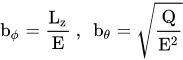
The azimutal and latitudinal impact parameters are
b
ϕ
=
L
z
E
,
b
θ
=
Q
E
2
{\displaystyle {\rm {b_{\phi }={\frac {L_{z}}{E}}\ ,\ \ b_{\theta }={\sqrt {\frac {Q}{E^{2}}}}}}}
The horizons and ergospheres have the Boyer-Lindquist-radius
r
H
±
=
1
±
1
−
a
2
−
℧
2
,
r
E
±
=
1
±
1
−
a
2
cos
2
θ
−
℧
2
{\displaystyle {\rm {r_{H}^{\pm }=1\pm {\sqrt {1-a^{2}-\mho ^{2}}}}}\ ,\ \ {\rm {r_{E}^{\pm }=1\pm {\sqrt {\rm {1-a^{2}\cos ^{2}\theta -\mho ^{2}}}}}}}
In this article the total mass equivalent M, which also contains the rotational and the electrical field energy, is set to 1; the relation of M with the irreducible mass is
M
i
r
r
=
2
M
2
−
℧
2
+
2
M
M
2
−
℧
2
−
a
2
2
→
M
=
16
M
i
r
r
4
+
8
M
i
r
r
2
℧
2
+
℧
4
16
M
i
r
r
2
−
4
a
2
{\displaystyle {\rm {M_{\rm {irr}}={\frac {\sqrt {2M^{2}-\mho ^{2}+2M{\sqrt {M^{2}-\mho ^{2}-a^{2}}}}}{2}}\ \to \ M={\sqrt {\frac {16M_{\rm {irr}}^{4}+8M_{\rm {irr}}^{2}\ \mho ^{2}+\mho ^{4}}{16M_{\rm {irr}}^{2}-4a^{2}}}}}}}
where a is in units of M.
Lisanslama
Ben, bu işin telif sahibi, burada işi aşağıdaki lisans altında yayımlıyorum:
Şu seçeneklerde özgürsünüz:
paylaşım – eser paylaşımı, dağıtımı ve iletimiiçeriği değiştirip uyarlama – eser adaptasyonu
Aşağıdaki koşullar geçerli olacaktır:
atıf – Esere yazar veya lisans sahibi tarafından belirtilen (ancak sizi ya da eseri kullanımınızı desteklediklerini ileri sürmeyecek bir) şekilde atıfta bulunmalısınız.benzer paylaşım – Maddeyi yeniden düzenler, dönüştürür veya inşa ederseniz, katkılarınızı özgünüyle aynı veya uyumlu lisans altında dağıtmanız gerekir. https://creativecommons.org/licenses/by-sa/4.0 CC BY-SA 4.0 Creative Commons Attribution-Share Alike 4.0 true true Türkçe Bu dosyanın temsil ettiği şeyin tek satırlık açıklamasını ekleyin.
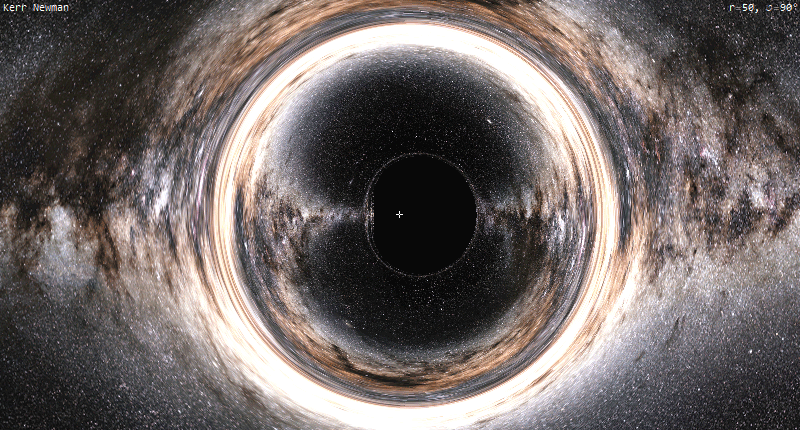
İngilizce spinning and charged black hole
Almanca rotierendes und geladenes schwarzes Loch










































.jpg)


