Dosya:XYCoordinates.gif - Vikipedi
İçeriğe atla
Ana menü
Gezinti
  • Anasayfa
  • Hakkımızda
  • İçindekiler
  • Rastgele madde
  • Seçkin içerik
  • Yakınımdakiler
Katılım
  • Deneme tahtası
  • Köy çeşmesi
  • Son değişiklikler
  • Dosya yükle
  • Topluluk portalı
  • Wikimedia dükkânı
  • Yardım
  • Özel sayfalar
Vikipedi Özgür Ansiklopedi
Ara
  • Bağış yapın
  • Hesap oluştur
  • Oturum aç
  • Bağış yapın
  • Hesap oluştur
  • Oturum aç

Dosya:XYCoordinates.gif
Sayfa içeriği diğer dillerde desteklenmemektedir.
  • Dosya
  • Tartışma
  • Oku
  • Wikimedia Commons üzerinde gör
  • Yerel açıklama ekle
  • Yerel açıklama kaynağı ekle
Araçlar
Eylemler
  • Oku
  • Wikimedia Commons üzerinde gör
  • Yerel açıklama ekle
  • Yerel açıklama kaynağı ekle
Genel
  • Sayfaya bağlantılar
  • Basılmaya uygun görünüm
  • Sayfa bilgisi
  • Kısaltılmış URL'yi al
  • Karekodu indir
Diğer projelerde
Görünüm
Vikipedi, özgür ansiklopedi
  • Dosya
  • Dosya geçmişi
  • Dosya kullanımı
  • Küresel dosya kullanımı
Dosya:XYCoordinates.gif
Daha yüksek çözünürlüğe sahip sürüm bulunmamaktadır.
XYCoordinates.gif ((454 × 189 piksel, dosya boyutu: 1,53 MB, MIME tipi: image/gif), döngüye girdi, 49 kare, 6,7 sn)
Bu dosya Wikimedia Commons'ta bulunmaktadır. Dosyanın açıklaması aşağıda gösterilmiştir.
Commons, serbest/özgür telifli medya dosyalarının bulundurulduğu depodur. Siz de yardım edebilirsiniz.
Bu dosya Wikimedia Commons'ta bulunmaktadır.

Özet

AçıklamaXYCoordinates.gif
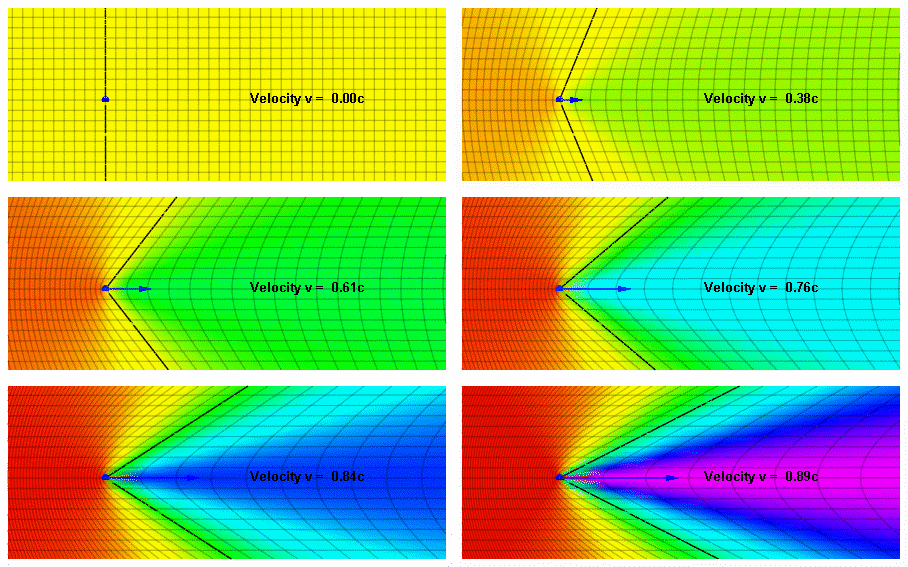
English: Demonstration of Aberration of light and Relativistic Doppler effect. In this diagram, the blue point represents the observer. The x,y-plane is represented by yellow graph paper. As the observer accelerates, he sees the graph paper change colors. Also he sees the distortion of the x,y-grid due to the aberration of light. The black vertical line is the y-axis. The observer accelerates along the x-axis.
  • Velocity is 0.44 speed of light.
    Velocity is 0.44 speed of light.
  • Velocity is 0.78 speed of light.
    Velocity is 0.78 speed of light.
  • Velocity is 0.89 speed of light
    Velocity is 0.89 speed of light
See below for additional description
Kaynak
  • en.wikipedia üzerinden Commons'a transfer edildi.
  • Yükleyenin kendi çalışması
Yazar TxAlien at İngilizce Vikipedi

How these images were made

Diagram 1
Animation: Image:Lcprojection2m.gif

In this section we will use the Minkowski space 4-dimension vectors and units where speed of light c = 1. In this notation velocity vector is

U = ( u 0 , u 1 , u 2 , u 3 ) ≡ ( u 0 , u ) = ( γ , γ v c ) {\displaystyle \mathbf {U} =(u_{0},u_{1},u_{2},u_{3})\equiv (u_{0},\mathbf {u} )=\left(\gamma ,\gamma {\frac {\mathbf {v} }{c}}\right)} {\displaystyle \mathbf {U} =(u_{0},u_{1},u_{2},u_{3})\equiv (u_{0},\mathbf {u} )=\left(\gamma ,\gamma {\frac {\mathbf {v} }{c}}\right)}

where

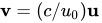
v = ( c / u 0 ) u {\displaystyle \mathbf {v} =(c/u_{0})\mathbf {u} \,} {\displaystyle \mathbf {v} =(c/u_{0})\mathbf {u} \,}

is a 3D velocity vector and

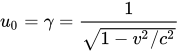
u 0 = γ = 1 1 − v 2 / c 2 {\displaystyle u_{0}=\gamma ={\frac {1}{\sqrt {1-v^{2}/c^{2}}}}} {\displaystyle u_{0}=\gamma ={\frac {1}{\sqrt {1-v^{2}/c^{2}}}}}

The component u 0 {\displaystyle u_{0}\,} {\displaystyle u_{0}\,} is the timelike component of U {\displaystyle \,\mathbf {U} \,} {\displaystyle \,\mathbf {U} \,} while the other three components are the spatial components and

u 0 2 − u 1 2 − u 2 2 − u 3 2 = u 0 2 − u ⋅ u = 1 {\displaystyle u_{0}^{2}-u_{1}^{2}-u_{2}^{2}-u_{3}^{2}=u_{0}^{2}-\mathbf {u} \cdot \mathbf {u} =1\,} {\displaystyle u_{0}^{2}-u_{1}^{2}-u_{2}^{2}-u_{3}^{2}=u_{0}^{2}-\mathbf {u} \cdot \mathbf {u} =1\,}

In spacetime, any small object is the sequence of spacetime events or world lines. Hence a 3D object in space-time can be described as a set of world lines corresponding to all the points that make up that object. Consider a simple objects in the space such as a sphere:


Diagram 2. The grey ellipse is moving relativistic sphere, its oblate shape due to Lorentz contraction. Colored ellipse is visual image of the sphere. Background curves are a xy-coordinates grid which is rigidly linked to the sphere, it is shown only at one moment in time.
x ( a , b ) = r cos ⁡ a {\displaystyle x(a,b)=r\cos a\,} {\displaystyle x(a,b)=r\cos a\,}
y ( a , b ) = r sin ⁡ a cos ⁡ b {\displaystyle y(a,b)=r\sin a\cos b\,} {\displaystyle y(a,b)=r\sin a\cos b\,}
z ( a , b ) = r sin ⁡ a sin ⁡ b {\displaystyle z(a,b)=r\sin a\sin b\,} {\displaystyle z(a,b)=r\sin a\sin b\,}

where a and b are parameters of the mapping and r is the radius of the sphere. To make the formulas easy to read we will leave out the parameters (a,b). In the frame where the object is at rest, the set of world lines can be represented as the world surface in Minkowski space

S ( a , b , τ ) = ( τ ,   x ( a , b ) ,   y ( a , b ) ,   z ( a , b ) ) {\displaystyle S(a,b,\tau )=\left(\tau ,\ x(a,b),\ y(a,b),\ z(a,b)\right)\,} {\displaystyle S(a,b,\tau )=\left(\tau ,\ x(a,b),\ y(a,b),\ z(a,b)\right)\,}

or

S ( τ ) = ( τ , x , y , z ) {\displaystyle S\left(\tau \right)=(\tau ,x,y,z)} {\displaystyle S\left(\tau \right)=(\tau ,x,y,z)}

where τ {\displaystyle \tau \,} {\displaystyle \tau \,} is timelike history parameter. In a frame which moves relatively to the object with velocity ( u 0 , u , 0 , 0 ) {\displaystyle \left(u_{0},u,0,0\right)\,} {\displaystyle \left(u_{0},u,0,0\right)\,} after Lorentz transformations

τ ′ = τ u 0 − x u {\displaystyle \tau '=\tau u_{0}-xu\,} {\displaystyle \tau '=\tau u_{0}-xu\,}
x ′ = x u 0 − τ u {\displaystyle x'=xu_{0}-\tau u\,} {\displaystyle x'=xu_{0}-\tau u\,}

it can be written as

S ( τ ) = ( τ u 0 − x u , x u 0 − τ u , y , z ) {\displaystyle S(\tau )=(\tau u_{0}-xu,xu_{0}-\tau u,y,z)\,} {\displaystyle S(\tau )=(\tau u_{0}-xu,xu_{0}-\tau u,y,z)\,}

At any given observer time

t ≡ τ ′ = τ u 0 − u {\displaystyle t\equiv \tau '=\tau u_{0}-u\,} {\displaystyle t\equiv \tau '=\tau u_{0}-u\,}

the surface in 3-d space after substitution

τ = t + x u u 0 {\displaystyle \tau ={\frac {t+xu}{u_{0}}}} {\displaystyle \tau ={\frac {t+xu}{u_{0}}}}

and

x u 0 − τ u = x u 0 2 − u 2 u 0 − u t u 0 = x − t u u 0 {\displaystyle xu_{0}-\tau u=x{\frac {u_{0}^{2}-u^{2}}{u_{0}}}-u{\frac {t}{u_{0}}}={\frac {x-tu}{u_{0}}}} {\displaystyle xu_{0}-\tau u=x{\frac {u_{0}^{2}-u^{2}}{u_{0}}}-u{\frac {t}{u_{0}}}={\frac {x-tu}{u_{0}}}}

can be written as

S L o r e n t z ( a , b , t ) = ( x − t u u 0 , y , z ) {\displaystyle S_{Lorentz}(a,b,t)=\left({\frac {x-tu}{u_{0}}},y,z\right)} {\displaystyle S_{Lorentz}(a,b,t)=\left({\frac {x-tu}{u_{0}}},y,z\right)}

However, observer can only see the object on light cone in the past when light is emitted by points on the object. Therefore, if observers coordinates are (t,0,0,0) he sees (Diagram 1) the surface points where they were in time

t ′ = t − d i s t a n c e / c {\displaystyle t'=t-distance/c\,} {\displaystyle t'=t-distance/c\,}

or in our notation

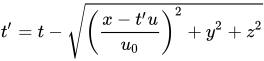
t ′ = t − ( x − t ′ u u 0 ) 2 + y 2 + z 2 {\displaystyle t'=t-{\sqrt {\left({\frac {x-t'u}{u_{0}}}\right)^{2}+y^{2}+z^{2}}}} {\displaystyle t'=t-{\sqrt {\left({\frac {x-t'u}{u_{0}}}\right)^{2}+y^{2}+z^{2}}}}

Solution to this equation is

t ′ = u 0 2 t − x u − u 0 ( x − u t ) 2 + y 2 + z 2 {\displaystyle t'=u_{0}2t-xu-u_{0}{\sqrt {\left(x-ut\right)^{2}+y^{2}+z^{2}}}} {\displaystyle t'=u_{0}2t-xu-u_{0}{\sqrt {\left(x-ut\right)^{2}+y^{2}+z^{2}}}}

Hence the observer will see the surface

S v i s u a l = S L o r e n t z ( a , b , t ′ ) = ( x ′ , y , z ) = ( x − t ′ u u 0 , y , z ) {\displaystyle S_{visual}=S_{Lorentz}(a,b,t')=\left(x',y,z\right)=\left({\frac {x-t'u}{u_{0}}},y,z\right)\,} {\displaystyle S_{visual}=S_{Lorentz}(a,b,t')=\left(x',y,z\right)=\left({\frac {x-t'u}{u_{0}}},y,z\right)\,}

where

x ′ = ( x − u t ) u 0 + u ( x − u t ) 2 + y 2 + z 2 {\displaystyle x'=\left(x-ut\right)u_{0}+u{\sqrt {\left(x-ut\right)^{2}+y^{2}+z^{2}}}} {\displaystyle x'=\left(x-ut\right)u_{0}+u{\sqrt {\left(x-ut\right)^{2}+y^{2}+z^{2}}}}

On Diagram 2 surface S L o r e n t z {\displaystyle S_{Lorentz}\,} {\displaystyle S_{Lorentz}\,} is flattened (this effect is called Lorentz contraction) grey ellipse, while the visible sphere image S v i s u a l {\displaystyle S_{visual}\,} {\displaystyle S_{visual}\,} is colored. Color change is due to the relativistic Doppler effect.


It's still not finished--TxAlien 05:04, 3 September 2006 (UTC)

Other images

Moving wave source..
Animation: Media:Waves01.gif
Relativistic Doppler effect in comparison with non-relativistic effect.
Animation: Media:Compare03s.gif


Next pictures show a model of movement through a subway tunnel at an increasing speed. Observer would not only see changes in colors but the outer walls will also appear convex. This convex appearance is due to seeing parts of the tunnel at different moments in time because of the finite speed of light. This effect is called aberration of light.

On this image observer (blue point) is inside the subway. Velocity is zero. It is the first frame in an animated model of movement.
Animation: Media:RelSubway2.gif
On this image observer (blue point) moves inside the same subway. Velocity is equal 0.7 speed of light
Animation: Media:RelSubway2.gif
The outside view of the subway. However, this is only a model, there does not exist an observer which can see the tunnel like this.


This images shows the view on a sphere moving at 0.7c relatively to a stationary observer, which is represented by blue point. Curved lines represent the xy grid coordinates of a moving system.

This sphere moves toward to observer.
Animation: Media:SphereAberration01.gif
On this picture an observer is inside the sphere.
Animation: Media:SphereAberration01.gif
This sphere moves away from observer.
Animation: Media:SphereAberration01.gif

Tachyon visualization. Since that object moves faster than speed of light we can not see it approaching. Only after a tachyon has passed nearby, we could see two images of the tachyon, appearing and departing in opposite directions.
Animation: Image:Tachyon03.gif
Animation: Media:Tachyon03.gif

All these images are graphical solutions of an accurate mathematical model which is based on the Lorentz transformation

Lisanslama

TxAlien from en.wikipedia.org, bu işin telif sahibi, burada işi aşağıdaki lisans altında yayımlıyor:
w:tr:Creative Commons
atıf benzer paylaşım
Bu dosya, Creative Commons Atıf-Benzer Paylaşım 3.0 Taşınmamış lisansı ile lisanslanmıştır Genel sorumluluk reddine tabidir.
Atıf: TxAlien from en.wikipedia.org
Şu seçeneklerde özgürsünüz:
  • paylaşım – eser paylaşımı, dağıtımı ve iletimi
  • içeriği değiştirip uyarlama – eser adaptasyonu
Aşağıdaki koşullar geçerli olacaktır:
  • atıf – Esere yazar veya lisans sahibi tarafından belirtilen (ancak sizi ya da eseri kullanımınızı desteklediklerini ileri sürmeyecek bir) şekilde atıfta bulunmalısınız.
  • benzer paylaşım – Maddeyi yeniden düzenler, dönüştürür veya inşa ederseniz, katkılarınızı özgünüyle aynı veya uyumlu lisans altında dağıtmanız gerekir.
Bu lisanslama etiketi, dosyaya GFDL lisanslama güncelleştirmenin bir parçası olarak eklenmiştir.http://creativecommons.org/licenses/by-sa/3.0/CC BY-SA 3.0Creative Commons Attribution-Share Alike 3.0truetrue
GNU head Bu belgenin GNU Özgür Belgeleme Lisansı, Sürüm 1.2 veya Özgür Yazılım Vakfı tarafından yayımlanan sonraki herhangi bir sürüm şartları altında bu belgenin kopyalanması, dağıtılması ve/veya değiştirilmesi için izin verilmiştir;

Değişmeyen Bölümler, Ön Kapak Metinleri ve Arka Kapak Metinleri yoktur. Lisansın bir kopyası GNU Özgür Belgeleme Lisansı sayfasında yer almaktadır. Genel sorumluluk reddine tabidir.http://www.gnu.org/copyleft/fdl.htmlGFDLGNU Free Documentation Licensetruetrue

Orijinal yükleme günlüğü

Dosyanın orjinal açıklama sayfası burada bulunmaktadır. Aşağıdaki tüm kullanıcı adları için en.wikipedia bakın.
  • 2006-08-12 23:50 TxAlien 454×189× (1600354 bytes) Demonstration of light aberration and [[Relativistic Doppler effect]].

Altyazılar

Bu dosyanın temsil ettiği şeyin tek satırlık açıklamasını ekleyin.

Bu dosyada gösterilen öğeler

betimlenen

telif hakkı durumu

telif hakkı alınmış

telif hakkı lisansı

GNU Free Documentation License, version 1.2 or later İngilizce

Creative Commons Atıf-AynıLisanslaPaylaş 3.0 Yerelleştirilmemiş

dosya kaynağı

yükleyicinin orijinal eseri

Dosya geçmişi

Dosyanın herhangi bir zamandaki hâli için ilgili tarih/saat kısmına tıklayın.

Tarih/SaatKüçük resimBoyutlarKullanıcıYorum
güncel21.28, 15 Ocak 201221.28, 15 Ocak 2012 tarihindeki sürümün küçültülmüş hâli454 × 189 (1,53 MB)Cantons-de-l'Est{{Information |Description={{en|Demonstration of en:Aberration of light and en:Relativistic Doppler effect. In this diagram, the blue point represents the observer. The x,y-plane is represented by yellow graph paper. As the observer accelerate

Dosya kullanımı

Bu görüntü dosyasına bağlantısı olan sayfalar:

  • Göreli Doppler etkisi

Küresel dosya kullanımı

Aşağıdaki diğer vikiler bu dosyayı kullanmaktadır:

  • bs.wikipedia.org üzerinde kullanımı
    • Relativistički Dopplerov efekt
  • es.wikipedia.org üzerinde kullanımı
    • Efecto Doppler relativista
  • fr.wikipedia.org üzerinde kullanımı
    • Effet Doppler relativiste
    • Wikipédia:RAW/2012-01-29
  • pt.wikipedia.org üzerinde kullanımı
    • Usuário(a):Gabriel.Oliveir./Efeito Doppler Relativístico
    • Efeito Doppler relativístico
"https://tr.wikipedia.org/wiki/Dosya:XYCoordinates.gif" sayfasından alınmıştır
  • Gizlilik politikası
  • Vikipedi hakkında
  • Sorumluluk reddi
  • Davranış Kuralları
  • Geliştiriciler
  • İstatistikler
  • Çerez politikası
  • Mobil görünüm
  • Wikimedia Foundation
  • Powered by MediaWiki
Dosya:XYCoordinates.gif
Konu ekle