Dosya:The 2010 Perseids over the VLT.jpg - Vikipedi
İçeriğe atla
Ana menü
Gezinti
  • Anasayfa
  • Hakkımızda
  • İçindekiler
  • Rastgele madde
  • Seçkin içerik
  • Yakınımdakiler
Katılım
  • Deneme tahtası
  • Köy çeşmesi
  • Son değişiklikler
  • Dosya yükle
  • Topluluk portalı
  • Wikimedia dükkânı
  • Yardım
  • Özel sayfalar
Vikipedi Özgür Ansiklopedi
Ara
  • Bağış yapın
  • Hesap oluştur
  • Oturum aç
  • Bağış yapın
  • Hesap oluştur
  • Oturum aç

Dosya:The 2010 Perseids over the VLT.jpg
Sayfa içeriği diğer dillerde desteklenmemektedir.
  • Dosya
  • Tartışma
  • Oku
  • Wikimedia Commons üzerinde gör
  • Yerel açıklama ekle
  • Yerel açıklama kaynağı ekle
Araçlar
Eylemler
  • Oku
  • Wikimedia Commons üzerinde gör
  • Yerel açıklama ekle
  • Yerel açıklama kaynağı ekle
Genel
  • Sayfaya bağlantılar
  • Basılmaya uygun görünüm
  • Sayfa bilgisi
  • Kısaltılmış URL'yi al
  • Karekodu indir
Diğer projelerde
Görünüm
Vikipedi, özgür ansiklopedi
  • Dosya
  • Dosya geçmişi
  • Dosya kullanımı
  • Küresel dosya kullanımı
  • Üstveri
Dosya:The 2010 Perseids over the VLT.jpg
Bu önizlemenin boyutu: 800 × 533 piksel. Diğer çözünürlükler: 320 × 213 piksel | 640 × 427 piksel | 1.024 × 683 piksel | 1.280 × 853 piksel | 2.560 × 1.707 piksel | 5.616 × 3.744 piksel.
Tam çözünürlük ((5.616 × 3.744 piksel, dosya boyutu: 5,68 MB, MIME tipi: image/jpeg))
Bu dosya Wikimedia Commons'ta bulunmaktadır. Dosyanın açıklaması aşağıda gösterilmiştir.
Commons, serbest/özgür telifli medya dosyalarının bulundurulduğu depodur. Siz de yardım edebilirsiniz.
Bu dosya Wikimedia Commons'ta bulunmaktadır.

Özet

AçıklamaThe 2010 Perseids over the VLT.jpg
Afrikaans: Jaarliks in middel-Augustus bereik die Perseïde-meteoorreën sy hoogtepunt. Meteore, algemeen bekend as "verskietende sterre", word veroorsaak deur stukke kosmiese puin wat die aarde se atmosfeer teen hoë snelheid binnedring, en 'n spoor van gloeiende gasse agterlaat. Die meeste deeltjies wat meteore veroorsaak, is kleiner as 'n sandkorrel en sal gewoonlik in die atmosfeer disintegreer. Enkeles bereik die oppervlak van die Aarde as 'n meteoriet.
   Die Perseïde-reën vind plaas as die Aarde deur die stroom van puin beweeg wat deur komeet Swift-Tuttle agtergelaat word. In 2010 is die piek voorspel om van 12 tot 13 Augustus 2010 plaas te vind. Ten spyte daarvan dat die Perseïdes, weens die oriëntasie van die baan van komeet Swift-Tuttle, beste uit die noordelike halfrond sigbaar was, was die reën tog in die besonder donker naghemel oor ESO se Paranal-sterrewag in Chili sigbaar.
   Om geen meteore mis te kyk nie, het ESO-fotoambassadeur Stephane Guisard 3 kameras opgestel om in aaneenlopende intervalle foto's vanaf die platform van die Baie Groot Teleskoop tydens die nagte van 12-13 en 13-14 Augustus 2010 te neem. Hierdie uitgesoekte foto van die nag van 13-14 Augustus, was een van Guisard se 8 000 beligtings, en toon een van die helderste meteore wat opgemerk is. Die sterrewag is verlig deur rooi lig van die ondergaande Maan links van die fotobeeld.
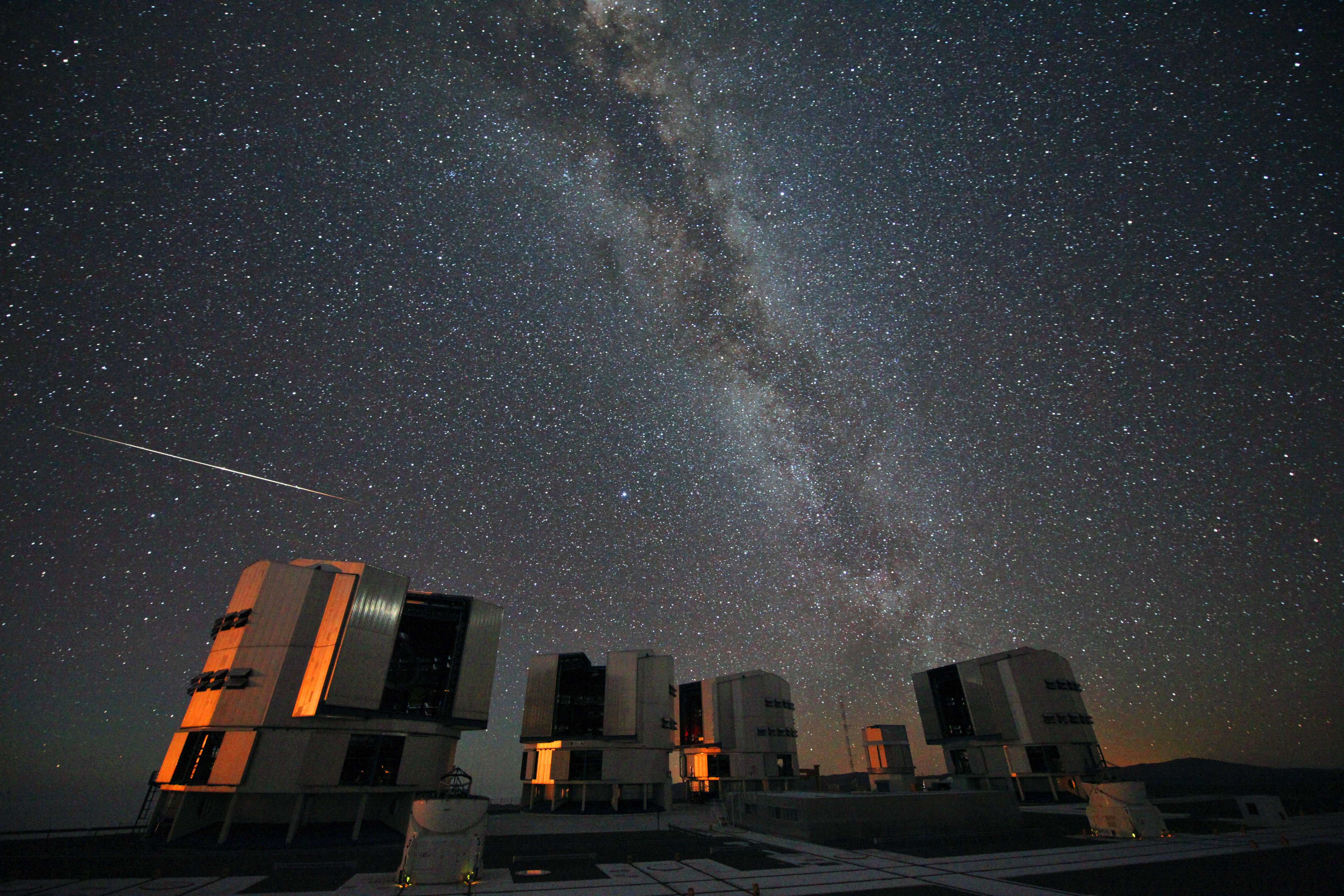
English: Every year in mid-August the Perseid meteor shower has its peak. Meteors, colloquially known as “shooting stars”, are caused by pieces of cosmic debris entering Earth’s atmosphere at high velocity, leaving a trail of glowing gases. Most of the particles that cause meteors are smaller than a grain of sand and usually disintegrate in the atmosphere, only rarely reaching the Earth’s surface as a meteorite. The Perseid shower takes place as the Earth moves through the stream of debris left behind by Comet Swift-Tuttle. In 2010 the peak was predicted to take place between 12–13 August 2010. Despite the Perseids being best visible in the northern hemisphere, due to the path of Comet Swift-Tuttle's orbit, the shower was also spotted from the exceptionally dark skies over ESO’s Paranal Observatory in Chile. In order not to miss any meteors in the display, ESO Photo Ambassador Stéphane Guisard set up 3 cameras to take continuous time-lapse pictures on the platform of the Very Large Telescope during the nights of 12–13 and 13–14 August 2010. This handpicked photograph, from the night of 13–14 August, was one of Guisard’s 8000 individual exposures and shows one of the brightest meteors captured. The scene is lit by the reddened light of the setting Moon outside the left of the frame.
Tarih 16 Ağustos 2010
Kaynak http://www.eso.org/public/images/potw1033a/
Yazar ESO/S. Guisard
İzin
(Bu dosyanın tekrar kullanımı)
This media was created by the European Southern Observatory (ESO).
Their website states: "Unless specifically noted, the images, videos, and music distributed on the public ESO website, along with the texts of press releases, announcements, pictures of the week, blog posts and captions, are licensed under a Creative Commons Attribution 4.0 International License, and may on a non-exclusive basis be reproduced without fee provided the credit is clear and visible."
To the uploader: You must provide a link (URL) to the original file and the authorship information if available.
w:tr:Creative Commons
atıf
Bu dosya Creative Commons Atıf 4.0 Uluslararası lisansı altında lisanslanmıştır.
Şu seçeneklerde özgürsünüz:
  • paylaşım – eser paylaşımı, dağıtımı ve iletimi
  • içeriği değiştirip uyarlama – eser adaptasyonu
Aşağıdaki koşullar geçerli olacaktır:
  • atıf – Esere yazar veya lisans sahibi tarafından belirtilen (ancak sizi ya da eseri kullanımınızı desteklediklerini ileri sürmeyecek bir) şekilde atıfta bulunmalısınız.
https://creativecommons.org/licenses/by/4.0CC BY 4.0 Creative Commons Attribution 4.0 truetrue

Altyazılar

Bu dosyanın temsil ettiği şeyin tek satırlık açıklamasını ekleyin.

Bu dosyada gösterilen öğeler

betimlenen

Perseid meteor yağmurları

telif hakkı durumu

telif hakkı alınmış

telif hakkı lisansı

Creative Commons Atıf 4.0 Uluslararası

kuruluşu

16 Ağustos 2010

ortam türü

image/jpeg

Dosya geçmişi

Dosyanın herhangi bir zamandaki hâli için ilgili tarih/saat kısmına tıklayın.

Tarih/SaatKüçük resimBoyutlarKullanıcıYorum
güncel17.32, 19 Şubat 202417.32, 19 Şubat 2024 tarihindeki sürümün küçültülmüş hâli5.616 × 3.744 (5,68 MB)C messierfull size
09.34, 18 Ağustos 201009.34, 18 Ağustos 2010 tarihindeki sürümün küçültülmüş hâli4.000 × 2.667 (5,82 MB)Lars Lindberg Christensen{{Information |Description={{en|1=Every year in mid-August the Perseid meteor shower has its peak. Meteors, colloquially known as “shooting stars”, are caused by pieces of cosmic debris entering Earth’s atmosphere at high velocity, leaving a trail o

Dosya kullanımı

Bu görüntü dosyasına bağlantısı olan sayfalar:

  • Perseid meteor yağmuru
  • Very Large Telescope

Küresel dosya kullanımı

Aşağıdaki diğer vikiler bu dosyayı kullanmaktadır:

  • af.wikipedia.org üzerinde kullanımı
    • Perseïdes
  • en.wikipedia.org üzerinde kullanımı
    • Perseids
  • eo.wikipedia.org üzerinde kullanımı
    • Perseidoj
  • es.wikipedia.org üzerinde kullanımı
    • Perseidas
  • fa.wikipedia.org üzerinde kullanımı
    • تلسکوپ بسیار بزرگ
    • کاربر:محمدخادمیان/مهر دوستان
  • gl.wikipedia.org üzerinde kullanımı
    • Perseidas
  • he.wikipedia.org üzerinde kullanımı
    • ויקיפדיה:תמונה מומלצת/הוספה למומלצים/ארכיון 80
  • hr.wikipedia.org üzerinde kullanımı
    • Perzeidi
  • hu.wikipedia.org üzerinde kullanımı
    • Very Large Telescope
    • Portál:Csillagászat/Áttekintés/quote archive
  • it.wikipedia.org üzerinde kullanımı
    • Very Large Telescope
    • Perseidi
  • la.wikipedia.org üzerinde kullanımı
    • Perseides
  • mk.wikipedia.org üzerinde kullanımı
    • Персеиди
  • ml.wikipedia.org üzerinde kullanımı
    • പെഴ്സീയിഡുകൾ
  • ms.wikipedia.org üzerinde kullanımı
    • Perseid
    • Kadar Kemuncak Sejam
  • my.wikipedia.org üzerinde kullanımı
    • ပါဆီးအစ် ကြယ်ကြွေများ
  • nn.wikipedia.org üzerinde kullanımı
    • Perseidane
  • pl.wikipedia.org üzerinde kullanımı
    • Perseidy
    • Portal:Astronomia/Artykuł miesiąca 08 2012
    • Portal:Astronomia/Artykuł miesiąca 08 2013
    • Portal:Astronomia/Artykuł miesiąca 08 2014
    • Portal:Astronomia/Artykuł miesiąca 08 2015
    • Portal:Astronomia/Artykuł miesiąca 08 2016
    • Portal:Astronomia/Artykuł miesiąca 08 2017
    • Portal:Astronomia/Artykuł miesiąca 08 2018
    • Portal:Astronomia/Artykuł miesiąca 08 2019
    • Portal:Astronomia/Artykuł miesiąca 08 2020
    • Portal:Astronomia/Artykuł miesiąca 08 2021
    • Portal:Astronomia/Artykuł miesiąca 08 2022
  • ro.wikipedia.org üzerinde kullanımı
    • Perseide
  • sh.wikipedia.org üzerinde kullanımı
    • Perzeidi
  • sk.wikipedia.org üzerinde kullanımı
    • Perzeidy
  • sl.wikipedia.org üzerinde kullanımı
    • Perzeidi
  • sv.wikipedia.org üzerinde kullanımı
    • Perseiderna
  • vi.wikipedia.org üzerinde kullanımı
    • Thành viên:Minh Tấn/Hình ảnh/T
    • Perseids
  • www.wikidata.org üzerinde kullanımı
    • Q265628
  • zh.wikipedia.org üzerinde kullanımı
    • 甚大望远镜
    • 英仙座流星雨

Üstveri

Bu dosyada, muhtemelen fotoğraf makinesi ya da tarayıcı tarafından eklenmiş ek bilgiler mevcuttur. Eğer dosyada sonradan değişiklik yapıldıysa, bazı bilgiler yeni değişikliğe göre eski kalmış olabilir.

Katkı/SağlayıcıESO/S. Guisard (sguisard.astrosurf.com)
KaynakEuropean Southern Observatory
Kısa başlık
  • The 2010 Perseids over the VLT
Resim başlığı
  • Every year in mid-August the Perseid meteor shower has its peak. Meteors, colloquially known as“shooting stars”, are caused by pieces of cosmic debris entering Earth’s atmosphere at high velocity, leaving a trail of glowing gases. Most of the particles that cause meteors are smaller than a grain of sand and usually disintegrate in the atmosphere, only rarely reaching the Earth’s surface as a meteorite. The Perseid shower takes place as the Earth moves through the stream of debris left behind by Comet Swift-Tuttle. In 2010 the peak was predicted to take place between 12–13 August 2010. Despite the Perseids being best visible in the northern hemisphere, due to the path of CometSwift-Tuttle's orbit, the shower was also spotted from the exceptionally dark skies over ESO’s Paranal Observatory in Chile. In order not to miss any meteors in the display, ESO Photo Ambassador Stéphane Guisard set up 3 cameras to take continuous time-lapse pictures on the platform of the Very Large Telescope during the nights of 12–13 and 13–14 August 2010. This handpicked photograph, from the night of 13–14 August, was one of Guisard’s 8000 individual exposures and shows one of the brightest meteors captured. The scene is lit by the reddened light of the setting Moon outside theleft of the frame. Although the comet debris particles are travelling parallel to each other, the meteors appear to radiate from a spot on the sky in the constellation of Perseus (here seen very low on the horizon and partly covered by the VLT enclosures). This effect is due to perspective, as the parallel tracks seem to converge at a distance. The apparent origin in Perseus is what gives the Perseid meteor shower its name. Around the globe, many thousands of people were out observing the Perseids. Some of them took part in citizen science projects such as Meteorwatch and the annual campaign organised by the International Meteor Organization (IMO). According to the IMO measurements, the 2010 Perseid meteor shower was above normal with a peak activity of over 100 meteors per hour under optimal viewing conditions, but not spectacular. In the coming nights the Perseids will still be visible, but with fewer and fewer meteors night by night. Links More about the 2010 Perseids at the International Meteor Organization More about ESO's Photo Ambassadors Meteorwatch: http://www.meteorwatch.org/
Kullanım şartları
  • Creative Commons Attribution 4.0 International License
Verinin ilk yaratılma zamanı10.10, 16 Ağustos 2010
JPEG dosyası yorumuEvery year in mid-August the Perseid meteor shower has its peak. Meteors, colloquially known as “shooting stars”, are caused by pieces of cosmic debris entering Earth’s atmosphere at high velocity, leaving a trail of glowing gases. Most of the particles that cause meteors are smaller than a grain of sand and usually disintegrate in the atmosphere, only rarely reaching the Earth’s surface as a meteorite. The Perseid shower takes place as the Earth moves through the stream of debris left behind by Comet Swift-Tuttle. In 2010 the peak was predicted to take place between 12–13 August 2010. Despite the Perseids being best visible in the northern hemisphere, due to the path of Comet Swift-Tuttle's orbit, the shower was also spotted from the exceptionally dark skies over ESO’s Paranal Observatory in Chile. In order not to miss any meteors in the display, ESO Photo Ambassador Stéphane Guisard set up 3 cameras to take continuous time-lapse pictures on the platform of the Very Large Telescope during the nights of 12–13 and 13–14 August 2010. This handpicked photograph, from the night of 13–14 August, was one of Guisard’s 8000 individual exposures and shows one of the brightest meteors captured. The scene is lit by the reddened light of the setting Moon outside the left of the frame. Although the comet debris particles are travelling parallel to each other, the meteors appear to radiate from a spot on the sky in the constellation of Perseus (here seen very low on the horizon and partly covered by the VLT enclosures). This effect is due to perspective, as the parallel tracks seem to converge at a distance. The apparent origin in Perseus is what gives the Perseid meteor shower its name. Around the globe, many thousands of people were out observing the Perseids. Some of them took part in citizen science projects such as Meteorwatch and the annual campaign organised by the International Meteor Organization (IMO). According to the IMO measurements, the 2010 Perseid meteor shower was above normal with a peak activity of over 100 meteors per hour under optimal viewing conditions, but not spectacular. In the coming nights the Perseids will still be visible, but with fewer and fewer meteors night by night. Links More about the 2010 Perseids at the International Meteor Organization: http://www.imo.net/live/perseids2010/ More about ESO's Photo Ambassadors Meteorwatch: http://www.meteorwatch.org/
Anahtar kelimeler
  • Perseid meteor shower
  • Very Large Telescope
İletişim bilgileri

http://www.eso.org/

Karl-Schwarzschild-Strasse 2

Garching bei München, , D-85748 Germany

IIM sürümü4
"https://tr.wikipedia.org/wiki/Dosya:The_2010_Perseids_over_the_VLT.jpg" sayfasından alınmıştır
  • Gizlilik politikası
  • Vikipedi hakkında
  • Sorumluluk reddi
  • Davranış Kuralları
  • Geliştiriciler
  • İstatistikler
  • Çerez politikası
  • Mobil görünüm
  • Wikimedia Foundation
  • Powered by MediaWiki
Dosya:The 2010 Perseids over the VLT.jpg
Konu ekle