Dosya:Palomar 2 Hubble.jpg - Vikipedi
İçeriğe atla
Ana menü
Gezinti
  • Anasayfa
  • Hakkımızda
  • İçindekiler
  • Rastgele madde
  • Seçkin içerik
  • Yakınımdakiler
Katılım
  • Deneme tahtası
  • Köy çeşmesi
  • Son değişiklikler
  • Dosya yükle
  • Topluluk portalı
  • Wikimedia dükkânı
  • Yardım
  • Özel sayfalar
Vikipedi Özgür Ansiklopedi
Ara
  • Bağış yapın
  • Hesap oluştur
  • Oturum aç
  • Bağış yapın
  • Hesap oluştur
  • Oturum aç

Dosya:Palomar 2 Hubble.jpg

Sayfa içeriği diğer dillerde desteklenmemektedir.
  • Dosya
  • Tartışma
  • Oku
  • Wikimedia Commons üzerinde gör
  • Yerel açıklama ekle
  • Yerel açıklama kaynağı ekle
Araçlar
Eylemler
  • Oku
  • Wikimedia Commons üzerinde gör
  • Yerel açıklama ekle
  • Yerel açıklama kaynağı ekle
Genel
  • Sayfaya bağlantılar
  • Basılmaya uygun görünüm
  • Sayfa bilgisi
  • Kısaltılmış URL'yi al
  • Karekodu indir
Diğer projelerde
Görünüm
Vikipedi, özgür ansiklopedi
  • Dosya
  • Dosya geçmişi
  • Dosya kullanımı
  • Küresel dosya kullanımı
  • Üstveri
Dosya:Palomar 2 Hubble.jpg
Bu önizlemenin boyutu: 643 × 599 piksel. Diğer çözünürlükler: 257 × 240 piksel | 515 × 480 piksel | 824 × 768 piksel | 1.098 × 1.024 piksel | 2.197 × 2.048 piksel | 4.146 × 3.865 piksel.
Tam çözünürlük ((4.146 × 3.865 piksel, dosya boyutu: 10,9 MB, MIME tipi: image/jpeg))
Bu dosya Wikimedia Commons'ta bulunmaktadır. Dosyanın açıklaması aşağıda gösterilmiştir.
Commons, serbest/özgür telifli medya dosyalarının bulundurulduğu depodur. Siz de yardım edebilirsiniz.
Bu dosya Wikimedia Commons'ta bulunmaktadır.

Özet

AçıklamaPalomar 2 Hubble.jpg

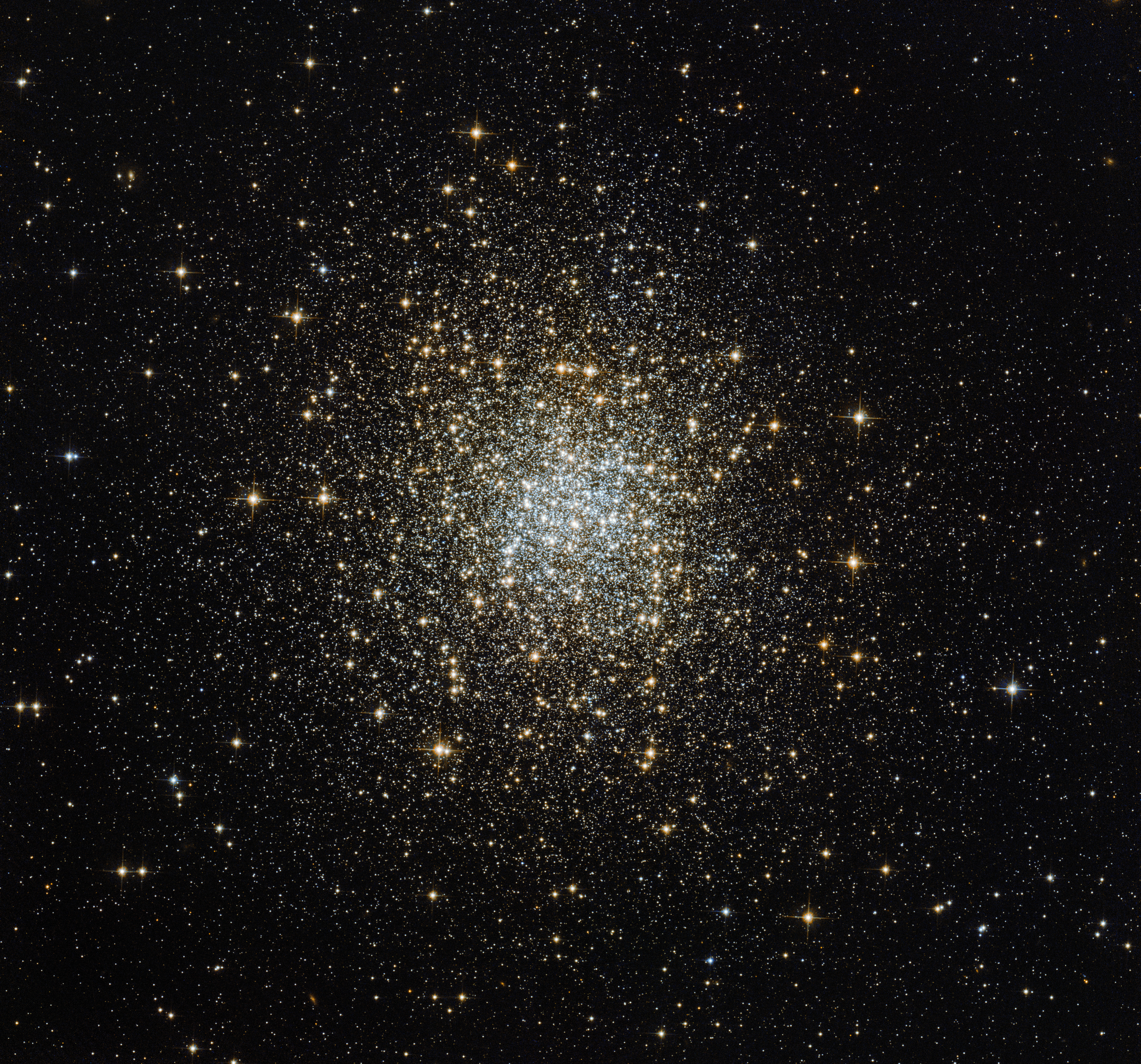
Palomar 2 - A unique cluster: one of the hidden 15

Globular clusters are relatively common in our sky, and generally look similar. However, this image, taken using the NASA/ESA Hubble Space Telescope, shows a unique example of such a cluster — Palomar 2.

Palomar 2 is part of a group of 15 globulars known as the Palomar clusters. These clusters, as the name suggests, were discovered in survey plates from the first Palomar Observatory Sky Survey in the 1950s, a project that involved some of the most well-known astronomers of the day, including Edwin Hubble. They were discovered quite late because they are so faint — each is either extremely remote, very heavily hidden behind blankets of dust, or has a very small number of remaining stars.

This particular cluster is unique in more than one way. For one, it is the only globular cluster that we see in this part of the sky, the northern constellation of Auriga (The Charioteer). Globular clusters orbit the centre of a galaxy like the Milky Way in the same way that satellites circle around the Earth. This means that they normally lie closer in to the galactic centre than we do, and so we almost always see them in the same region of the sky. Palomar 2 is an exception to this, as it is around five times further away from the centre of the Milky Way than other clusters. It also lies in the opposite direction — further out than Earth — and so it is classed as an “outer halo” globular.

It is also unusual due to its brightness. The cluster is veiled by a mask of dust, dampening the apparent brightness of the stars within it and making it appear as a very faint burst of stars. The stunning NASA/ESA Hubble Space Telescope image above shows Palomar 2 in a way that could not be captured from smaller or ground-based telescopes — some amateur astronomers with large telescopes attempt to observe all of the obscure and well-hidden Palomar 15 as a challenge, to see how many they can pick out from the starry sky.

Credit:

ESA/Hubble & NASA

Colours & filters Band	Wavelength	Telescope
 
Optical V      	606 nm  	Hubble Space Telescope ACS
Infrared I     	814 nm  	Hubble Space Telescope ACS
.
Tarih Release date: 15 April 2013, 10:00
Kaynak http://www.spacetelescope.org/images/potw1315a/ http://www.spacetelescope.org/static/archives/images/large/potw1315a.jpg
Yazar Credit: ESA/Hubble & NASA
İzin
(Bu dosyanın tekrar kullanımı)
http://www.spacetelescope.org/copyright/

Lisanslama

Public domainPublic domainfalsefalse
Public domain
This file is in the public domain because it was created by NASA and ESA. NASA Hubble material (and ESA Hubble material prior to 2009) is copyright-free and may be freely used as in the public domain without fee, on the condition that only NASA, STScI, and/or ESA is credited as the source of the material. This license does not apply if ESA material created after 2008 or source material from other organizations is in use.

The material was created for NASA by Space Telescope Science Institute under Contract NAS5-26555, or for ESA by the Hubble European Space Agency Information Centre. Copyright statement at hubblesite.org or 2008 copyright statement at spacetelescope.org.

For material created by the European Space Agency on the spacetelescope.org site since 2009, use the {{ESA-Hubble}} tag.

Dosya geçmişi

Dosyanın herhangi bir zamandaki hâli için ilgili tarih/saat kısmına tıklayın.

Tarih/SaatKüçük resimBoyutlarKullanıcıYorum
güncel08.38, 17 Nisan 201308.38, 17 Nisan 2013 tarihindeki sürümün küçültülmüş hâli4.146 × 3.865 (10,9 MB)Fabian RRRR{{Information |Description='''Palomar 2 - A unique cluster: one of the hidden 15''' Globular clusters are relatively common in our sky, and generally look similar. However, this image, taken using the NASA/ESA Hubble Space Telescope, shows a unique ex...

Dosya kullanımı

Bu görüntü dosyasına bağlantısı olan sayfalar:

  • Palomar 2

Küresel dosya kullanımı

Aşağıdaki diğer vikiler bu dosyayı kullanmaktadır:

  • ar.wikipedia.org üzerinde kullanımı
    • بالومار 2
  • ckb.wikipedia.org üzerinde kullanımı
    • پالۆمار ٢
  • cs.wikipedia.org üzerinde kullanımı
    • Palomar 2
  • de.wikipedia.org üzerinde kullanımı
    • Palomar 2
  • el.wikipedia.org üzerinde kullanımı
    • Πάλομαρ 2
  • en.wikipedia.org üzerinde kullanımı
    • List of globular clusters
    • Palomar 2
  • fr.wikipedia.org üzerinde kullanımı
    • Liste d'amas stellaires
    • Projet:Astronomie/Suggestions d'articles à créer
    • Projet:Astronomie/Suggestions d'articles à créer/Amas globulaires
  • lb.wikipedia.org üzerinde kullanımı
    • Palomar 2
  • pl.wikipedia.org üzerinde kullanımı
    • Palomar 2
    • Portal:Astronomia/Zdjęcie miesiąca 10 2017
  • pt.wikipedia.org üzerinde kullanımı
    • Via Láctea
    • Usuário:WOtP/Via-Láctea
  • ru.wikipedia.org üzerinde kullanımı
    • Паломар 2
  • sv.wikipedia.org üzerinde kullanımı
    • Palomar 2
  • www.wikidata.org üzerinde kullanımı
    • Q2964963

Üstveri

Bu dosyada, muhtemelen fotoğraf makinesi ya da tarayıcı tarafından eklenmiş ek bilgiler mevcuttur. Eğer dosyada sonradan değişiklik yapıldıysa, bazı bilgiler yeni değişikliğe göre eski kalmış olabilir.

Katkı/SağlayıcıESA/Hubble & NASA 
KaynakESA/Hubble
Kısa başlık
  • A unique cluster: one of the hidden 15
Resim başlığı
  • Globular clusters are relatively common in our sky, and generally look similar. However, this image, taken using the NASA/ESA Hubble Space Telescope, shows a unique example of such a cluster— Palomar 2. Palomar 2 is part of a group of 15 globulars known as the Palomar clusters. These clusters, as the name suggests, were discovered in survey plates from the first Palomar Observatory Sky Survey in the 1950s, a project that involved some of the most well-known astronomers of the day, including Edwin Hubble. They were discovered quite late because they are so faint — each is either extremely remote, very heavily hidden behind blankets of dust, or has a very small number of remaining stars. This particular cluster is unique in more than one way. For one, it is the only globular cluster that we see in this part of the sky, the northern constellation of Auriga (The Charioteer). Globular clusters orbit the centre of a galaxy like the Milky Way in the same way that satellites circle around the Earth. This means that they normally lie closer in to the galactic centrethan we do, and so we almost always see them in the same region of the sky. Palomar 2 is an exception to this, as it is around five times further away from the centre of the Milky Way than other clusters. It also lies in the opposite direction — further out than Earth — and so it is classedas an “outer halo” globular. It is also unusual due to its brightness. The cluster is veiled by a mask of dust, dampening the apparent brightness of the stars within it and making it appear as a very faint burst of stars. The stunning NASA/ESA Hubble Space Telescope image above shows Palomar 2 in a way that could not be captured from smaller or ground-based telescopes —  some amateur astronomers with large telescopes attempt to observe all of the obscure and well-hidden Palomar 15 as a challenge, to see how many they can pick out from the starry sky.
Kullanım şartları
  • Creative Commons Attribution 3.0 Unported license
Verinin ilk yaratılma zamanı10.00, 15 Nisan 2013
Anahtar kelimelerPalomar 2
İletişim bilgileri

http://www.spacetelescope.org/

Karl-Schwarzschild-Strasse 2

Garching bei München, , D-85748 Germany

"https://tr.wikipedia.org/wiki/Dosya:Palomar_2_Hubble.jpg" sayfasından alınmıştır
  • Gizlilik politikası
  • Vikipedi hakkında
  • Sorumluluk reddi
  • Davranış Kuralları
  • Geliştiriciler
  • İstatistikler
  • Çerez politikası
  • Mobil görünüm
  • Wikimedia Foundation
  • Powered by MediaWiki
Dosya:Palomar 2 Hubble.jpg
Konu ekle