Dosya:NASA-PerseusGalaxyCluster-ChandraXRayObservatory-20140624.jpg - Vikipedi
İçeriğe atla
Ana menü
Gezinti
  • Anasayfa
  • Hakkımızda
  • İçindekiler
  • Rastgele madde
  • Seçkin içerik
  • Yakınımdakiler
Katılım
  • Deneme tahtası
  • Köy çeşmesi
  • Son değişiklikler
  • Dosya yükle
  • Topluluk portalı
  • Wikimedia dükkânı
  • Yardım
  • Özel sayfalar
Vikipedi Özgür Ansiklopedi
Ara
  • Bağış yapın
  • Hesap oluştur
  • Oturum aç
  • Bağış yapın
  • Hesap oluştur
  • Oturum aç

Dosya:NASA-PerseusGalaxyCluster-ChandraXRayObservatory-20140624.jpg

Sayfa içeriği diğer dillerde desteklenmemektedir.
  • Dosya
  • Tartışma
  • Oku
  • Wikimedia Commons üzerinde gör
  • Yerel açıklama ekle
  • Yerel açıklama kaynağı ekle
Araçlar
Eylemler
  • Oku
  • Wikimedia Commons üzerinde gör
  • Yerel açıklama ekle
  • Yerel açıklama kaynağı ekle
Genel
  • Sayfaya bağlantılar
  • Basılmaya uygun görünüm
  • Sayfa bilgisi
  • Kısaltılmış URL'yi al
  • Karekodu indir
Diğer projelerde
Görünüm
Vikipedi, özgür ansiklopedi
  • Dosya
  • Dosya geçmişi
  • Dosya kullanımı
  • Küresel dosya kullanımı
  • Üstveri
Dosya:NASA-PerseusGalaxyCluster-ChandraXRayObservatory-20140624.jpg
Bu önizlemenin boyutu: 600 × 600 piksel. Diğer çözünürlükler: 240 × 240 piksel | 480 × 480 piksel | 768 × 768 piksel | 1.024 × 1.024 piksel | 2.048 × 2.048 piksel | 3.600 × 3.600 piksel.
Tam çözünürlük ((3.600 × 3.600 piksel, dosya boyutu: 6,9 MB, MIME tipi: image/jpeg))
Bu dosya Wikimedia Commons'ta bulunmaktadır. Dosyanın açıklaması aşağıda gösterilmiştir.
Commons, serbest/özgür telifli medya dosyalarının bulundurulduğu depodur. Siz de yardım edebilirsiniz.
Bu dosya Wikimedia Commons'ta bulunmaktadır.

Özet

AçıklamaNASA-PerseusGalaxyCluster-ChandraXRayObservatory-20140624.jpg
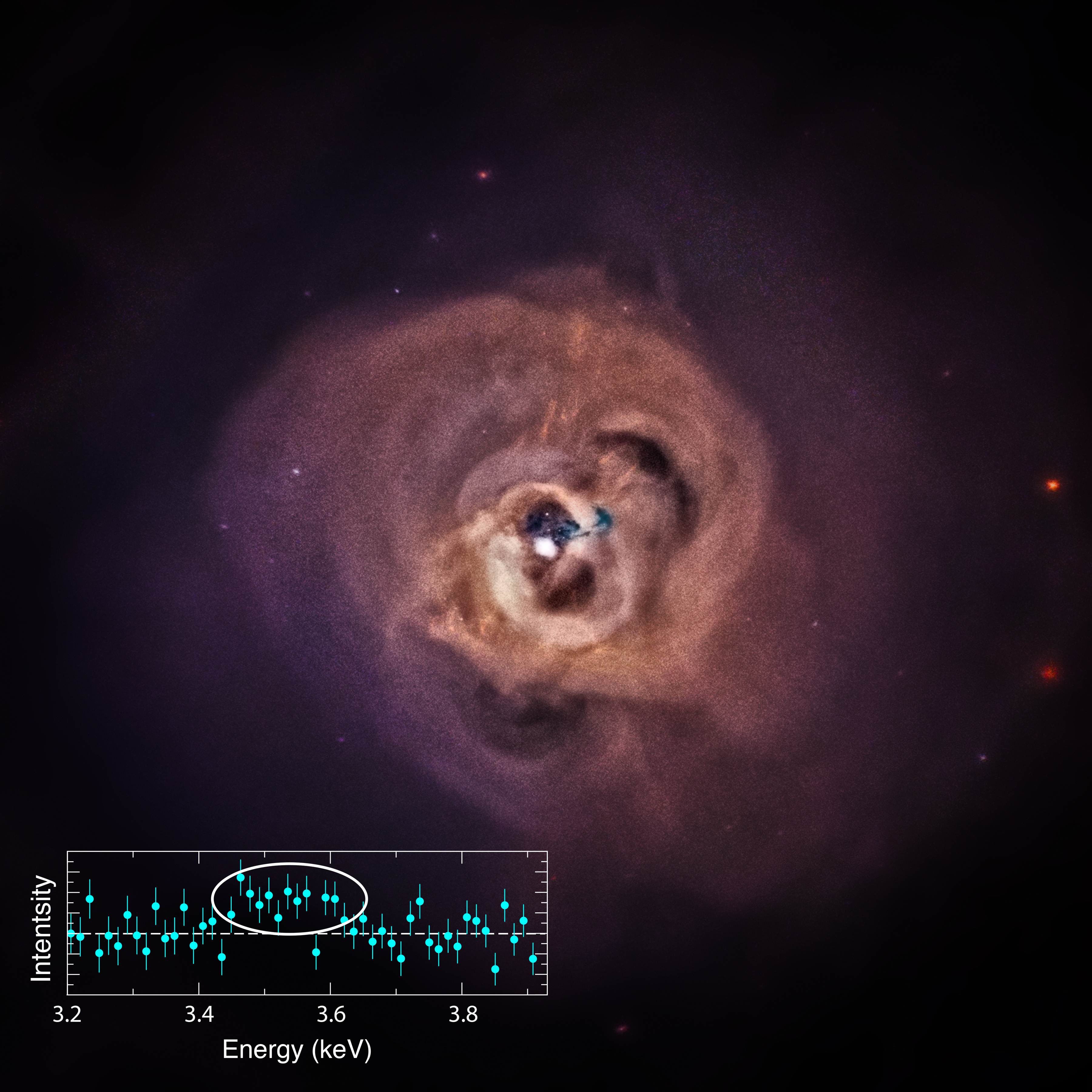
English: A new study of the central region of the Perseus galaxy cluster, shown in this image, using NASA's Chandra X-ray Observatory and 73 other clusters with ESA's XMM-Newton has revealed a mysterious X-ray signal in the data. This signal is represented in the circled data points in the inset, which is a plot of X-ray intensity as a function of X-ray energy. The signal is also seen in over 70 other galaxy clusters using XMM-Newton. This unidentified X-ray emission line - that is, a spike of intensity at a very specific energy, in this case centered on about 3.56 kiloelectron volts (keV) - requires further investigation to confirm both the signal's existence and nature as described in the latest Chandra press release.

One intriguing possible explanation of this X-ray emission line is that it is produced by the decay of sterile neutrinos, a type of particle that has been proposed as a candidate for dark matter. While holding exciting potential, these results must be confirmed with additional data to rule out other explanations and determine whether it is plausible that dark matter has been observed.

There is uncertainty in these results, in part, because the detection of this emission line is pushing the capabilities of both Chandra and XMM-Newton in terms of sensitivity. Also, there may be explanations other than sterile neutrinos if this X-ray emission line is deemed to be real. For example, there are ways that normal matter in the cluster could have produced the line, although the team's analysis suggested that all of these would involve unlikely changes to our understanding of physical conditions in the galaxy cluster or the details of the atomic physics of extremely hot gases.

This image is Chandra's latest view of hot gas in the central region of the Perseus Cluster, where red, green, and blue show low, medium, and high-energy X-rays respectively. It combines data equivalent to more than 17 days worth of observing time taken over a decade with Chandra. The Perseus Cluster is one of the most massive objects in the Universe, and contains thousands of galaxies immersed in an enormous cloud of superheated gas. In Chandra's X-ray image, enormous bright loops, ripples, and jet-like streaks throughout the cluster can be seen. The dark blue filaments in the center are likely due to a galaxy that has been torn apart and is falling into NGC 1275 (a.k.a. Perseus A), the giant galaxy that lies at the center of the cluster.
Tarih 24 Haziran 2014 (released)
Kaynak http://chandra.harvard.edu/photo/2014/perseus/ (image source)
Yazar NASA/CXC/SAO/E. Bulbul, et al.
İzin
(Bu dosyanın tekrar kullanımı)
Images from NASA usually are free of copyright.

Lisanslama

Public domainPublic domainfalsefalse
Public domain Bu dosya NASA tarafından üretildiği için kamu malıdır. Aksi belirtilmediği sürece "NASA tarafından üretilen malzemenin telif hakkı olmadığı" NASA telif politikasında belirtilmiştir. (Bkz. Template:PD-USGov, NASA copyright policy page veya JPL Image Use Policy.)
Uyarılar:
  • NASA logoları, işaret ve amblemlerinin kullanımı ABD yasaları uyarınca sınırlandırılmıştır 14 CFR 1221.
  • NASA internet sitesi, Sovyet / Rus uzay ajansı ve diğer sivil ABD uzay ajanslarına ait çok sayıda görüntü barındırmaktadır. Bunların bazıları kamu malı olmayabilir.
  • Bunlardan STScI tarafından üretildiği açıkça belirtilmeyen, Hubble Uzay Teleskobuna dayalı verilerin telif hakkı saklı olabilir.[1] Ayrıca bakınız {{PD-Hubble}} ve {{Cc-Hubble}} veya {{Spacetelescope.org}}.
  • SOHO (ESA & NASA) ortak projesi olan prob tarafından oluşturulan tüm materyallerin telif hakkı saklıdır ve ticari olmayan eğitim amaçlı kullanım için izin alınması gerektiği anlamına gelmektedir. [2]
  • Özellikle Günün Astronomi Görüntülerinin (APOD) internet sitesinde telif hakkı saklı olabilir. [3]
Annotations
InfoField
This image is annotated: View the annotations at Commons
1668
1650
366
270
3600
3600

NGC 1275

Altyazılar

Bu dosyanın temsil ettiği şeyin tek satırlık açıklamasını ekleyin.

Bu dosyada gösterilen öğeler

betimlenen

telif hakkı durumu

kamu malı

geçerlilik alanı: Amerika Birleşik Devletleri
tespit yöntemi: work of the federal government of the United States İngilizce

kuruluşu

24 Haziran 2014

ortam türü

image/jpeg

Dosya geçmişi

Dosyanın herhangi bir zamandaki hâli için ilgili tarih/saat kısmına tıklayın.

Tarih/SaatKüçük resimBoyutlarKullanıcıYorum
güncel15.36, 25 Haziran 201415.36, 25 Haziran 2014 tarihindeki sürümün küçültülmüş hâli3.600 × 3.600 (6,9 MB)DrbogdanUser created page with UploadWizard

Dosya kullanımı

Bu görüntü dosyasına bağlantısı olan sayfalar:

  • Küme içi ortam

Küresel dosya kullanımı

Aşağıdaki diğer vikiler bu dosyayı kullanmaktadır:

  • ar.wikipedia.org üzerinde kullanımı
    • عنقود حامل رأس الغول
  • cs.wikipedia.org üzerinde kullanımı
    • Kupa galaxií v Perseovi
  • en.wikipedia.org üzerinde kullanımı
    • Perseus Cluster
    • Intracluster medium
    • User:Drbingbing/sandbox
  • en.wikiversity.org üzerinde kullanımı
    • User:Marshallsumter/Radiation astronomy1/Neutrinos
  • es.wikipedia.org üzerinde kullanımı
    • Gas intracúmulo
  • fa.wikipedia.org üzerinde kullanımı
    • خوشه برساووش
  • ja.wikipedia.org üzerinde kullanımı
    • ステライルニュートリノ
  • simple.wikipedia.org üzerinde kullanımı
    • Intracluster medium
  • sv.wikipedia.org üzerinde kullanımı
    • Perseushopen
  • uk.wikipedia.org üzerinde kullanımı
    • Чандра (телескоп)
    • Скупчення Персея
  • vi.wikipedia.org üzerinde kullanımı
    • Cụm Anh Tiên

Üstveri

Bu dosyada, muhtemelen fotoğraf makinesi ya da tarayıcı tarafından eklenmiş ek bilgiler mevcuttur. Eğer dosyada sonradan değişiklik yapıldıysa, bazı bilgiler yeni değişikliğe göre eski kalmış olabilir.

Resim başlığı
  • A new study of the Perseus galaxy cluster, shown in this image, and others using Chandra and XMM-Newton has revealed a mysterious X-ray signal in the data. This signal is represented in the circled data points in the inset, which is a plot of X-ray intensity as a function of X-ray energy. The signal is also seen in over 70 other galaxy clusters using XMM-Newton. This unidentified X-ray emission line - a spike of intensity centered on about 3.56 kiloelectron volts - requires further investigation to confirm both the signal's existence and nature. One possibility is this signal is from the decay of sterile neutrinos, one proposed candidate to explain dark matter.
Yazar18 09:33:07
KaynakChandra X-ray Observatory
BaşlıkA giant collection of galaxies immersed in hot gas about 250 million light years from Earth.
Katkı/Sağlayıcı X-ray: NASA/CXC/SAO/E.Bulbul, et al.
Kısa başlık
  • Mysterious X-ray Signal Intrigues Astronomers
Kullanım şartları
  • http://chandra.harvard.edu/photo/image_use.html
Verinin ilk yaratılma zamanı24 Haziran 2014
Genişlik3.600 px
Yükseklik3.600 px
Bileşen başına bit sayısı
  • 0
  • 1
  • 0
Sıkıştırma şemasıSıkıştırılmamış
Piksel bileşimiRGB
YönlendirmeNormal
Bileşen sayısı3
Yatay çözünürlük0,84269634025785 dpi
Dikey çözünürlük0,17476533333333 dpi
Veri düzenitıknaz biçimi
Dosya değişiklik tarihi ve zamanı6 (Windows)
Exif sürümü2.21
Renk aralığısRGB
Dijitalleştirme zamanı13.21, 22 Mayıs 2014
Üst veri son değişim tarihi11.47, 23 Haziran 2014
Oylama (5 üzerinden)0
Kullanılan yazılımAdobe Photoshop CS6 (Macintosh)
Özgün belgenin benzersiz kimliği2326CE1C087E657932BE0945BAE97C73
Anahtar kelimelerPerseus A
İletişim bilgilericxcpub@cfa.harvard.edu

http://chandra.harvard.edu

60 Garden St.

Cambridge, MA, 02138 USA

617.496.7941
IIM sürümü4
"https://tr.wikipedia.org/wiki/Dosya:NASA-PerseusGalaxyCluster-ChandraXRayObservatory-20140624.jpg" sayfasından alınmıştır
  • Gizlilik politikası
  • Vikipedi hakkında
  • Sorumluluk reddi
  • Davranış Kuralları
  • Geliştiriciler
  • İstatistikler
  • Çerez politikası
  • Mobil görünüm
  • Wikimedia Foundation
  • Powered by MediaWiki
Dosya:NASA-PerseusGalaxyCluster-ChandraXRayObservatory-20140624.jpg
Konu ekle