


Dosya:NASA-14114-HubbleSpaceTelescope-DebrisDisks-20140424.jpg
 | Bu dosya Wikimedia Commons'ta bulunmaktadır. Dosyanın açıklaması aşağıda gösterilmiştir. Commons, serbest/özgür telifli medya dosyalarının bulundurulduğu depodur. Siz de yardım edebilirsiniz. |


Özet
| Açıklama |
English: April 24, 2014
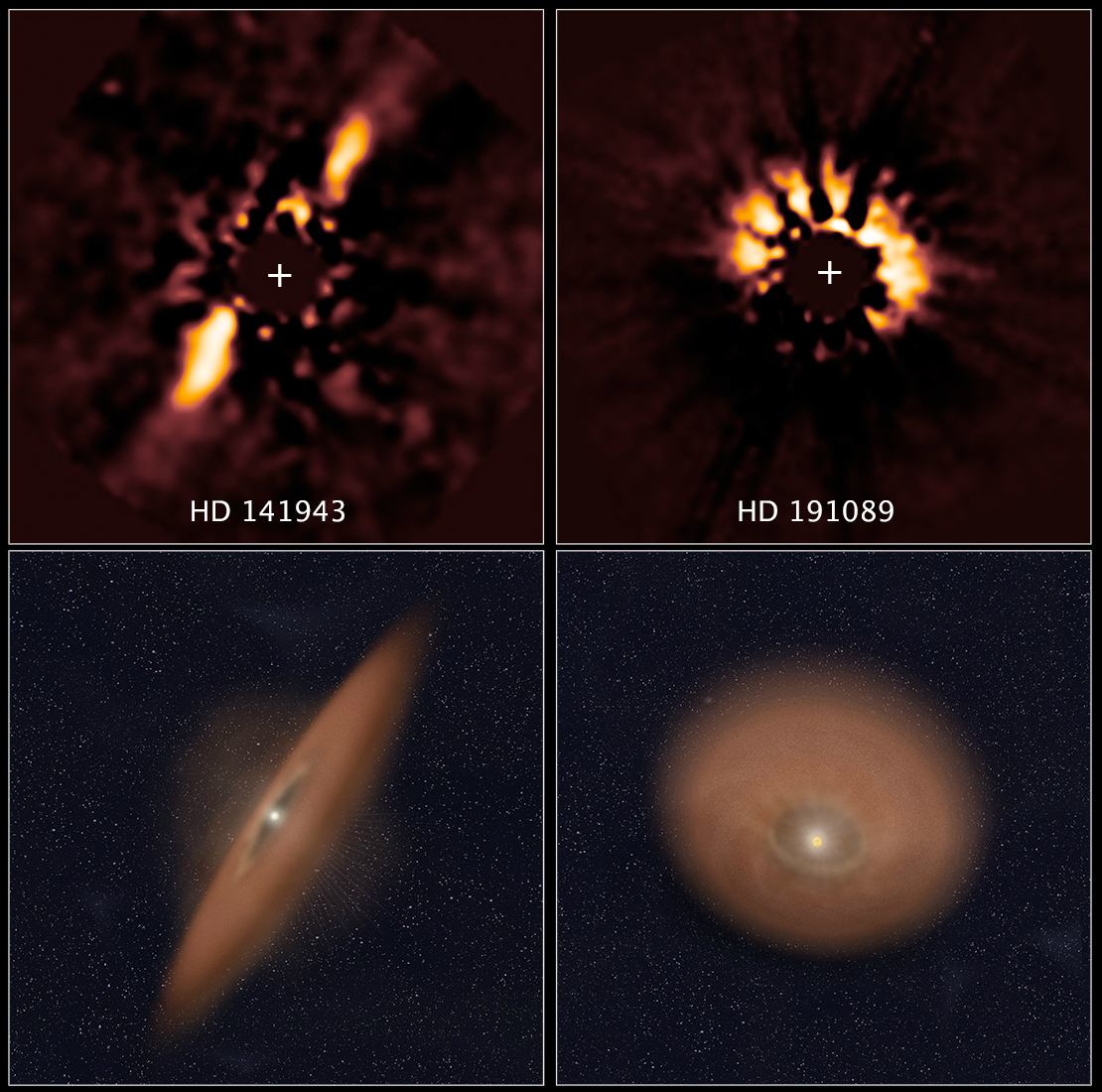
RELEASE 14-114 Astronomical Forensics Uncover Planetary Disks in NASA's Hubble Archive Debris disks around young stars The two images at top reveal debris disks around young stars uncovered in archival images taken by NASA’s Hubble Space Telescope. The illustration beneath each image depicts the orientation of the debris disks. Image Credit: NASA/ESA, R. Soummer, Ann Feild (STScI) Astronomers using NASA's Hubble Space Telescope have applied a new image processing technique to obtain near-infrared scattered light photos of five disks observed around young stars in the Mikulski Archive for Space Telescopes database. These disks are telltale evidence for newly formed planets. If astronomers initially miss something in their review of data, they can make new discoveries by revisiting earlier data with new image processing techniques, thanks to the wealth of information stored in the Hubble data archive. This is what Rémi Soummer, of the Space Telescope Science Institute (STScI) in Baltimore, Md., and his team recently did while on a hunt for hidden Hubble treasures. The stars in question initially were targeted with Hubble's Near Infrared Camera and Multi-Object Spectrometer (NICMOS) based on unusual heat signatures obtained from NASA's Spitzer Space Telescope and the Infrared Astronomical Satellite that flew in 1983. The previous data provided interesting clues that dusty disks could exist around these stars. Small dust particles in the disks might scatter light and therefore make the disks visible. But when Hubble first viewed the stars between 1999 and 2006, no disks were detected in the NICMOS pictures. Recently, with improvements in image processing, including algorithms used for face-recognition software, Soummer and his team reanalyzed the archived images. This time, they could unequivocally see the debris disks and even determine their shapes. The NICMOS instrument, which began collecting data in 1997, has been so cutting-edge that ground-based technology only now is beginning to match its power. Because Hubble has been in operation for almost 24 years, it provides a long baseline of high-quality archival observations. "Now, with such new technologies in image processing, we can go back to the archive and conduct research more precisely than previously possible with NICMOS data," said Dean Hines of STScI. "These findings increase the number of debris disks seen in scattered light from 18 to 23. By significantly adding to the known population and by showing the variety of shapes in these new disks, Hubble can help astronomers learn more about how planetary systems form and evolve," said Soummer. The dust in the disks is hypothesized to be produced by collisions between small planetary bodies such as asteroids. The debris disks are composed of dust particles formed from these grinding collisions. The tiniest particles are constantly blown outward by radiation pressure from the star. This means they must be replenished continuously though more collisions. This game of bumper cars was common in the solar system 4.5 billion years ago. Earth's moon and the satellite system around Pluto are considered to be collisional byproducts. "One star that is particularly interesting is HD 141943," said Christine Chen, debris disk expert and team member. "It is an exact twin of our sun during the epoch of terrestrial planet formation in our own solar system." Hubble found the star exhibits an asymmetrical, edge-on disk. This asymmetry could be evidence the disk is being gravitationally sculpted by the tug of one or more unseen planets. "Being able to see these disks now also has let us plan further observations to study them in even more detail using other Hubble instruments and large telescopes on the ground," added Marshall Perrin of STScI. "We also are working to implement the same techniques as a standard processing method for NASA's upcoming James Webb Space Telescope," said STScI teammate Laurent Pueyo. "These disks will also be prime targets for the Webb telescope." Soummer's team has just begun its work. They next will search for structures in the disks that suggest the presence of planets. The Hubble Space Telescope is a project of international cooperation between NASA and the European Space Agency. NASA's Goddard Space Flight Center in Greenbelt, Md., manages the telescope. STScI in Baltimore conducts Hubble science operations. STScI is operated for NASA by the Association of Universities for Research in Astronomy, Inc., in Washington. For images and more information about Hubble, visit: http://www.nasa.gov/hubble |
| Tarih | |
| Kaynak | http://www.nasa.gov/sites/default/files/14-114-hubble2_0.jpg |
| Yazar | NASA/ESA, R. Soummer, Ann Feild (STScI) |

Lisanslama

|
Bu dosya NASA tarafından üretildiği için kamu malıdır. Aksi belirtilmediği sürece "NASA tarafından üretilen malzemenin telif hakkı olmadığı" NASA telif politikasında belirtilmiştir. (Bkz. Template:PD-USGov, NASA copyright policy page veya JPL Image Use Policy.) |  |
 |
Uyarılar:
|
Dosya geçmişi
Dosyanın herhangi bir zamandaki hâli için ilgili tarih/saat kısmına tıklayın.
| Tarih/Saat | Küçük resim | Boyutlar | Kullanıcı | Yorum | |
|---|---|---|---|---|---|
| güncel | 13.19, 25 Nisan 2014 | | 1.110 × 1.100 (930 KB) | Drbogdan | User created page with UploadWizard |
Dosya kullanımı
Bu görüntü dosyasına bağlantısı olan sayfalar:
Küresel dosya kullanımı
Aşağıdaki diğer vikiler bu dosyayı kullanmaktadır:
- ar.wikipedia.org üzerinde kullanımı
- ast.wikipedia.org üzerinde kullanımı
- bn.wikipedia.org üzerinde kullanımı
- bs.wikipedia.org üzerinde kullanımı
- el.wikipedia.org üzerinde kullanımı
- en.wikipedia.org üzerinde kullanımı
- es.wikipedia.org üzerinde kullanımı
- fa.wikipedia.org üzerinde kullanımı
- fr.wikipedia.org üzerinde kullanımı
- he.wikipedia.org üzerinde kullanımı
- hi.wikipedia.org üzerinde kullanımı
- hr.wikipedia.org üzerinde kullanımı
- id.wikipedia.org üzerinde kullanımı
- ig.wikipedia.org üzerinde kullanımı
- ja.wikipedia.org üzerinde kullanımı
- ka.wikipedia.org üzerinde kullanımı
- ko.wikipedia.org üzerinde kullanımı
- lt.wikipedia.org üzerinde kullanımı
- mk.wikipedia.org üzerinde kullanımı
- ms.wikipedia.org üzerinde kullanımı
- nl.wikipedia.org üzerinde kullanımı
- oc.wikipedia.org üzerinde kullanımı
- pt.wikipedia.org üzerinde kullanımı
- ru.wikipedia.org üzerinde kullanımı
- sr.wikipedia.org üzerinde kullanımı
- sv.wikipedia.org üzerinde kullanımı
- tt.wikipedia.org üzerinde kullanımı
- uk.wikipedia.org üzerinde kullanımı
- vi.wikipedia.org üzerinde kullanımı
- www.wikidata.org üzerinde kullanımı
- zh.wikipedia.org üzerinde kullanımı
