


Dosya:NASA's Hubble Reveals Rogue Planetary Orbit For Fomalhaut B.jpg
 | Bu dosya Wikimedia Commons'ta bulunmaktadır. Dosyanın açıklaması aşağıda gösterilmiştir. Commons, serbest/özgür telifli medya dosyalarının bulundurulduğu depodur. Siz de yardım edebilirsiniz. |


Özet
| Açıklama |
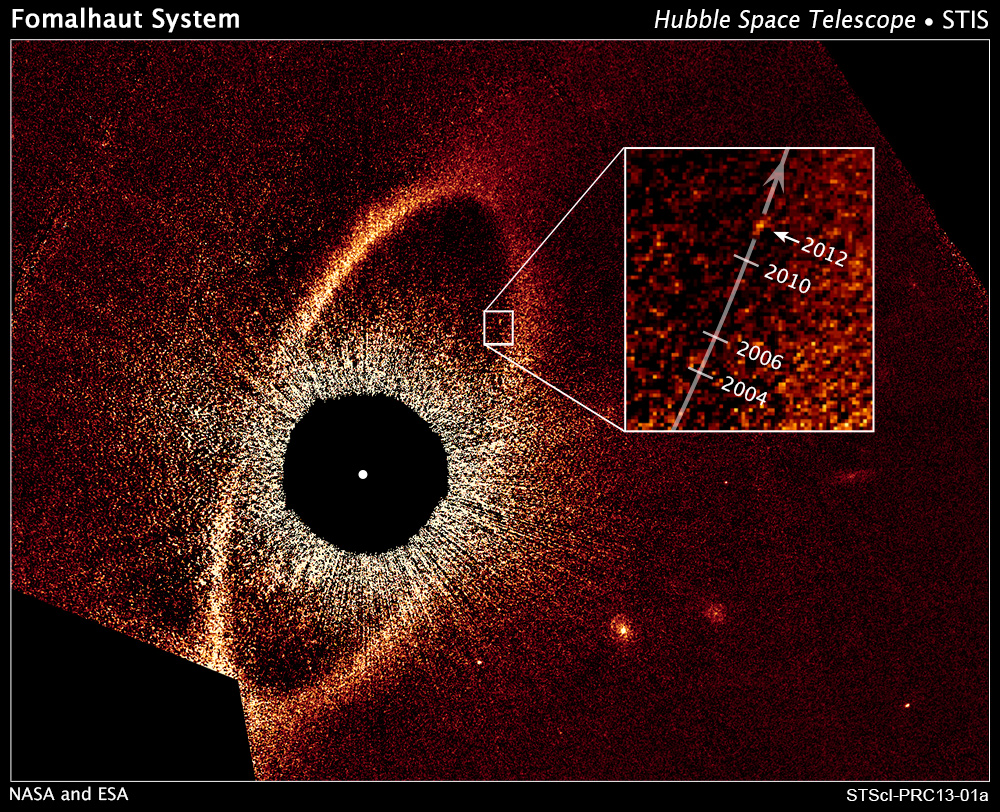
English: NASA's Hubble Reveals Rogue Planetary Orbit For Fomalhaut B01.08.13
This false-color composite image, taken with the Hubble Space Telescope, reveals the orbital motion of the planet Fomalhaut b. Based on these observations, astronomers calculated that the planet is in a 2,000-year-long, highly elliptical orbit. The planet will appear to cross a vast belt of debris around the star roughly 20 years from now. If the planet's orbit lies in the same plane with the belt, icy and rocky debris in the belt could crash into the planet's atmosphere and produce various phenomena. The black circle at the center of the image blocks out the light from the bright star, allowing reflected light from the belt and planet to be photographed. The Hubble images were taken with the Space Telescope Imaging Spectrograph in 2010 and 2012. Credit: NASA, ESA, and P. Kalas (University of California, Berkeley and SETI Institute) Newly released NASA Hubble Space Telescope images of a vast debris disk encircling the nearby star Fomalhaut and a mysterious planet circling it may provide forensic evidence of a titanic planetary disruption in the system. Astronomers are surprised to find the debris belt is wider than previously known, spanning a section of space from 14 to nearly 20 billion miles (23 and 32 billion kilometers, respectively) from the star. Even more surprisingly, the latest Hubble images have allowed a team of astronomers to calculate the planet follows an unusual elliptical orbit that carries it on a potentially destructive path through the vast dust ring. The planet, called Fomalhaut b, swings as close to its star as 4.6 billion miles (7.4 billion kilometers or 49 AU), and the outermost point of its orbit is 27 billion miles (43 billion kilometers or 290 AU) away from the star. The orbit was recalculated from the newest Hubble observation made last year. "We are shocked. This is not what we expected," said Paul Kalas of the University of California at Berkeley and the SETI Institute in Mountain View, Calif. The Fomalhaut team led by Kalas considers this circumstantial evidence there may be other planet-like bodies in the system that gravitationally disturbed Fomalhaut b to place it in such a highly eccentric orbit. The team presented its finding Tuesday at the 221st meeting of the American Astronomical Society in Long Beach, Calif. Among several scenarios to explain Fomalhaut b's 2,000-year-long orbit is the hypothesis that an as yet undiscovered planet gravitationally ejected Fomalhaut b from a position closer to the star, and sent it flying in an orbit that extends beyond the dust belt. "Hot Jupiters get tossed through scattering events, where one planet goes in and one gets thrown out," said co-investigator Mark Clampin of NASA's Goddard Space Flight Center in Greenbelt, Md. "This could be the planet that gets thrown out." Hubble also found the dust and ice belt encircling the star Fomalhaut has an apparent gap slicing across the belt. This might have been carved by another undetected planet. Hubble's exquisite view of the dust belt shows irregularities that strongly motivate a search for other planets in the system. If its orbit lies in the same plane with the dust belt, then Fomalhaut b will intersect the belt around 2032 on the outbound leg of its orbit. During the crossing, icy and rocky debris in the belt could crash into the planet's atmosphere and create the type of cosmic fireworks seen when Comet Shoemaker-Levy 9 crashed into Jupiter. Most of the fireworks from collisions will be seen in infrared light. However, if Fomalhaut b is not co-planar with the belt, the only thing to be seen will be a gradual dimming of Fomalhaut b as it travels farther from the star. Kalas hypothesized that Fomalhaut b's extreme orbit is a major clue in explaining why the planet is unusually bright in visible light, but very dim in infrared light. It is possible the planet's optical brightness originates from a ring or shroud of dust around the planet, which reflects starlight. The dust would be rapidly produced by satellites orbiting the planet, which would suffer extreme erosion by impacts and gravitational stirring when Fomalhaut b enters into the planetary system after a millennium of deep freeze beyond the main belt. An analogy can be found by looking at Saturn, which has a tenuous, but very large dust ring produced when meteoroids hit the outer moon Phoebe. The team has also considered a different scenario where a hypothetical second dwarf planet suffered a catastrophic collision with Fomalhaut b. The collision scenario would explain why the star Fomalhaut has a narrow outer belt linked to an extreme planet. But in this case the belt is young, less than 10,000 years old, and it is difficult to produce energetic collisions far from the star in such young systems. Fomalhaut is a special system because it looks like scientists may have a snapshot of what our solar system was doing 4 billion years ago. The planetary architecture is being redrawn, the comet belts are evolving, and planets may be gaining and losing their moons. Astronomers will continue monitoring Fomalhaut b for decades to come because they may have a chance to observe a planet entering an icy debris belt that is like the Kuiper Belt at the fringe of our own solar system. RELEASE: 13-005 |
| Tarih | |
| Kaynak | https://www.nasa.gov/mission_pages/hubble/science/rogue-fomalhaut.html (image link) |
| Yazar | NASA, ESA, and P. Kalas (University of California, Berkeley and SETI Institute) |

Lisanslama

|
This file is in the public domain because it was created by NASA and ESA. NASA Hubble material (and ESA Hubble material prior to 2009) is copyright-free and may be freely used as in the public domain without fee, on the condition that only NASA, STScI, and/or ESA is credited as the source of the material. This license does not apply if ESA material created after 2008 or source material from other organizations is in use.
The material was created for NASA by Space Telescope Science Institute under Contract NAS5-26555, or for ESA by the Hubble European Space Agency Information Centre. Copyright statement at hubblesite.org or 2008 copyright statement at spacetelescope.org. For material created by the European Space Agency on the spacetelescope.org site since 2009, use the {{ESA-Hubble}} tag. |
Dosya geçmişi
Dosyanın herhangi bir zamandaki hâli için ilgili tarih/saat kısmına tıklayın.
| Tarih/Saat | Küçük resim | Boyutlar | Kullanıcı | Yorum | |
|---|---|---|---|---|---|
| güncel | 03.50, 10 Ocak 2013 | | 1.000 × 812 (789 KB) | Drbogdan | User created page with UploadWizard |
Dosya kullanımı
Bu görüntü dosyasına bağlantısı olan sayfalar:
Küresel dosya kullanımı
Aşağıdaki diğer vikiler bu dosyayı kullanmaktadır:
- ar.wikipedia.org üzerinde kullanımı
- bg.wikipedia.org üzerinde kullanımı
- cs.wikipedia.org üzerinde kullanımı
- da.wikipedia.org üzerinde kullanımı
- el.wikipedia.org üzerinde kullanımı
- en.wikipedia.org üzerinde kullanımı
- es.wikipedia.org üzerinde kullanımı
- fa.wikipedia.org üzerinde kullanımı
- fi.wikipedia.org üzerinde kullanımı
- fr.wikipedia.org üzerinde kullanımı
- ja.wikipedia.org üzerinde kullanımı
- ko.wikipedia.org üzerinde kullanımı
- mk.wikipedia.org üzerinde kullanımı
- ml.wikipedia.org üzerinde kullanımı
- pt.wikipedia.org üzerinde kullanımı
- ru.wikipedia.org üzerinde kullanımı
- sr.wikipedia.org üzerinde kullanımı
- uk.wikipedia.org üzerinde kullanımı
- vi.wikipedia.org üzerinde kullanımı
- war.wikipedia.org üzerinde kullanımı
- zh.wikipedia.org üzerinde kullanımı
