Dosya:M27 - Dumbbell Nebula.jpg - Vikipedi
İçeriğe atla
Ana menü
Gezinti
  • Anasayfa
  • Hakkımızda
  • İçindekiler
  • Rastgele madde
  • Seçkin içerik
  • Yakınımdakiler
Katılım
  • Deneme tahtası
  • Köy çeşmesi
  • Son değişiklikler
  • Dosya yükle
  • Topluluk portalı
  • Wikimedia dükkânı
  • Yardım
  • Özel sayfalar
Vikipedi Özgür Ansiklopedi
Ara
  • Bağış yapın
  • Hesap oluştur
  • Oturum aç
  • Bağış yapın
  • Hesap oluştur
  • Oturum aç

Dosya:M27 - Dumbbell Nebula.jpg

Sayfa içeriği diğer dillerde desteklenmemektedir.
  • Dosya
  • Tartışma
  • Oku
  • Wikimedia Commons üzerinde gör
  • Yerel açıklama ekle
  • Yerel açıklama kaynağı ekle
Araçlar
Eylemler
  • Oku
  • Wikimedia Commons üzerinde gör
  • Yerel açıklama ekle
  • Yerel açıklama kaynağı ekle
Genel
  • Sayfaya bağlantılar
  • Basılmaya uygun görünüm
  • Sayfa bilgisi
  • Kısaltılmış URL'yi al
  • Karekodu indir
Diğer projelerde
Görünüm
Vikipedi, özgür ansiklopedi
  • Dosya
  • Dosya geçmişi
  • Dosya kullanımı
  • Küresel dosya kullanımı
  • Üstveri
Dosya:M27 - Dumbbell Nebula.jpg
Bu önizlemenin boyutu: 600 × 599 piksel. Diğer çözünürlükler: 240 × 240 piksel | 480 × 480 piksel | 769 × 768 piksel | 1.025 × 1.024 piksel | 2.044 × 2.042 piksel.
Tam çözünürlük ((2.044 × 2.042 piksel, dosya boyutu: 1,74 MB, MIME tipi: image/jpeg))
Bu dosya Wikimedia Commons'ta bulunmaktadır. Dosyanın açıklaması aşağıda gösterilmiştir.
Commons, serbest/özgür telifli medya dosyalarının bulundurulduğu depodur. Siz de yardım edebilirsiniz.
Bu dosya Wikimedia Commons'ta bulunmaktadır.

AçıklamaM27 - Dumbbell Nebula.jpg
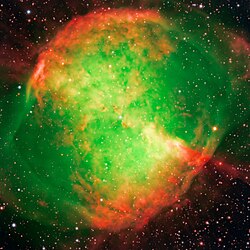
English: The Dumbbell Nebula

The Dumbbell Nebula ­— also known as Messier 27 or NGC 6853 — is a typical planetary nebula and is located in the constellation Vulpecula (The Fox). The distance is rather uncertain, but is believed to be around 1,200 light-years. It was first described by the French astronomer and comet hunter Charles Messier who found it in 1764 and included it as no. 27 in his famous list of extended sky objects [2] .Despite its class, the Dumbbell Nebula has nothing to do with planets. It consists of very rarified gas that has been ejected from the hot central star (well visible on this photo), now in one of the last evolutionary stages. The gas atoms in the nebula are excited (heated) by the intense ultraviolet radiation from this star and emit strongly at specific wavelengths.

This image is the beautiful by-product of a technical test of some FORS1 narrow-band optical interference filtres. They only allow light in a small wavelength range to pass and are used to isolate emissions from particular atoms and ions. In this three-colour composite, a short exposure was first made through a wide-band filtre registering blue light from the nebula. It was then combined with exposures through two interference filtres in the light of double-ionized oxygen atoms and atomic hydrogen. They were colour-coded as “blue”, “green” and “red”, respectively, and then combined to produce this picture that shows the structure of the nebula in “approximately true” colours.

They are three-colour composite based on two interference ([OIII] at 501 nm and 6 nm FWHM — 5 min exposure time; H-alpha at 656 nm and 6 nm FWHM — 5 min) and one broadband (Bessell B at 429 nm and 88 nm FWHM; 30 sec) filtre images, obtained on September 28, 1998, during mediocre seeing conditions (0.8 arcsec). The CCD camera has 2048 x 2048 pixels, each covering 24 x 24 µm and the sky fields shown measure 6.8 x 6.8 arcminutes and 3.5 x 3.9 arcminutes, respectively. North is up; East is left.

Credit:

ESO/I. Appenzeller, W. Seifert, O. Stahl, M. Zamani

Coordinates
Position (RA):  	19 59 36.41
Position (Dec): 	22° 43' 16.00"
Field of view:  	6.76 x 6.82 arcminutes
Orientation:    	North is 0.0° left of vertical
Colours & filters
Band            	Wavelength	Telescope
Optical u       	361 nm   	Very Large Telescope FORS1
Optical B       	429 nm   	Very Large Telescope FORS1
Optical Oiii    	501 nm   	Very Large Telescope FORS1
Optical HeII    	472 nm   	Very Large Telescope FORS1
Optical R       	655 nm   	Very Large Telescope FORS1
Optical H-alpha 	656 nm   g	Very Large Telescope FORS1
.
Tarih 7 Ekim 1998
Kaynak http://www.eso.org/public/images/eso9846a/
Yazar ESO
İzin
(Bu dosyanın tekrar kullanımı)
This media was created by the European Southern Observatory (ESO).
Their website states: "Unless specifically noted, the images, videos, and music distributed on the public ESO website, along with the texts of press releases, announcements, pictures of the week, blog posts and captions, are licensed under a Creative Commons Attribution 4.0 International License, and may on a non-exclusive basis be reproduced without fee provided the credit is clear and visible."
To the uploader: You must provide a link (URL) to the original file and the authorship information if available.
w:tr:Creative Commons
atıf
Bu dosya Creative Commons Atıf 4.0 Uluslararası lisansı altında lisanslanmıştır.
Şu seçeneklerde özgürsünüz:
  • paylaşım – eser paylaşımı, dağıtımı ve iletimi
  • içeriği değiştirip uyarlama – eser adaptasyonu
Aşağıdaki koşullar geçerli olacaktır:
  • atıf – Esere yazar veya lisans sahibi tarafından belirtilen (ancak sizi ya da eseri kullanımınızı desteklediklerini ileri sürmeyecek bir) şekilde atıfta bulunmalısınız.
https://creativecommons.org/licenses/by/4.0CC BY 4.0 Creative Commons Attribution 4.0 truetrue

Altyazılar

Bu dosyanın temsil ettiği şeyin tek satırlık açıklamasını ekleyin.

Bu dosyada gösterilen öğeler

betimlenen

telif hakkı durumu

telif hakkı alınmış

telif hakkı lisansı

Creative Commons Atıf 4.0 Uluslararası

kuruluşu

7 Ekim 1998

ortam türü

image/jpeg

Dosya geçmişi

Dosyanın herhangi bir zamandaki hâli için ilgili tarih/saat kısmına tıklayın.

Tarih/SaatKüçük resimBoyutlarKullanıcıYorum
güncel18.14, 25 Ağustos 202218.14, 25 Ağustos 2022 tarihindeki sürümün küçültülmüş hâli2.044 × 2.042 (1,74 MB)Fabian RRRRfrom the actual source
08.34, 2 Mart 201008.34, 2 Mart 2010 tarihindeki sürümün küçültülmüş hâli4.961 × 5.004 (3,04 MB)TryphonHigher resolution, from http://www.eso.org/public/archives/images/large/eso9846a.jpg.
09.02, 18 Eylül 200809.02, 18 Eylül 2008 tarihindeki sürümün küçültülmüş hâli3.966 × 4.000 (849 KB)Lars Lindberg Christensen{{Information |Description={{en|1=The Dumbbell Nebula - also known as Messier 27 or NGC 6853 - is a typical planetary nebula and is located in the constellation Vulpecula (The Fox). The distance is rather uncertain, but is believed to be around 1200 light

Dosya kullanımı

Bu görüntü dosyasına bağlantısı olan sayfalar:

  • Gezegenimsi bulutsular listesi

Küresel dosya kullanımı

Aşağıdaki diğer vikiler bu dosyayı kullanmaktadır:

  • af.wikipedia.org üzerinde kullanımı
    • Handgewignewel
    • Lys van planetêre newels
  • ar.wikipedia.org üzerinde kullanımı
    • سديم دمبل
    • مستخدم:TheFlyingHorse
    • قائمة السدم الكوكبية
  • arz.wikipedia.org üzerinde kullanımı
    • ڤالبيكولا
  • ast.wikipedia.org üzerinde kullanımı
    • Vulpecula
  • az.wikipedia.org üzerinde kullanımı
    • Messye cisimləri
  • bs.wikipedia.org üzerinde kullanımı
    • Messier 27
  • ca.wikipedia.org üzerinde kullanımı
    • Llista de nebuloses planetàries
  • ckb.wikipedia.org üzerinde kullanımı
    • تەنەکانی مێسییە
  • cs.wikipedia.org üzerinde kullanımı
    • Činka (mlhovina)
    • Seznam planetárních mlhovin
  • de.wikipedia.org üzerinde kullanımı
    • Hantelnebel
  • el.wikipedia.org üzerinde kullanımı
    • Νεφέλωμα του Αλτήρα
  • en.wikipedia.org üzerinde kullanımı
    • Messier object
    • Vulpecula
    • List of planetary nebulae
    • User:Sunfishtommy/sandbox
    • User:Exoplanetaryscience/sandbox
    • User:TheEagle107
  • en.wikibooks.org üzerinde kullanımı
    • Messier Index/M27
    • Messier Index/Print Version/2
  • es.wikipedia.org üzerinde kullanımı
    • Vulpecula
  • et.wikipedia.org üzerinde kullanımı
    • Rebane (tähtkuju)
  • eu.wikipedia.org üzerinde kullanımı
    • Halteraren nebulosa
  • fi.wikipedia.org üzerinde kullanımı
    • Nostopainosumu
  • fr.wikipedia.org üzerinde kullanımı
    • Nébuleuse de l'Haltère
    • Listes de nébuleuses planétaires
  • fr.wikibooks.org üzerinde kullanımı
    • Mini-guide du catalogue Messier/Nébuleuses
  • he.wikipedia.org üzerinde kullanımı
    • ערפילית המשקולת
  • hu.wikipedia.org üzerinde kullanımı
    • Súlyzó-köd
  • id.wikipedia.org üzerinde kullanımı
    • Objek Messier
    • Nebula Dumbbell
  • it.wikipedia.org üzerinde kullanımı
    • Galassia di Andromeda
    • Galassia del Triangolo
    • Nebulosa di Orione
    • Nebulosa Granchio
    • Catalogo di Messier
    • Galassia Virgo A
    • M4 (astronomia)
    • Ammasso Farfalla
    • M7 (astronomia)
    • Nebulosa Laguna
    • M11 (astronomia)
    • Galassia Sombrero
    • Nebulosa Trifida
    • Nebulosa Manubrio
    • Nebulosa Anello
    • Galassia Occhio Nero

Bu dosyanın daha fazla küresel kullanımını görüntüle.

Üstveri

Bu dosyada, muhtemelen fotoğraf makinesi ya da tarayıcı tarafından eklenmiş ek bilgiler mevcuttur. Eğer dosyada sonradan değişiklik yapıldıysa, bazı bilgiler yeni değişikliğe göre eski kalmış olabilir.

Katkı/SağlayıcıESO/I. Appenzeller, W. Seifert, O. Stahl, M. Zamani
KaynakEuropean Southern Observatory
Kısa başlık
  • The Dumbbell Nebula
Resim başlığı
  • The Dumbbell Nebula­— also known as Messier 27 or NGC 6853 — is a typical planetary nebula and is located in the constellation Vulpecula (The Fox). The distance is rather uncertain, but is believed to be around 1,200 light-years. It was first described by the French astronomer and comet hunter Charles Messier whofound it in 1764 and included it as no. 27 in his famous list of extended sky objects [2] .Despite its class, the Dumbbell Nebula has nothing to do with planets. It consists of very rarified gas that has been ejected from the hot central star (well visible on this photo), now in one of the last evolutionary stages. The gas atoms in the nebula are excited (heated) by the intense ultraviolet radiation from this star and emit strongly at specific wavelengths.This image is the beautiful by-product of a technical test of some FORS1 narrow-band optical interference filtres. They only allow light ina small wavelength range to pass and are used to isolate emissions from particular atoms and ions. In this three-colour composite, a short exposure was first made through a wide-band filtre registering blue light from the nebula. It was then combined with exposures through two interference filtresin the light of double-ionized oxygen atoms and atomic hydrogen. They were colour-coded as “blue”, “green” and “red”, respectively, and then combined to produce this picture that shows the structure of the nebula in “approximately true” colours.They are three-colour composite based on two interference ([OIII] at 501 nm and 6 nm FWHM — 5 min exposure time; H-alpha at 656 nm and 6 nm FWHM — 5 min) and one broadband (Bessell B at 429 nm and 88 nm FWHM; 30 sec) filtre images, obtained on September 28, 1998, during mediocre seeing conditions (0.8 arcsec). The CCD camera has 2048 x 2048 pixels, each covering 24 x 24 µm and the sky fields shown measure 6.8 x 6.8 arcminutes and 3.5 x 3.9 arcminutes, respectively. North is up; East is left.
Kullanım şartları
  • Creative Commons Attribution 4.0 International License
Verinin ilk yaratılma zamanı00.00, 7 Ekim 1998
JPEG dosyası yorumuThe Dumbbell Nebula ­— also known as Messier 27 or NGC 6853 — is a typical planetary nebula and is located in the constellation Vulpecula (The Fox). The distance is rather uncertain, but is believed to be around 1,200 light-years. It was first described by the French astronomer and comet hunter Charles Messier who found it in 1764 and included it as no. 27 in his famous list of extended sky objects [2] .Despite its class, the Dumbbell Nebula has nothing to do with planets. It consists of very rarified gas that has been ejected from the hot central star (well visible on this photo), now in one of the last evolutionary stages. The gas atoms in the nebula are excited (heated) by the intense ultraviolet radiation from this star and emit strongly at specific wavelengths.This image is the beautiful by-product of a technical test of some FORS1 narrow-band optical interference filtres. They only allow light in a small wavelength range to pass and are used to isolate emissions from particular atoms and ions. In this three-colour composite, a short exposure was first made through a wide-band filtre registering blue light from the nebula. It was then combined with exposures through two interference filtres in the light of double-ionized oxygen atoms and atomic hydrogen. They were colour-coded as “blue”, “green” and “red”, respectively, and then combined to produce this picture that shows the structure of the nebula in “approximately true” colours.They are three-colour composite based on two interference ([OIII] at 501 nm and 6 nm FWHM — 5 min exposure time; H-alpha at 656 nm and 6 nm FWHM — 5 min) and one broadband (Bessell B at 429 nm and 88 nm FWHM; 30 sec) filtre images, obtained on September 28, 1998, during mediocre seeing conditions (0.8 arcsec). The CCD camera has 2048 x 2048 pixels, each covering 24 x 24 µm and the sky fields shown measure 6.8 x 6.8 arcminutes and 3.5 x 3.9 arcminutes, respectively. North is up; East is left.
Anahtar kelimeler
  • Dumbbell Nebula
  • M 27
  • Messier 27
  • NGC 6853
İletişim bilgileri

http://www.eso.org/

Karl-Schwarzschild-Strasse 2

Garching bei München, None, D-85748 Germany

IIM sürümü4
"https://tr.wikipedia.org/wiki/Dosya:M27_-_Dumbbell_Nebula.jpg" sayfasından alınmıştır
  • Gizlilik politikası
  • Vikipedi hakkında
  • Sorumluluk reddi
  • Davranış Kuralları
  • Geliştiriciler
  • İstatistikler
  • Çerez politikası
  • Mobil görünüm
  • Wikimedia Foundation
  • Powered by MediaWiki
Dosya:M27 - Dumbbell Nebula.jpg
Konu ekle