


Dosya:Laser Towards Milky Ways Centre.jpg

 | Bu dosya Wikimedia Commons'ta bulunmaktadır. Dosyanın açıklaması aşağıda gösterilmiştir. Commons, serbest/özgür telifli medya dosyalarının bulundurulduğu depodur. Siz de yardım edebilirsiniz. |

Özet
| Açıklama |
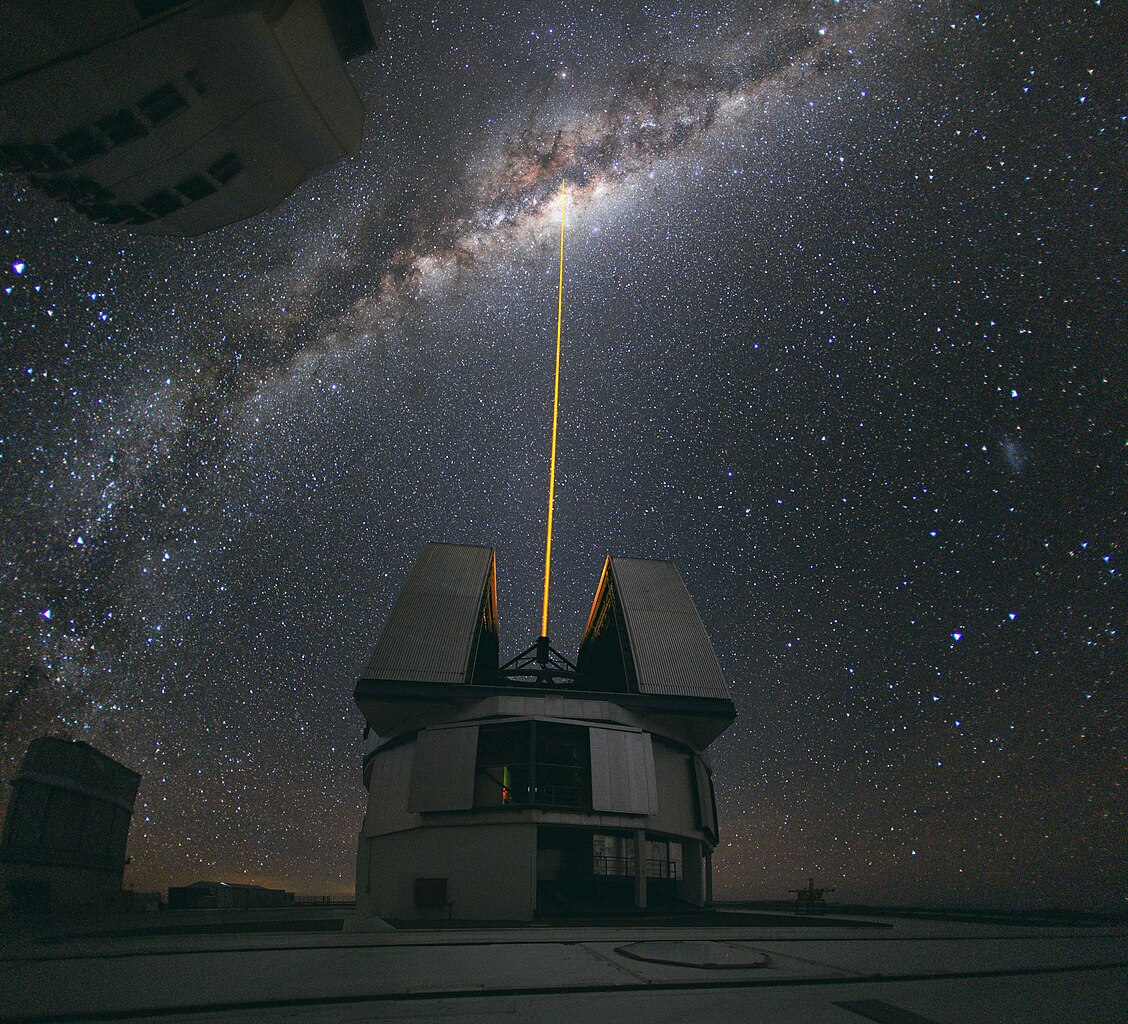
Afrikaans: Die ESO-fotoambassadeur Yuri Beletsky het hierdie foto in mid-Augustus 2010 by die ESO se Paranal-sterrewag in Chili bekom. 'n Sterrekundige werkgroep was besig om die sentrum van die Melkweg met behulp van die lasergidsster-gerief te Yepun, een van vier eenheidsteleskope van die Baie Groot Teleskoop (BGT), te bestudeer. Yepun se laserstraal oorspan die suiderhemel om sodoende kunsmatige sterlig 90 kilometer bo die aarde in die mesosfeer te vorm. Die lasergidsster (LGS) is deel van die BGT se aanpassende optiese konfigurasie wat 'n verwysingspunt vir korreksie van atmosferiese steuringseffekte op beelde skep. Die laser se kleur is gekalibreer om energie na 'n laag natriumatome in een van die boonste atmosferiese lae oor te dra, wat vermoedelik uit die reste van meteore bestaan. Die kenmerkende kleur van natriumstraatlampe kan aldus aan die laser herken word. Die atome wat deur die laser opgewek word begin te gloei, sodat 'n helder ligpunt gevorm word wat as 'n kunsmatige verwysingster vir die aanpassingsoptiek dien. Sodoende kan sterrekundiges duideliker waarnemings maak, byvoorbeeld hier waar die sentrum van die Melkweg onder die loep is. Navorsers kan die galaktiese middelpunt nou beter moniteer, 'n gebied waar 'n supermassiewe swartkolk gas en stof akkumuleer en 'n gravitasieveld oor die naaswentelende sterre werp. Die beeld is met 'n wyehoeklens verkry wat 'n hoek van sowat 180 grade onderspan. Deutsch: Mitte August 2010 machte der ESO-Fotobotschafter Yuri Beletsky dieses Foto des Paranal-Observatoriums der ESO. Eine Gruppe von Astronomen beobachtete das Zentrum der Milchstraße unter Verwendung der Vorrichtung zur Erzeugung eines künstlichen Leitsterns mit dem Yepun-Teleskop, einem der vier Unit-Teleskope des Very Large Telescope (VLT). Yepuns Laserstrahl durchquert den südlichen Himmel und erzeugt einen künstlichen Stern in 90 km Höhe in der Mesosphäre der Erde. Der Laser-Leitstern (LGS) ist ein Teil der adaptiven Optik des VLT und wird als Referenz zur Korrektur der durch die Atmosphäre verursachten Unschärfe-Effekte auf Aufnahmen verwendet. Die Farbe des Lasers ist exakt abgestimmt, um eine Schicht von Natrium-Atomen anzuregen, die sich in einer der oberen Schichten der Atmosphäre befindet – die bekannte Farbe der Natrium-Lampen der Straßenbeleuchtung lässt sich in der Farbe des Lasers wiedererkennen. Vermutlich ist diese Schicht von Natrium-Atomen ein Überrest von Meteoriten, die in die Erdatmosphäre eintreten. Wenn sie durch das Licht des Lasers angeregt werden, beginnen die Atome zu leuchten und bilden so einen kleinen hellen Fleck, der als künstlicher Referenzstern für die adaptive Optik benutzt werden kann. Mittels dieser Technik können Astronomen schärfere Beobachtungsergebnisse erhalten. Beispielsweise können Forscher bei der Beobachtung des Zentrums unserer Milchstraße besser den galaktischen Kern überwachen. In diesem verschluckt ein supermassereiches schwarzes Loch Gas und Staub, während es von nahen Sternen umkreist wird. English: In mid-August 2010 ESO Photo Ambassador Yuri Beletsky snapped this photo at ESO’s Paranal Observatory, Chile. A group of astronomers were observing the centre of the Milky Way using the laser guide star facility at Yepun, one of the four Unit Telescopes of the Very Large Telescope (VLT). Yepun’s laser beam crosses the southern sky and creates an artificial star at an altitude of 90 km high in the Earth's mesosphere. The Laser Guide Star (LGS) is part of the VLT’s adaptive optics system and is used as a reference to correct the blurring effect of the atmosphere on images. The colour of the laser is precisely tuned to energise a layer of sodium atoms found in one of the upper layers of the atmosphere — one can recognise the familiar colour of sodium street lamps in the colour of the laser. This layer of sodium atoms is thought to be a leftover from meteorites entering the Earth’s atmosphere. When excited by the light from the laser, the atoms start glowing, forming a small bright spot that can be used as an artificial reference star for the adaptive optics. Using this technique, astronomers can obtain sharper observations. For example, when looking towards the centre of our Milky Way, researchers can better monitor the galactic core, where a central supermassive black hole, surrounded by closely orbiting stars, is swallowing gas and dust. Español: A mediados de agosto de 2010 el embajador fotográfico del Observatorio Europeo Austral (ESO), Yuri Beletsky, tomó esta foto en el Observatorio Paranal del ESO, Chile. Un grupo de astrónomos observaban el centro de la Vía Láctea usando el sistema de estrella guía láser en Yepun, uno de los cuatro telescopios del Very Large Telescope (VLT).
El rayo láser de Yepun cruza el cielo del sur y crea una estrella artificial a una altitud de 90 km de altura en la mesosfera de la Tierra. La Estrella Guía Láser (LGS) es parte del sistema de óptica adaptativa del VLT y se utiliza como referencia para corregir el efecto borroso de la atmósfera en las imágenes. El color del láser está sintonizada precisamente para energizar una capa de átomos de sodio que se encuentran en una de las capas superiores de la atmósfera - uno puede reconocer el color familiar de las lámparas de sodio de la calle en el color del láser. Esta capa de átomos de sodio se piensa que es una reminiscencia de los meteoritos que entran en la atmósfera de la Tierra. Cuando es excitado por la luz desde el láser, los átomos comienzan a brillar intensamente, formando un pequeño punto brillante que se puede utilizar como una estrella de referencia artificial para la óptica adaptativa. Usando esta técnica, los astrónomos pueden obtener observaciones más agudas. Por ejemplo, cuando se mira hacia el centro de nuestra Vía Láctea, los investigadores pueden controlar mejor el núcleo galáctico, donde un agujero negro supermasivo en el centro, rodeado por las estrellas que orbitan cerca, está tragando gas y polvo. Français : Utilisation d'un laser pour observer en détail le centre galactique. Le laser du téléscope de Yepun sert de référence pour compenser les turbulences atmosphériques. Le laser est réglé sur la fréquence d'excitation du sodium, afin de faire réagir une couche de sodium dans la mésosphère, à 90 km d'altitude. Sa couleur jaune rappelle celle des lampes à sodium utilisées dans l'éclairage urbain. La couche de sodium dans l'atmosphère serait une trace laissée par les météorites qui la traversent. Lorsqu'elle est excitée par la lumière du laser, les atomes qui la composent émettent de la lumière, ce qui provoque la formation d'une « étoile artificielle ». L'optique adaptative l'utilise comme référence pour corriger sur les images le manque de netteté provoqué par l'atmosphère terrestre. Cette méthode permet d'étudier des détails fins du ciel tels que le centre galactique de la Voie Lactée, objet de l'étude menée ici. Les chercheurs peuvent notamment y suivre l'activité d'un trou noir supermassif qui absorbe des gaz et des poussières, entouré d'étoiles en orbite proche. Photo prise à la mi-août 2008 au VLT sur le Cerro Paranal, au Chili. La photo, prise avec un grand angle, couvre 180°.Galego: Foto tomada a mediados de agosto de 2010 por Yri Beletsky nas instalacións de Yepun, unha das catro instalacións telescópicas do VLT (siglas inglesas de Telescopio Moi Grande) do ESO (siglas inglesas do gl:Observatorio Espacial Europeo) de Cerro Paranal (Chile). A foto está tomada cun grande angular, que cobre arredor de 180º da bóveda celeste. Nela pode verse o uso dun láser para observar detalladamente o centro da nosa galaxia, a Vía Láctea. O láser provoca a creación dunha estrela artificial na mesosfera a 90 km de altitude, debido a que está sincronizado coa frecuencia de exticatión do sodio. Por iso, a súa cor amarela-laranxa lembra ás lámpadas de sodio usadas na iluminación urbana. Suponse que esta capa de átomos de sodio son os restos dos meteoritos que entran na atmosfera terrestre. Cando se excitan pola luz do láser, os átomos comezan a brillar formando un punto rechamante que pode usarse como unha estrela artificial de referencia para calibrar os sistemas ópticos: usando este sitema, os astrónomos poden obter observacións máis exactas. Por exemplo: cando se observa o centro da nosa galaxia, os investigadores poden controlar mellor o núcleo galáctico, onde un burato negro central supermasivo rodeado de estrelas orbitando moi preto, absorbe gas e po. Italiano: Il 6 agosto 2010, il Photo Ambassador dell'ESO, Yuri Beletsky, ha scattato questa fotografia all'Osservatorio astronomico del Paranal in Cile, dove un gruppo di astronomi stava osservando il centro della Via Lattea usando uno dei quattro telescopi ottici (chiamato "Yepun") del Very Large Telescope (VLT). Il raggio laser di Yepun attraversa il cielo australe e crea una stella artificiale ad un'altitudine di 90 chilometri, all'altezza della mesosfera della Terra. Questa Laser Guide Star (LGS) è parte del sistema ottico adattivo del VLT ed è usata come riferimento per correggere l'effetto blur dell'atmosfera sulle immagini. Il colore del laser è calibrato precisamente per energizzare uno strato di atomi di sodio che si trova in uno degli strati superiori dell'atmosfera — si può riconoscere il familiare colore dei lampioni stradali, che usano lampade al sodio. Si pensa che questo strato di atomi di sodio sia un residuo lasciato da meteoriti penetrati nell'atmosfera terrestre. Quando eccitati dalla luce emessa dal laser, gli atomi iniziano a brillare, formando un piccolo punto luminoso che può essere usato come stella artificiale di riferimento dall'ottica adattiva. Usando questa tecnica, gli atronomi possono ottenere osservazioni più precise. Per esempio, quando si osserva il centro della Via Lattea, i ricercatori possono monitorare meglio il centro galattico, dove un buco nero supermassiccio, circondato a breve distanza da stelle orbitanti, ingoia gas e polveri. Scattata con lenti panoramiche, questa fotografia copre il cielo a circa 180°. Português: Esta fotografia foi tirada em meados de agosto de 2010 no Observatório do Paranal do ESO. Um grupo de astrónomos estava a observar o centro da Via Láctea com o auxílio do sistema de estrela guia laser do Yepun, um dos quatro Telescópios Principais do Very Large Telescope (VLT).
O raio laser do Yepun atravessa o majestoso céu austral, criando uma estrela artificial a uma altitude de 90 km na mesosfera terrestre. A Estrela Guia Laser faz parte do sistema de ótica adaptativa do VLT e é usada como referência para corrigir as imagens astronómicas que aparecem desfocadas devido ao efeito de distorção da atmosfera. A cor do laser está calibrada de forma precisa de modo a que a sua energia excite uma faixa de átomos de sódio situada numa das camadas superiores da atmosfera - podemos reconhecer a cor familiar das lâmpadas de sódio da rua na cor do laser. Pensa-se que esta camada de átomos de sódio seja os resquícios de meteoritos que entram na atmosfera terrestre. Quando excitados pela radiação do laser, os átomos começam a brilhar, formando um pequeno ponto brilhante que pode ser usado como uma estrela de referência artificial para a ótica adaptativa. Com esta técnica, os astrónomos conseguem obter imagens muito mais nítidas. Por exemplo, quando olham na direção do centro da Via Láctea, os investigadores podem monitorizar melhor o núcleo galáctico, onde um buraco negro de elevada massa, rodeado por estrelas que o orbitam de muito perto, se encontra a engolir gás e poeira. A fotografia, que foi escolhida como Fotografia Astronómica do Dia a 6 de setembro de 2010 e Fotografia Wikimedia do Ano 2010, foi tirada com uma lente grande angular e cobre cerca de 180 graus no céu.Tiếng Việt: Chiếu tia laser hướng về tâm của Ngân Hà từ một trạm thiên văn đơn vị của hệ thống thiên văn VLT. Türkçe: 2010'un Ağustos ayında ESO Fotoğraf Büyükelçisi Yuri Beletsky ESO'nun Paranal Gözlemevi'nde bu inanılmaz fotoğrafı çekti. Bir grup gökbilimci Yepun (Çok Büyük Teleskop (VLT)'un dört teleskobundan biri)'un lazer kılavuz özelliğini kullanarak Samanyolu'nun merkezini gözlemledi. Русский: В августе 2010 г. группа астрономов наблюдала центр Млечного Пути с использованием лазерного оборудования телескопа Yepun (Венера на языке индейцев Мапуче), одного из четырех телескопов Очень Большого Телескопа Европейской южной обсерватории (англ. ESO), Обсерватория Паранал, Чили. Фото посла ESO Юрия Белецкого. Українська: В серпні 2010 р. група астрономів спостерігала центр Чумацького Шляху з використанням лазерного обладнання телескопа Yepun (Венера мовою індіанців Мапуче) (одного з чотирьох телескопів Дуже Великого Телескопа Європейської південної обсерваторії (англ. ESO), Обсерваторія Паранал, Чилі. Фото посла ESO Юрія Білецького. 日本語: ヨーロッパ南天天文台 (ESO) パラナル天文台(チリ)が備える4基の巨大望遠鏡の一つイェプン望遠鏡による、レーザーガイドを使用した天の川銀河の中心部の観測。2010年8月中旬、ESO のフォト・アンバサダーであるユーリ・ベレツキーの撮影。 中文(简体): 2010年八月中旬,ESO摄影大使Yuri Beletsky在ESO的智利帕瑞纳天文台拍了这张照片。一群天文学家正在用Yepun的激光导引星设施观测银河中心,Yepun是那个甚大望远镜望远镜中四个单元望远镜中的一个。 Yepus的激光束穿越南部的天空,在海拔90千米的地球中间层造了一个人工星。激光导引星是甚大望远镜的适应性光学系统的一部分,它作为一个参考点可以用来纠正大气层导致的图像的模糊。那束激光的颜色(频率)被精确地调谐用来激发上层大气中的一个钠原子层,你肯定能认出这束激光的颜色,就是你熟悉的街边钠灯的颜色。这层钠原子被认为进入地球大气层的陨石的残留物。当这些钠原子被激光激发后,这些原子开始闪烁,形成一个小亮点可以被适应性光学设备用作一个人工参考星。使用这种技术,天文学家可以获取更清晰的观测结果。例如,当观测银河中心时,研究人员可以更好地监视银心,那里有一个超大黑洞,被近处绕它旋转的恒星包围着,吞噬着气体和星际尘埃。 العربية : في أواسط شهر آب (أغسطس) سنة 2010م التقط مبعوث المرصد الأوروپي الجنوبي يوري بلتسكي هذه الصُورة في مرصد پارانال، بالتشيلي. كانت مجموعة من الفلكيين تُراقب مركز مجرَّة درب التبَّانة بِمبنى نجمة دليل الليزر في يپون، وهي إحدى وحدات المقراب (التلسكوپ) الأربع المُخصصة لِلمقراب فائق الضخامة. تعبر أشعَّة يپون الليزريَّة السماء الجنوبيَّة وتصنعُ نجمًا اصطناعيًّا على بُعد 90 كيلومترًا في طبقة المُتكوَّر الأوسط (الميزوسفير) من الغلاف الجوِّي لِلأرض. نجمة دليل الليزر هي جُزءٌ من النظام العدسي لِلمقراب فائق الضخامة وهي تُستعمل كدليل لِتصويب التأثير المُشوِّش لِلغلاف الجوِّي على الصُور المُلتقطة. يتمُّ ضبط لون الليزر بِدقَّةٍ مُتناهيةٍ في سبيل تنشيط إحدى طبقات ذرَّات الصوديوم الكائنة في إحدى الطبقات العُليا لِلغلاف الجوِّي — يُمكنُ لِلمرء مُلاحظة التطابق بين لون أشعَّة الليزر هذه ولون مصابيح الصوديوم المُستعملة لِإنارة شوارع المُدن. يُعتقدُ بِأنَّ هذه الطبقة من ذرَّات الصوديوم هي بقايا تركتها النيازك أثناء خرقها لِلغلاف الجوِّي. عندما تُثارُ الذرَّات بِواسطة أشعَّة الليزر، تبدأ بِالتوهُّج، فتُشكِّلُ نُقطة صغيرة لامعة يُمكنُ استعمالها كنجمٍ اصطناعيٍّ دليلٍ بِواسطة العدسات المُخصصة. باستخدام هذه التقنيَّة، يُمكنُ لِعُلماء الفلك أن يحصلوا على نتائج أدق لِدراساتهم. على سبيل المِثال، عند النظر إلى مركز مجرَّة درب التبَّانة، يُمكن لِلباحثين مُراقبة لُب المجرَّة بِدقَّةٍ أكبر، حيثُ يُوجدُ ثٌقبٌ أسودٌ مركزيّ ضخم، تُحيطُ به النُجوم، ويبتلع الغاز والغُبار. فارسی : این نگاره را امبسدور یوری بلتسکی در اواسط اوت ۲۰۱۰ گرفتهاست. گروهی از ستارهشناسان، مرکز کهکشان راه شیری را توسط ستاره هدایت لیزری در یپون (یکی از چهار عدد از بزرگترین تلسکوپهای دنیا) رصد میکردند. پرتوی لیزری «یپون» از قسمت جنوبی آسمان عبور میکند و ستارهای ساختگی در ۹۰ کیلومتری لایه مزوسفر زمین به وجود میآورد. رنگ لیزر برای انرژی دادن به اتمهای سدیم لایه بالایی اتمسفر تنظیم شده که همان رنگ آشنای لامپهای سدیم در خیابانها است. وقتی این اتمها توسط لیزر برانگیخته میشوند، شروع به تابش میکنند و نقطهٔ نورانی کوچکی را شکل میدهند که میتواند به عنوان یک ستاره مرجع ساختگی جهت انطباق نورها استفاده شود. با استفاده از این شیوه فناوری ستارهشناسان میتوانند به رصدهای دقیقتری دست یابند. برای مثال وقتی به سمت مرکز کهکشان راه شیری نگاه انداخته میشود، محققان بهتر میتوانند هسته کهکشان را ببینند، محلی که یک سیاهچاله فوق بزرگ توسط ستارههای که دور آن میگردند احاطه شده و گاز و خاکستر به خود جذب میکند. |
||
| Tarih | (released) | ||
| Kaynak |
|
||
| Yazar | ESO/Yuri Beletsky (ybialets at eso.org) | ||
| Diğer sürümler |
Bu dosyanın türev çalışmaları: |

| Kamera pozisyonu |  | Bu ve diğer görüntülerin konumlarını şurada belirle: OpenStreetMap |  |
|---|
Lisanslama
_logo.svg) |
This media was created by the European Southern Observatory (ESO).
Their website states: "Unless specifically noted, the images, videos, and music distributed on the public ESO website, along with the texts of press releases, announcements, pictures of the week, blog posts and captions, are licensed under a Creative Commons Attribution 4.0 International License, and may on a non-exclusive basis be reproduced without fee provided the credit is clear and visible." To the uploader: You must provide a link (URL) to the original file and the authorship information if available. |
  Bu dosya Creative Commons Atıf 4.0 Uluslararası lisansı altında lisanslanmıştır.
| |
Değerlendirme
|




|
Bu görüntü 11 Şubat 2011 tarihinde günün resmi olarak seçilmiştir. Görüntünün başlığı o tarihte aşağıdaki gibiydi: English: In mid-August 2010 ESO Photo Ambassador Yuri Beletsky snapped this amazing photo at ESO’s Paranal Observatory. A group of astronomers were observing the centre of the Milky Way using the laser guide star facility at Yepun, one of the four Unit Telescopes of the Very Large Telescope (VLT). Diğer diller:
Bahasa Melayu: Pada pertengahan bulan Ogos 2010, Duta Balai Cerap Selatan Eropah (ESO), Yuri Beletsky telah mengambil gambar yang menakjubkan di Balai Cerap Paranal ESO. Sekumpulan ahli astronomi ketika itu sedang memerhati pusat galaksi Bima Sakti menggunakan kemudahan panduan laser bintang di Yepun iaitu salah satu daripada unit teleskop "Teleskop Sangat Besar" ("Very Large Telescope, VLT"). Dansk: I midten af august 2010 tog ESO Photo Ambassador Yuri Beletsky dette imponerende billede ved ESO's observatorium i Paranal. En gruppe astronomer var ved at observere Mælkevejens centrum ved hjælp af et af anlæggets VLT'er (Very Large Telescope). Deutsch: Mitte August 2010 schoss der ESO-Fotobotschafter Yuri Beletsky dieses großartige Foto des ESO-Paranal-Observatoriums. Eine Gruppe von Astronomen beobachtet das Zentrum der Milchstraße mit dem Yepun-Teleskop, einem von vier vereinigten Teleskopen der Very Large Telescope (VLT). English: In mid-August 2010 ESO Photo Ambassador Yuri Beletsky snapped this amazing photo at ESO’s Paranal Observatory. A group of astronomers were observing the centre of the Milky Way using the laser guide star facility at Yepun, one of the four Unit Telescopes of the Very Large Telescope (VLT). Español: Un grupo de astrónomos observa el centro de la Vía Láctea usando las instalaciones laser de estrella guía de Yepun, uno de los cuatro telescopios del VLT. Imagen tomada a mediados de agosto de 2010. Français : À la mi-août 2010, Youri Beletskyl, « ambassadeur photo » auprès de l'ESO, a pris cette photographie exceptionnelle à l'observatoire du Cerro Paranal. Un groupe d'astronomes y étudiait alors le centre de la Voie Lactée en utilisant un guidage laser partant du télescope de Yepun, l'un des quatre composants principaux du Very Large Telescope. Italiano: Il 6 agosto 2010, il Photo Ambassador dell'ESO, Yuri Beletsky, ha scattato questa fotografia all'Osservatorio astronomico del Paranal, dove un gruppo di astronomi stava osservando il centro della Via Lattea usando uno dei quattro telescopi ottici (chiamato "Yepun") del Very Large Telescope (VLT). Nederlands: Een laser gericht op de Melkweg vanuit de koepel Yepun van het Paranal-observatorium op de gelijknamige berg in Chili. Македонски: Набљудување на средиштето на Млечниот Пат со ласерска водилка во Параналската опсерваторија, Чиле. Українська: В серпні 2010 р. група астрономів спостерігала центр Чумацького Шляху з використанням лазерного обладнання телескопа Yepun (Венера мовою індіанців Мапуче) (одного з чотирьох телескопів Дуже Великого Телескопа Європейської південної обсерваторії (англ. ESO), Обсерваторія Паранал, Чилі. Фото посла ESO Юрія Білецького മലയാളം : 2010 മദ്ധ്യത്തിൽ യൂറോപ്യൻ ദക്ഷിണ നിരീക്ഷണാലയത്തിലെ ഫോട്ടോ അംബാസഡറായ യൂറി ബലറ്റ്സ്കി, പാരനൽ നിരീക്ഷണാലയത്തിൽ നിന്ന് പകർത്തിയതാണ് ഈ മനോഹര ചിത്രം. നാല് മഹാ ഭീമ ദൂരദർശിനി ഉള്ളതിൽ ഒരെണ്ണം ഉപയോഗിച്ച്, ജ്യോതിശാസ്ത്രജ്ഞരുടെ ഒരു സംഘം ക്ഷീരപഥത്തിന്റെ കേന്ദ്രം ലേസർ ഗൈഡ് താരകനിരീക്ഷണ സൗകര്യം വഴി നിരീക്ഷിക്കുന്നതാണ് ദൃശ്യം. 한국어: 2010년 8월 중순 유럽 남방 천문대(ESO)의 사진가 유리 벨렛스키(Yuri Beletsky)가 파라날 관측소에서 이 놀라운 사진을 촬영했다. 일단의 천문학자들이 남유럽천문대(VLT)의 4대 천체망원경 중 하나인 예푼 망원경(YEPUN: UT4)에서, 레이저 설비를 사용하여 은하수의 중심을 관찰하고 있다. 日本語: ヨーロッパ南天天文台 (ESO) パラナル天文台(チリ)が備える4基の巨大望遠鏡の一つイェプン望遠鏡による、レーザーガイドを使用した天の川銀河の中心部の観測。2010年8月中旬、ESO のフォト・アンバサダーであるユーリ・ベレツキーの撮影。 中文: 2010年8月中旬欧洲南方天文台摄影师尤里·贝雷特斯凯在帕瑞纳天文台拍摄了这张照片。当时一组天文学家正使用四个甚大望远镜之一的金星观测银河系中心。 فارسی : در نیمهٔ اوت ۲۰۱۰، یوری بلتسکی، سفیر عکس ESO (رصدخانه جنوبی اروپا) موفق به ثبت این عکس شگفتانگیز در رصدخانهٔ پارانال شد. گروهی از ستارهشناسان در حال مشاهدهٔ مرکز راه شیری به وسیلهٔ یکی از چهار تلسکوپهای ویالتی میباشند. |
|
|
This image was selected as picture of the day on Vietnamese Wikipedia.
|
| Annotations | This image is annotated: View the annotations at Commons |
Dosya geçmişi
Dosyanın herhangi bir zamandaki hâli için ilgili tarih/saat kısmına tıklayın.
| Tarih/Saat | Küçük resim | Boyutlar | Kullanıcı | Yorum | |
|---|---|---|---|---|---|
| güncel | 13.17, 8 Ağustos 2018 | | 4.000 × 3.631 (10,3 MB) | Sergkarman | User created page with UploadWizard |
| 11.29, 8 Nisan 2016 |  | 2.000 × 1.816 (2,04 MB) | Jean-Frédéric | Reverted to version as of 16:19, 21 September 2010 (UTC) | |
| 07.00, 8 Nisan 2016 |  | 2.000 × 1.816 (2,08 MB) | SteinsplitterBot | Bot: Image rotated by 180° | |
| 16.19, 21 Eylül 2010 |  | 2.000 × 1.816 (2,04 MB) | Lars Lindberg Christensen | {{Information |Description={{en|1=In mid-August 2010 ESO Photo Ambassador Yuri Beletsky snapped this amazing photo at ESO’s Paranal Observatory. A group of astronomers were observing the centre of the Milky Way using the laser guide star facility at Ye |
Dosya kullanımı
Bu görüntü dosyasına bağlantısı olan sayfalar:
Küresel dosya kullanımı
Aşağıdaki diğer vikiler bu dosyayı kullanmaktadır:
- ace.wikipedia.org üzerinde kullanımı
- af.wikipedia.org üzerinde kullanımı
- anp.wikipedia.org üzerinde kullanımı
- ar.wikipedia.org üzerinde kullanımı
- علم الفلك
- علوم الفضاء
- ويكيميديا كومنز
- مرصد بارانال
- المقراب الكبير جدا
- المرصد الأوروبي الجنوبي
- نجمة دليل الليزر
- ويكيبيديا:صور مختارة/الفضاء والكون/في الفهم
- مستخدم:عبد المؤمن/مصور/بنية
- بوابة:علم الفلك/صورة مختارة
- ويكيبيديا:صورة اليوم المختارة/فبراير 2017
- ويكيبيديا:ترشيحات الصور المختارة/مرصد بارانال (درب التبانة)
- قالب:صورة اليوم المختارة/2017-02-20
- بوابة:علم الفلك/صورة مختارة/21
- ويكيبيديا:صورة اليوم المختارة/يونيو 2021
- قالب:صورة اليوم المختارة/2021-06-08
- مستخدم:Said3456/ملعب
- قائمة رواصد مستكشفة للكويكبات
- الصدع العظيم (علم الفلك)
- ويكيبيديا:صورة اليوم المختارة/أغسطس 2024
- قالب:صورة اليوم المختارة/2024-08-12
- ar.wikiversity.org üzerinde kullanımı
- arz.wikipedia.org üzerinde kullanımı
- ast.wikipedia.org üzerinde kullanımı
- as.wikipedia.org üzerinde kullanımı
- awa.wikipedia.org üzerinde kullanımı
- az.wikipedia.org üzerinde kullanımı
- ba.wikipedia.org üzerinde kullanımı
- be-tarask.wikipedia.org üzerinde kullanımı
- be.wikipedia.org üzerinde kullanımı
- bjn.wikipedia.org üzerinde kullanımı
- bm.wikipedia.org üzerinde kullanımı
Bu dosyanın daha fazla küresel kullanımını görüntüle.

