


Dosya:Internet Key Layers.png
 | Bu dosya Wikimedia Commons'ta bulunmaktadır. Dosyanın açıklaması aşağıda gösterilmiştir. Commons, serbest/özgür telifli medya dosyalarının bulundurulduğu depodur. Siz de yardım edebilirsiniz. |

Özet
| Açıklama |
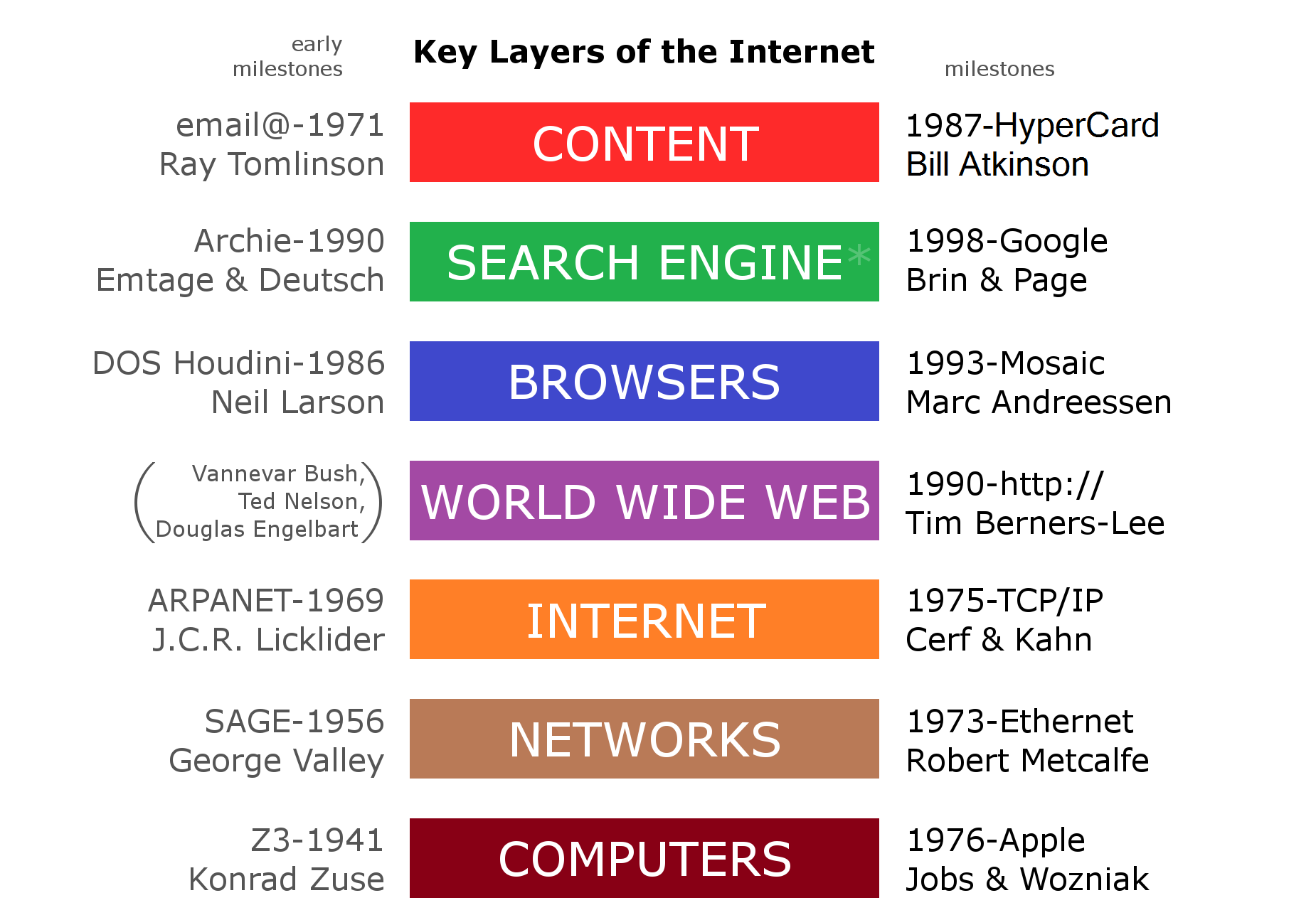
English: Seven key layers of the internet are illustrated, showing how users are connected to content (ie, web pages) served by content providers. Significant milestones are highlighted in columns on the left and right, showing key contributions made by some of the instrumental people involved in inventing and developing the technology. Listed on the left side are the highlighted rudimentary advances. Listed on the right side are the more refined advances that helped to enable major breakthroughs. For example, while computers were around since the 1940s, it was not until the advent of inexpensive personal computers in the mid-1970s that the Internet revolution could be enabled. These two columns can be thought of as the "first wave" and the "second wave" in construction toward the internet.
A network is formed when multiple computers are linked together. The Internet is the formation consisting of a 'network of networks', enabled globally through a standard Internet Protocol (IP). It is said that email was the first extremely popular application of the Internet. The World Wide Web was a significant advance in accessing information on the Internet, by implementing the HyperText Transfer Protocol (http). But even the Web was in want of an engaging User Interface, and this was provided by the web browser, where images could be displayed along with text and hyperlinks. Up through the late 1990s, browsing the web was frequently frustrating when trying to find specific content. This problem was solved by significant advances in the search engine, specifically with the advent of Google in 1998 and their backlink "voting" algorithm for ranking page relevance. Content in specific webpages, coded in HyperText Markup Language (html), is directly accessible in the Web. For this reason, the Search Engine layer is marked with an asterisk (*). But if content cannot be found by a user, then this is indistinguishable from that content not existing, from the perspective of that user. (Content can also be accessed without using a browser nor the Web, as was the norm prior to the invention of the Web, but this is no longer typically done by the average user.) Solving the search problem was a critical step in the creation of a highly usable internet. 1976 could be taken as the first singular point in this computer revolution timeline, where the devices started to make great headway into the home, and 1998 can be seen as the culminating layer where the search problem became mostly solved. The web was then engaging and very easily usable. Maturation of these seven layers then set the stage for subsequent revolutions, such as YouTube and Social Networking. That mature version was later referred to as Web 2.0, so this diagram can be seen as identifying the layers and milestones accomplished in the creation of "Web 1.0". Layers are labeled in the plural when a multitude of elements exist within that layer, versus just one (such as one Internet) or only several (as with search engines). Note that 'content' here is used in the plural, as there are literally trillions of webpages. At the bottom of these layers is the user, interfacing with their computer. At the top is the content. So the internet is a system that connects users to content presented by its creators. When providers of content are users themselves, then the connection is what is known as peer-to-peer. The path used by creators to upload their content is similar to the path for users in accessing the content. A more complete diagram could be shown in the geometry of the letter lambda: Λ, depicting a direct connection with a content creator located at their computer at the base of one leg, and the user at their computer at the base of the other leg. But a strictly vertical geometry is depicted in this diagram for the sake of simplicity. HyperCard was a major breakthrough for hyperlinked user content, and while it failed to make the transition to internetworked connectivity, it was inspirational toward the creation of advancements like html. A distinction between Web 2.0 versus Web 1.0 is that the early version of the internet had very few content creators, whereas applications like social media has enabled exponential growth in the numbers of users who are also content creators. One way that Web 3.0 has been defined is with the rise of distributed computing platforms like the P2P (peer-to-peer) file sharing protocol BitTorrent (released in 2001) and TOR (launched in the mid-2000s) which have been a shift away from the centralized control of servers. This was followed in 2009 by the cryptocurrency BitCoin which establishes trust by way of a distributed secure ledger known as a blockchain. A more comprehensive realization of the potential of the blockchain was released in 2015 as the Turing-complete distributed computing platform Ethereum. The functionality of these features of "Web 3.0" could be generally described as a distributed layer operating on top of TCP/IP, but is not represented in this current diagram. A timeline could be identified as:
Quote:
For further information, see:
Advancement in the computer layer can be summarized by the "Silicon Valley formula for success": "More gates equals jobs." That "equation" is a tongue in cheek play on words that indicates how Moore's Law drives the microprocessor chip density to have more and more logic gates stuffed into them, which in turn increases computer power, which then in turn increases success in the industry, which ultimately creates jobs and wealth. The names "Moore-Gates" identifies two iconic leaders from the Wintel monopoly: Gordon Moore and Bill Gates, with "Jobs" being the icon from the personal computer revolution who ended up with the short end of the stick (as far as desktop market share goes): Steve Jobs. The expanded form of this "formula for success": ΣMoore • Gates / Kahn = Cerf - Jobs "Some more gates can equal internet (surf) jobs." This version recognizes that the full power of personal computers is realized by interconnecting them in a network.
 File:Information Technology Infrastructure Layers 2014.pdf |
||||||||||||
| Tarih | |||||||||||||
| Kaynak | Yükleyenin kendi çalışması | ||||||||||||
| Yazar | Concord hioz | ||||||||||||
| Diğer sürümler |
|
||||||||||||


Lisanslama


- Şu seçeneklerde özgürsünüz:
- paylaşım – eser paylaşımı, dağıtımı ve iletimi
- içeriği değiştirip uyarlama – eser adaptasyonu
- Aşağıdaki koşullar geçerli olacaktır:
- atıf – Esere yazar veya lisans sahibi tarafından belirtilen (ancak sizi ya da eseri kullanımınızı desteklediklerini ileri sürmeyecek bir) şekilde atıfta bulunmalısınız.
- benzer paylaşım – Maddeyi yeniden düzenler, dönüştürür veya inşa ederseniz, katkılarınızı özgünüyle aynı veya uyumlu lisans altında dağıtmanız gerekir.
- ↑ Roads and Crossroads of Internet History Chapter 4: Birth of the Web
Dosya geçmişi
Dosyanın herhangi bir zamandaki hâli için ilgili tarih/saat kısmına tıklayın.
| Tarih/Saat | Küçük resim | Boyutlar | Kullanıcı | Yorum | |
|---|---|---|---|---|---|
| güncel | 01.36, 25 Ağustos 2016 | | 1.850 × 1.294 (197 KB) | Concord hioz | Switching to HyperCard as arguably the more critical milestone for hypermedia content. WWW recognition is given in separate (middle) layer. |
| 03.06, 24 Kasım 2014 |  | 1.850 × 1.294 (213 KB) | Concord hioz | Content layer added. Other milestones listed. Headers added to clearly identify these to NOT be dates of invention, in general. | |
| 11.04, 22 Kasım 2014 |  | 1.544 × 1.080 (139 KB) | Concord hioz | User created page with UploadWizard |
Dosya kullanımı
Bu görüntü dosyasına bağlantısı olan sayfalar:
Küresel dosya kullanımı
Aşağıdaki diğer vikiler bu dosyayı kullanmaktadır:
- ar.wikipedia.org üzerinde kullanımı
- bg.wikipedia.org üzerinde kullanımı
- en.wikipedia.org üzerinde kullanımı
- hy.wikipedia.org üzerinde kullanımı
- id.wikipedia.org üzerinde kullanımı
- it.wikiversity.org üzerinde kullanımı
- ko.wikipedia.org üzerinde kullanımı
- ru.wikipedia.org üzerinde kullanımı
- sh.wikipedia.org üzerinde kullanımı
- tw.wikipedia.org üzerinde kullanımı
- uk.wikipedia.org üzerinde kullanımı
- vi.wikipedia.org üzerinde kullanımı
- zh-yue.wikipedia.org üzerinde kullanımı
- zh.wikipedia.org üzerinde kullanımı
