

Dosya:HD 106906 b imaged by SPHERE.jpg - Vikipedi
İçeriğe atla
Ana menü
Gezinti
  • Anasayfa
  • Hakkımızda
  • İçindekiler
  • Rastgele madde
  • Seçkin içerik
  • Yakınımdakiler
Katılım
  • Deneme tahtası
  • Köy çeşmesi
  • Son değişiklikler
  • Dosya yükle
  • Topluluk portalı
  • Wikimedia dükkânı
  • Yardım
  • Özel sayfalar
Vikipedi Özgür Ansiklopedi
Ara
  • Bağış yapın
  • Hesap oluştur
  • Oturum aç
  • Bağış yapın
  • Hesap oluştur
  • Oturum aç

Dosya:HD 106906 b imaged by SPHERE.jpg
Sayfa içeriği diğer dillerde desteklenmemektedir.
  • Dosya
  • Tartışma
  • Oku
  • Wikimedia Commons üzerinde gör
  • Yerel açıklama ekle
  • Yerel açıklama kaynağı ekle
Araçlar
Eylemler
  • Oku
  • Wikimedia Commons üzerinde gör
  • Yerel açıklama ekle
  • Yerel açıklama kaynağı ekle
Genel
  • Sayfaya bağlantılar
  • Basılmaya uygun görünüm
  • Sayfa bilgisi
  • Kısaltılmış URL'yi al
  • Karekodu indir
Diğer projelerde
Görünüm
Vikipedi, özgür ansiklopedi
  • Dosya
  • Dosya geçmişi
  • Dosya kullanımı
  • Küresel dosya kullanımı
  • Üstveri
Dosya:HD 106906 b imaged by SPHERE.jpg
Bu önizlemenin boyutu: 684 × 600 piksel. Diğer çözünürlükler: 274 × 240 piksel | 547 × 480 piksel | 876 × 768 piksel | 1.168 × 1.024 piksel | 1.348 × 1.182 piksel.
Tam çözünürlük ((1.348 × 1.182 piksel, dosya boyutu: 142 KB, MIME tipi: image/jpeg))
Bu dosya Wikimedia Commons'ta bulunmaktadır. Dosyanın açıklaması aşağıda gösterilmiştir.
Commons, serbest/özgür telifli medya dosyalarının bulundurulduğu depodur. Siz de yardım edebilirsiniz.
Bu dosya Wikimedia Commons'ta bulunmaktadır.

Özet

AçıklamaHD 106906 b imaged by SPHERE.jpg
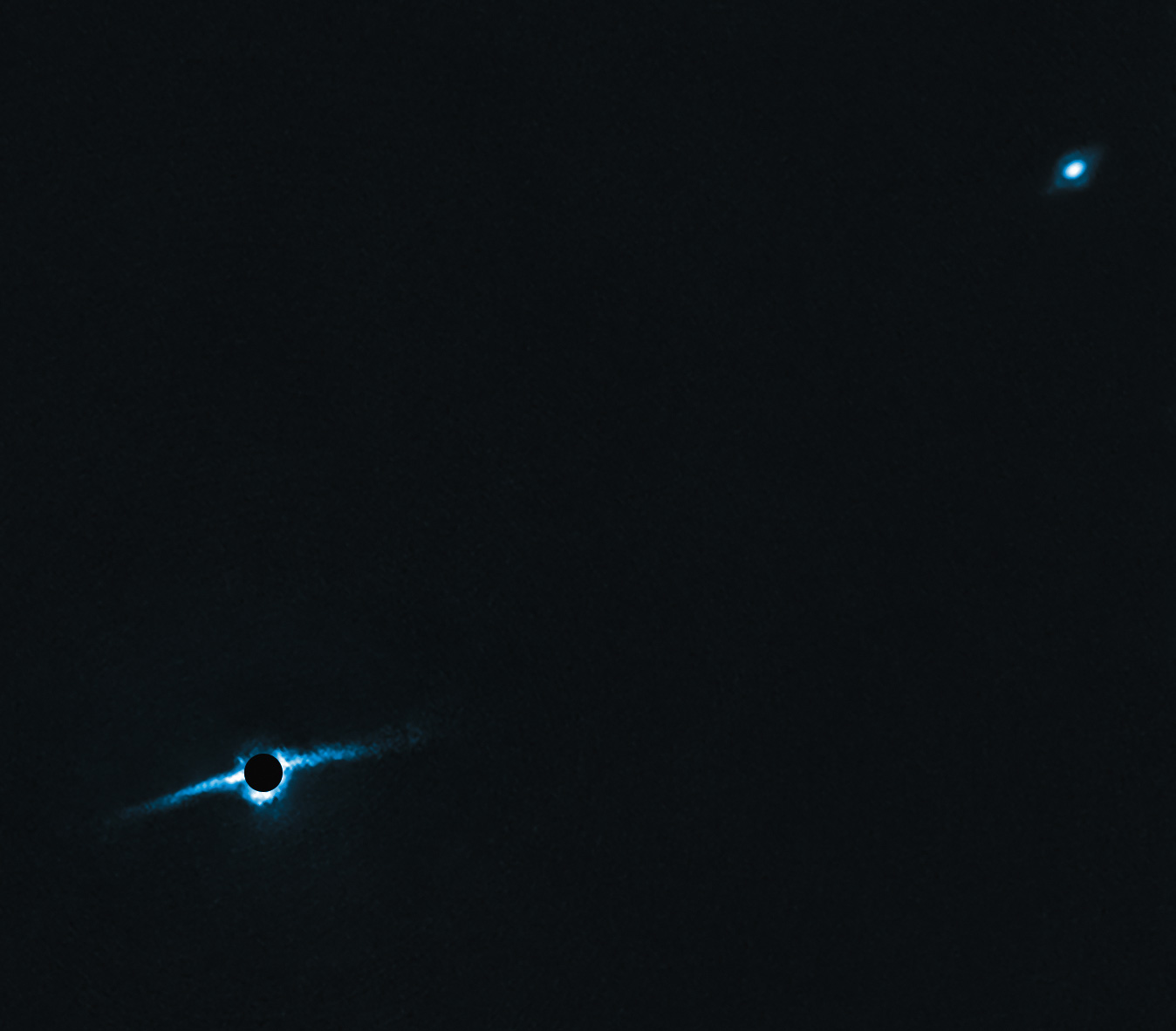
English: Observations by ESO’s planet-finding instrument, SPHERE, a high-contrast adaptive optics system installed on the third Unit Telescope of ESO’s Very Large Telescope, have revealed the edge-on disc of gas and dust present around the binary star system HD 106906AB. HD 106906AB is a double star located in the constellation of Crux (The Southern Cross). Astronomers had long suspected that this 13 million-year-old stellar duo was encircled by a debris disc, due to the system’s youth and characteristic radiation. However, this disc had remained unseen — until now! The system’s spectacular debris disc can be seen towards the lower left area of this image. It is surrounding both stars, hence its name of circumbinary disc. The stars themselves are hidden behind a mask which prevent their glare from blinding the instrument. These stars and the disc are also accompanied by an exoplanet, visible in the upper right, named HD 106906 b, which orbits around the binary star and its disc at a distance greater than any other exoplanet discovered to date — 650 times the average Earth–Sun distance, or nearly 97 billion kilometres. HD 106906 b has a mammoth mass of up to 11 times that of Jupiter, and a scorching surface temperature of 1500 degrees Celsius. Thanks to SPHERE, HD 106906AB has become the first binary star system to have both an exoplanet and a debris disc successfully imaged, providing astronomers with a unique opportunity to study the complex process of circumbinary planet formation.
Русский: Со специализированным инструментом ESO для поиска экзопланет SPHERE, высококонтрастной адаптивно-оптической системой, установленной на третьем «юните» -- Базовом телескопе комплекса Очень Большого Телескопа ESO, обнаружен видимый с ребра газо-пылевой диск вокруг двойной звездной системы HD 106906AB.

HD 106906AB – двойная звезда в созвездии Южного Креста. Астрономы давно подозревали, что эта двойная, возраст которой составляет 13 миллионов лет, окружена так называемым осколочным диском (debris disc) – об этом говорили и молодость двойной звезды и особенности ее излучения. Однако, диск оставался невидимым – до последнего времени! На представленном изображении он заметен в левой нижней части поля. Диск окружает обе звезды, поэтому его можно называть «циркумбинарным». Сами звезды закрыты маской, которая экранирует их слишком яркое излучение.

Кроме диска, вокруг звезд вращается экзопланета, заметная на фото справа вверху -- HD 106906 b. Расстояние от нее до двойной и до диска больше, чем у любой другой известной экзопланеты — в 650 раз больше, чем расстояние от Земли до Солнца или около 97 миллиардов километров. HD 106906 b отличается и колоссальной массой: в 11 раз больше Юпитера, а на поверхности ее настоящее пекло, с температурой 1500 градусов Цельсия.

Благодаря приемнику SPHERE HD 106906AB стала первой двойной системой, у которой обнаружены и успешно сфотографированы и экзопланета, и обломочный диск. Теперь у астрономов есть великолепная и уникальная возможность исследовать сложные процессы образования циркумбинарных планет вокруг звезд двойной системы.
Tarih 26 Ekim 2015, 10:00:00
Kaynak ESO website
Yazar ESO, A. M. Lagrange (Université Grenoble Alpes)

Lisanslama

This media was created by the European Southern Observatory (ESO).
Their website states: "Unless specifically noted, the images, videos, and music distributed on the public ESO website, along with the texts of press releases, announcements, pictures of the week, blog posts and captions, are licensed under a Creative Commons Attribution 4.0 International License, and may on a non-exclusive basis be reproduced without fee provided the credit is clear and visible."
To the uploader: You must provide a link (URL) to the original file and the authorship information if available.
w:tr:Creative Commons
atıf
Bu dosya Creative Commons Atıf 4.0 Uluslararası lisansı altında lisanslanmıştır.
Şu seçeneklerde özgürsünüz:
  • paylaşım – eser paylaşımı, dağıtımı ve iletimi
  • içeriği değiştirip uyarlama – eser adaptasyonu
Aşağıdaki koşullar geçerli olacaktır:
  • atıf – Esere yazar veya lisans sahibi tarafından belirtilen (ancak sizi ya da eseri kullanımınızı desteklediklerini ileri sürmeyecek bir) şekilde atıfta bulunmalısınız.
https://creativecommons.org/licenses/by/4.0CC BY 4.0 Creative Commons Attribution 4.0 truetrue

Altyazılar

Bu dosyanın temsil ettiği şeyin tek satırlık açıklamasını ekleyin.

Bu dosyada gösterilen öğeler

betimlenen

telif hakkı durumu

telif hakkı alınmış

telif hakkı lisansı

Creative Commons Atıf 4.0 Uluslararası

kuruluşu

26 Ekim 2015

Dosya geçmişi

Dosyanın herhangi bir zamandaki hâli için ilgili tarih/saat kısmına tıklayın.

Tarih/SaatKüçük resimBoyutlarKullanıcıYorum
güncel11.40, 26 Ekim 201511.40, 26 Ekim 2015 tarihindeki sürümün küçültülmüş hâli1.348 × 1.182 (142 KB)Artem KorzhimanovUser created page with UploadWizard

Dosya kullanımı

Bu görüntü dosyasına bağlantısı olan sayfalar:

  • Çift yıldız

Küresel dosya kullanımı

Aşağıdaki diğer vikiler bu dosyayı kullanmaktadır:

  • ar.wikipedia.org üzerinde kullanımı
    • HD 106906 b
  • en.wikipedia.org üzerinde kullanımı
    • Binary star
    • List of directly imaged exoplanets
    • HD 106906
    • User:Mike Peel/Exoplanets
  • es.wikipedia.org üzerinde kullanımı
    • HD 106906 b
  • fr.wikipedia.org üzerinde kullanımı
    • HD 106906
    • Discussion:Liste de naines brunes
  • ru.wikipedia.org üzerinde kullanımı
    • HD 106906 b
  • uk.wikipedia.org üzerinde kullanımı
    • HD 106906 b
  • vi.wikipedia.org üzerinde kullanımı
    • Thành viên:Minh Tấn/Hình ảnh/H
  • www.wikidata.org üzerinde kullanımı
    • Q15291487
    • Q17309907
  • zh-yue.wikipedia.org üzerinde kullanımı
    • 雙子星
  • zh.wikipedia.org üzerinde kullanımı
    • 聯星

Üstveri

Bu dosyada, muhtemelen fotoğraf makinesi ya da tarayıcı tarafından eklenmiş ek bilgiler mevcuttur. Eğer dosyada sonradan değişiklik yapıldıysa, bazı bilgiler yeni değişikliğe göre eski kalmış olabilir.

Katkı/SağlayıcıESO, A. M. Lagrange (Université Grenoble Alpes)
KaynakEuropean Southern Observatory
Kısa başlık
  • Planet-hunting SPHERE Images First Circumbinary Planet System with Disc
Resim başlığı
  • Observations by ESO’s planet-finding instrument, SPHERE, a high-contrast adaptive optics system installed on the third Unit Telescope of ESO’s Very Large Telescope, have revealed the edge-on disc of gas and dust present around the binary star system HD 106906AB. HD 106906AB is a double star located in the constellation of Crux (The Southern Cross). Astronomers had long suspected that this 13 million-year-old stellar duo was encircled by a debris disc, due to the system’s youth and characteristic radiation. However, this disc had remained unseen — until now! The system’s spectacular debris disc can be seen towards the lower left area of this image. It is surrounding both stars, hence its name of circumbinary disc. The stars themselves are hidden behind a mask which prevent their glare from blinding the instrument. These stars and the disc are also accompanied by an exoplanet, visible in the upper right, named HD 106906 b, which orbits around the binary star and its disc at a distance greater than any other exoplanet discovered to date — 650 times the average Earth–Sun distance, or nearly 97 billion kilometres. HD 106906 b has a mammoth mass of up to 11 times that of Jupiter, and a scorching surface temperature of 1500 degrees Celsius. Thanks to SPHERE, HD 106906AB has become the first binary star system to have both an exoplanet and a debris disc successfully imaged, providing astronomers with a unique opportunity to study the complex process of circumbinary planet formation.
Kullanım şartları
  • Creative Commons Attribution 3.0 Unported license.
Verinin ilk yaratılma zamanı10.00, 26 Ekim 2015
Kullanılan yazılımAdobe Photoshop CC 2014 (Windows)
Özgün belgenin benzersiz kimliğixmp.did:8FC05137A378E5119DC38661F583A072
Anahtar kelimeler
  • HD 106906AB
  • HD 106906 b
İletişim bilgileri

http://www.eso.org/

Karl-Schwarzschild-Strasse 2

Garching bei München, , D-85748 Germany

IIM sürümü4
"https://tr.wikipedia.org/wiki/Dosya:HD_106906_b_imaged_by_SPHERE.jpg" sayfasından alınmıştır
  • Gizlilik politikası
  • Vikipedi hakkında
  • Sorumluluk reddi
  • Davranış Kuralları
  • Geliştiriciler
  • İstatistikler
  • Çerez politikası
  • Mobil görünüm
  • Wikimedia Foundation
  • Powered by MediaWiki
Dosya:HD 106906 b imaged by SPHERE.jpg
Konu ekle