


Dosya:Charon Discovery.jpg
 | Bu dosya Wikimedia Commons'ta bulunmaktadır. Dosyanın açıklaması aşağıda gösterilmiştir. Commons, serbest/özgür telifli medya dosyalarının bulundurulduğu depodur. Siz de yardım edebilirsiniz. |


Özet
| Açıklama |
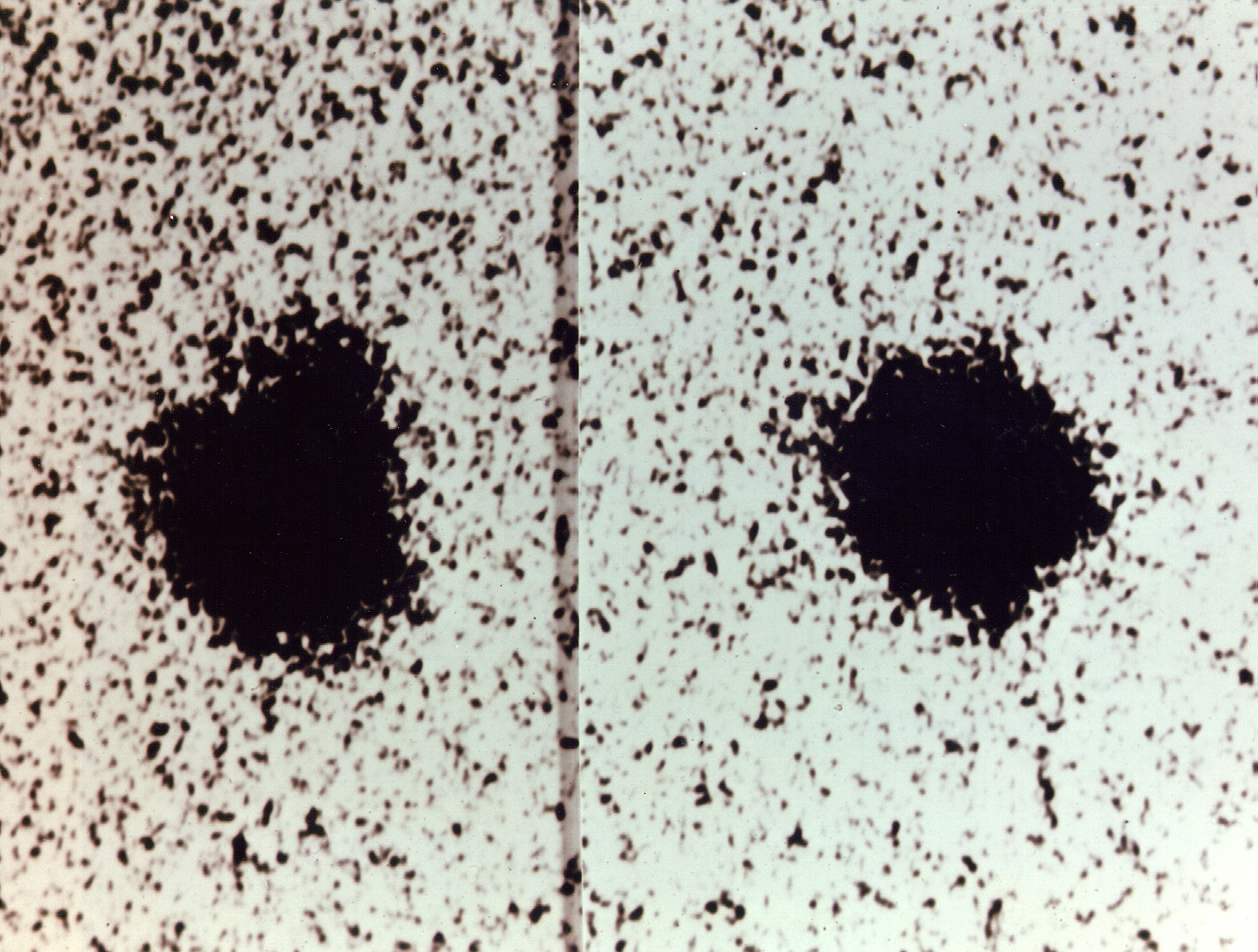
On 22 June 1978, an astronomer at the U.S. Naval Observatory in Washington, D.C. was making routine measurements of photographic plates taken with the 1.55-meter (61-inch) Kaj Strand Astrometric Reflector at the USNO Flagstaff Station in Arizona. The purpose of these images was to refine the orbit of the far-flung planet Pluto to help compute a better ephemeris for this distant object. Astronomer James W. Christy had noticed that a number of the images of Pluto appeared elongated, but images of background stars on the same plate did not. Other plates showed the planet as a tiny, round dot. Christy examined a number of Pluto images from the USNO archives, and he noticed the elongations again. Furthermore, the elongations appeared to change position with respect to the stars over time. After eliminating the possibility that the elongations were produced by plate defects and background stars, the only plausible explanation was that they were caused by a previously unknown moon orbiting Pluto at a distance of about 19,600 kilometers (12,100 miles) with a period of just over six days. On 7 July 1978, the discovery was formally announced to the astronomical community and the world by the IAU Central Bureau for Astronomical Telegrams via IAU Circular 3241. The discovery received the provisional designation "1978 P 1"; Christy proposed the name "Charon", after the mythological ferryman who carried souls across the river Acheron, one of the five mythical rivers that surrounded Pluto's underworld. Over the course of the next several years, another USNO astronomer, the late Robert S. Harrington, calculated that Pluto and its newly-found moon would undergo a series of mutual eclipses and occultations, beginning in early 1985. On 17 February 1985 the first successful observation of one of these transits was made at with the 0.9-meter (36-inch) reflector at the University of Texas McDonald Observatory, within 40 minutes of Harrington's predicted time. The IAU Circular announcing these confirming observations was issued on 22 February 1985. With this confirmation, the new moon was officially named Charon. Pluto was discovered at Lowell Observatory in 1930 by the late Clyde W. Tombaugh, an amateur astronomer from Kansas who was hired by the Observatory specifically to photograph the sky with a special camera and search for the planet predicted by the Observatory's founder, Percival Lowell. Lowell had deduced the existence of a "Planet X" by studying small anomalies in the orbits of Uranus and Neptune. As it turned out, Pluto's discovery was almost entirely serendipitous; Pluto's tiny mass was far too small to account for the anomalies, which were resolved when Voyager 2 determined more precise masses for Uranus and Neptune. The discovery of Charon has led to a much better understanding of just how tiny Pluto is. Its diameter is about 2274 km (1413 miles), and its mass is 0.25% of the mass of the Earth. Charon has a diameter of about 1172 kilometers (728 miles) and a mass of about 22% that of Pluto. The two worlds circle their common center of mass with a period of 6.387 days and are locked in a "super-synchronous" rotation: observers on Pluto's surface would always see Charon in the same part of the sky relative to their local horizon. Normally Pluto is considered the most distant world in the solar system, but during the period from January 1979 until February 1999 it was actually closer to the Sun than Neptune. It has the most eccentric and inclinced orbit of any of the major planets. This orbit won't bring Pluto back to its discovery position until the year 2178! |
| Tarih | July 25 |
| Kaynak | http://solarsystem.nasa.gov/multimedia/display.cfm?IM_ID=572 |
| Yazar | U.S. Naval Observatory |
Lisanslama

|
Bu resim veya dosya ABD Deniz Kuvvetlerinde çalışan bir denizcinin ya da çalışan kişinin resmi görevi sırasında yapılmıştır. ABD federal hükûmetinde yapılan bu gibi çalışmalar ve resimler kamu malıdır.
|
 |
| Bu dosyanın, tüm ilgili ve komşu haklar da dâhil olmak üzere, telif hakkı yasası kapsamında bilinen kısıtlamalardan arınmış olduğu belirlendi. | ||
Dosya geçmişi
Dosyanın herhangi bir zamandaki hâli için ilgili tarih/saat kısmına tıklayın.
| Tarih/Saat | Küçük resim | Boyutlar | Kullanıcı | Yorum | |
|---|---|---|---|---|---|
| güncel | 11.51, 25 Temmuz 2006 | | 1.416 × 1.072 (952 KB) | Brallan~commonswiki | {{Information |Description=On 22 June 1978, an astronomer at the U.S. Naval Observatory in Washington, D.C. was making routine measurements of photographic plates taken with the 1.55-meter (61-inch) Kaj Strand Astrometric Reflector at the USNO Flagstaff S |
Dosya kullanımı
Bu görüntü dosyasına bağlantısı olan sayfalar:
Küresel dosya kullanımı
Aşağıdaki diğer vikiler bu dosyayı kullanmaktadır:
- af.wikipedia.org üzerinde kullanımı
- ar.wikipedia.org üzerinde kullanımı
- arz.wikipedia.org üzerinde kullanımı
- ast.wikipedia.org üzerinde kullanımı
- bs.wikipedia.org üzerinde kullanımı
- ca.wikipedia.org üzerinde kullanımı
- de.wikipedia.org üzerinde kullanımı
- el.wikipedia.org üzerinde kullanımı
- en.wikipedia.org üzerinde kullanımı
- en.wikiversity.org üzerinde kullanımı
- es.wikipedia.org üzerinde kullanımı
- fi.wikipedia.org üzerinde kullanımı
- fr.wikipedia.org üzerinde kullanımı
- gl.wikipedia.org üzerinde kullanımı
- hr.wikipedia.org üzerinde kullanımı
- it.wikipedia.org üzerinde kullanımı
- ja.wikipedia.org üzerinde kullanımı
- ko.wikipedia.org üzerinde kullanımı
- mk.wikipedia.org üzerinde kullanımı
- nl.wikipedia.org üzerinde kullanımı
- pl.wikipedia.org üzerinde kullanımı
- pt.wikipedia.org üzerinde kullanımı
- ro.wikipedia.org üzerinde kullanımı
- ru.wikipedia.org üzerinde kullanımı
- simple.wikipedia.org üzerinde kullanımı
- th.wikipedia.org üzerinde kullanımı
- uk.wikipedia.org üzerinde kullanımı
- uz.wikipedia.org üzerinde kullanımı
- vi.wikipedia.org üzerinde kullanımı
