Dosya:Chaos Monster and Sun God.png - Vikipedi
İçeriğe atla
Ana menü
Gezinti
  • Anasayfa
  • Hakkımızda
  • İçindekiler
  • Rastgele madde
  • Seçkin içerik
  • Yakınımdakiler
Katılım
  • Deneme tahtası
  • Köy çeşmesi
  • Son değişiklikler
  • Dosya yükle
  • Topluluk portalı
  • Wikimedia dükkânı
  • Yardım
  • Özel sayfalar
Vikipedi Özgür Ansiklopedi
Ara
  • Bağış yapın
  • Hesap oluştur
  • Oturum aç
  • Bağış yapın
  • Hesap oluştur
  • Oturum aç

Dosya:Chaos Monster and Sun God.png
Sayfa içeriği diğer dillerde desteklenmemektedir.
  • Dosya
  • Tartışma
  • Oku
  • Wikimedia Commons üzerinde gör
  • Yerel açıklama ekle
  • Yerel açıklama kaynağı ekle
Araçlar
Eylemler
  • Oku
  • Wikimedia Commons üzerinde gör
  • Yerel açıklama ekle
  • Yerel açıklama kaynağı ekle
Genel
  • Sayfaya bağlantılar
  • Basılmaya uygun görünüm
  • Sayfa bilgisi
  • Kısaltılmış URL'yi al
  • Karekodu indir
Diğer projelerde
Görünüm
Vikipedi, özgür ansiklopedi
  • Dosya
  • Dosya geçmişi
  • Dosya kullanımı
  • Küresel dosya kullanımı
  • Üstveri
Dosya:Chaos Monster and Sun God.png
Bu önizlemenin boyutu: 800 × 590 piksel. Diğer çözünürlükler: 320 × 236 piksel | 640 × 472 piksel | 1.024 × 755 piksel | 1.280 × 944 piksel | 2.012 × 1.484 piksel.
Tam çözünürlük ((2.012 × 1.484 piksel, dosya boyutu: 3,52 MB, MIME tipi: image/png))
Bu dosya Wikimedia Commons'ta bulunmaktadır. Dosyanın açıklaması aşağıda gösterilmiştir.
Commons, serbest/özgür telifli medya dosyalarının bulundurulduğu depodur. Siz de yardım edebilirsiniz.
Bu dosya Wikimedia Commons'ta bulunmaktadır.

Özet

AçıklamaChaos Monster and Sun God.png
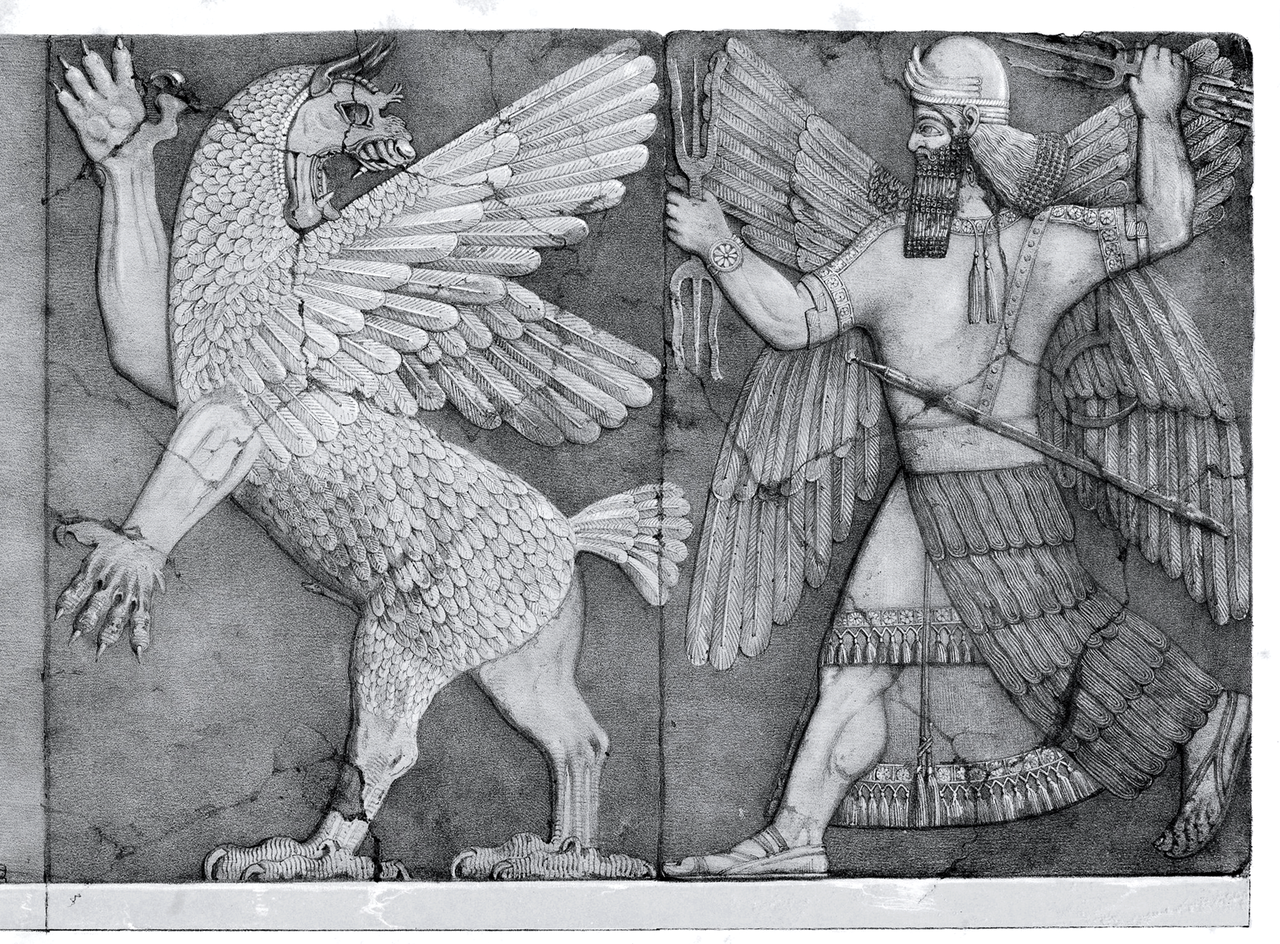
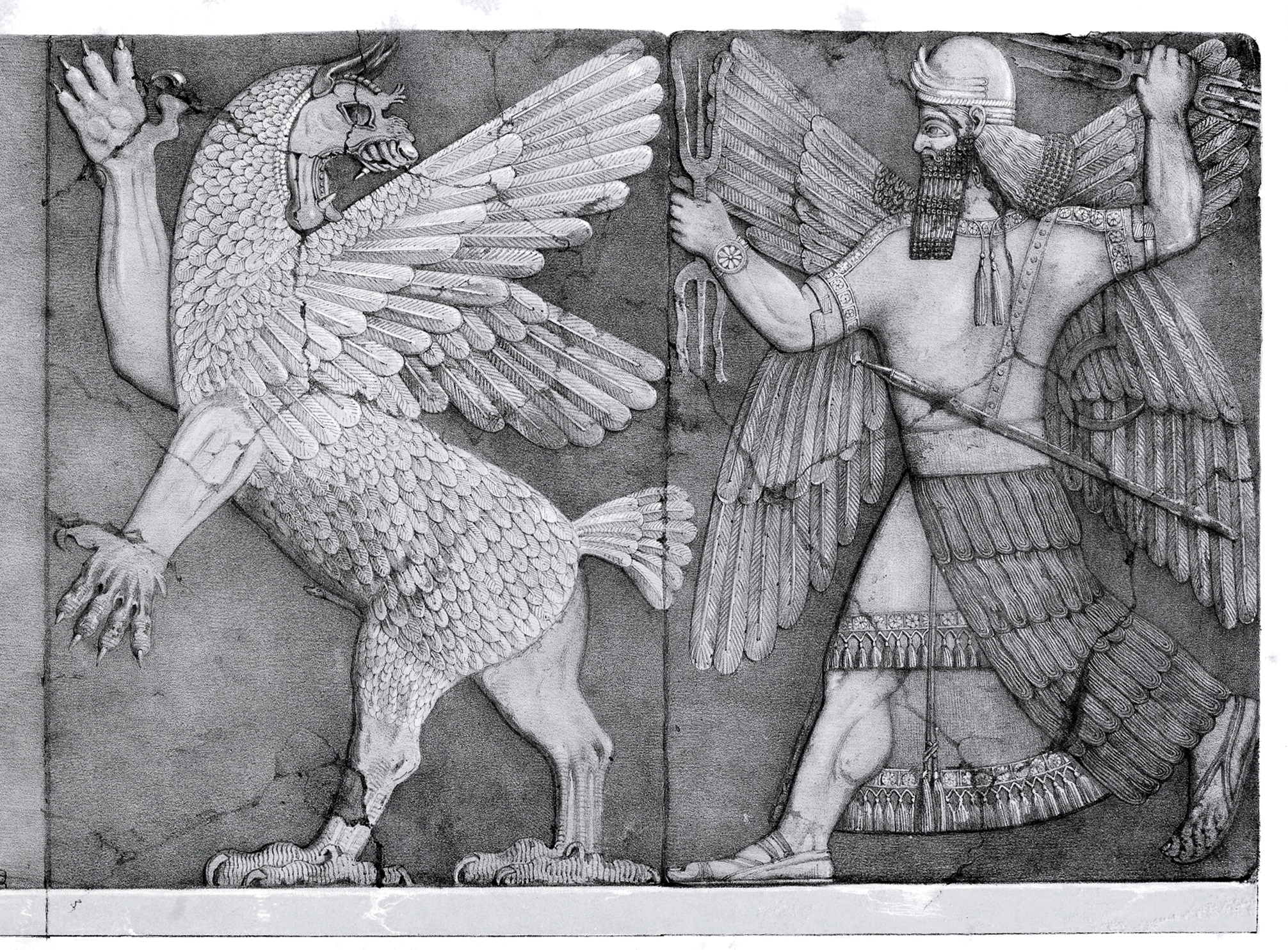
English: Black and white crop of full engraving plate scan - from Plate 5 of the work "A second series of the monuments of Nineveh: including bas-reliefs from the Palace of Sennacherib and bronzes from the ruins of Nimroud ; from drawings made on the spot, during a second expedition to Assyria" (AH Layard). The image depicts Ninurta (on the right) battling Anzû.

The description given in the text of the work of the plate reads:

PLATE V

BAS-RELIEFS AT AN ENTRANCE TO A SMALL TEMPLE (NIMROUD)

Part of one side of the entrance near which stood the bas-relief of the King last described. The group is believed to represent the god to whom the temple was dedicated, driving out the evil spirit.† On the opposite side of the doorway the same figures were repeated. These bas-reliefs are now in the British Museum

[..]

† Ibid.. p.348

The plate description is on page 2 of the work.

The image in the book is by Faucher-Gudin , an drawing based on the excavated Bas-Relief. The Bas-Relief was in not as good condition.

Sources for the description an full plate include :

  • http://digi.ub.uni-heidelberg.de/diglit/layard1853/0010/image
  • http://www.etana.org/sites/default/files/coretexts/17171.pdf (no text)

The reference in the text to "Ibid. p.348" is to Discoveries in the ruins of Nineveh and Babylon (Layard, 1853) - which can be seen here https://archive.org/stream/discoveriesinru00layagoog#page/n398/mode/2up

quote (p.348-349):

About thirty feet to the right, or north, of the lion gateway was a second entrance, at each side of which were two singular figures. One was that of a monster, whose head, of fanciful and hideous form, had long pointed ears and extended jaws, armed with huge teeth. Its body was covered with feathers, its fore-feet were those of a lion, its hind legs ended in the talons of an eagle, and it had spreading wings and the tail of a bird. Behind this strange image was a winged man, whose dress consisted of an upper garment with a skirt of skin or fur, an under robe fringed with tassels, and the sacred horned hat. A long sword was suspended from his shoulders by an embossed belt; sandals, armlets, and bracelets, completed his attire. He grasped in each hand an object in the form of a double trident, resembling the thunderbolt of the Greek Jove, which he was in the attitude of hurling against the monster, who turned furiously towards him.
This group appears to represent the bad spirit driven out by a good deity; a fit subject for the entrance to a temple, dedicated to the god of war. The singular combination of forms by which the Assyrian sculptor portrayed the evil principle, so prominent an element in the Chaldæan, and afterwards in the Magian, religions system, cannot fail to strike the reader.

There is also in the same work and illustration of the relief in situ in the temple (between p.350 and 351)

Interpretation

There are at least two interpretations of what the image is/was intended to represent.

  1. Some sources interpret the image as [Bel-Merodach] Marduk (with thunderbolt) fighting Tiamat eg History of Egypt, Chaldea, Syria, Babylonia, and Assyria Vol. 3 (Maspero, G.; Sayce, A. H.) , https://archive.org/stream/egypt03maspuoft#page/n28/mode/1up
  2. Some modern sources state this is probably Anzu and Ninurta. eg in Gods, Demons and Symbols of Ancient Mesopotamia: An Illustrated Dictionary? (Jeremy A. Black and Anthony Green ISBN: 978-0-292-70794-8) p.142 states as text to same image: "Ninurta or Adad pursues a leonine bird-monster, perhaps the Anzû or Asakku."; Schroer, Silvia (2018) (Almanca) Die Ikonographie Palastinas/Israels und der Alte Orient, Band 4: Die Eisenzeit bis zum Beginn der achämenidischen Herrschaft, Schwabe Verlag, pp. 611 : "Ein kriegerischer, geflügelter Sturmgott, vielleicht Ninurta, vertreibt mit blitzgabelförmigen Waffen den Anzu-Drachen, einen geflügelten Löwendrachen."

A discussion of the development of the interpretation of this image can be found here http://oracc.museum.upenn.edu/nimrud/livesofobjects/anzu/index.html archived link

Original Source

The original gypsum wall carving from which the drawing was taken is now (2018) displayed in Room 6 of the British Museum. Details of the object can be found here:

  • British Museum reference BM 124571
  • http://www.britishmuseum.org/research/collection_online/collection_object_details.aspx?objectId=367087&partId=1&searchText=relief&people=117843&page=1
  • http://www.britishmuseum.org/research/collection_online/collection_object_details.aspx?objectId=367087&partId=1&searchText=relief&people=117843&page=2

The actual object also has a cuneiform inscription across the (approx.) middle third, not reproduced in the drawing. The texts is thought to be a "boilerplate" text used throughout the palace/temple on several reliefs - for more details and translation of a presumed nearly identical text see Assyrian Rulers of the Early First Millennium BC, I (1114-859 BC) vol. 1, (Grayson, Albert Kirk,Toronto, University of Toronto Press, 1991) p.232 no.5 (entry A.0.101.5) which references entry A.0.101.3 ; there were also inscriptions on the backs of the slabs - see same publication reference A.0.101.31 (no.31, p.293) .. the inscriptions reference Ashurnasirpal [II] son of Tukulti-Ninurta [II] - which dates the objects to 883 to 859 BC. (see en:Ashurnasirpal II)

Note that the object was one of a pair on either side of the passage - [based on the drawing by Malan] the object's pair was left-right inverted so that the portrayals matched - a drawing of the object's pair by S.C. Malan partially in-situ at the excavation can be found in A Visiting Artist at Nineveh in 1850 (C. J. Gadd) in the journal "Iraq" vol.5, 1938 , DOI: 10.2307/4241628 , [1] , description p.120 no. 134, illus. plate XV
Tarih 1853
Kaynak 'Monuments of Nineveh, Second Series' plate 5, London, J. Murray, 1853
Yazar editor Austen Henry Layard , drawing by L. Gruner

Lisanslama

Public domainPublic domainfalsefalse
Public domain

Bu çalışma ABD'de veya yazarın yaşamının sona ermiş olmasından 100 veya daha fazla süre geçtiğinde bu duruma uygun telif yasaları olan tüm ülkelerde kamu malıdır.


Bu çalışma 1 Ocak 1930 tarihinden önce yayımlanmıştır (veya ABD Telif Hakkı Ofisinde kayıtlıdır). Bu nedenle eser ABD'de kamu malıdır.

Bu dosyanın, tüm ilgili ve komşu haklar da dâhil olmak üzere, telif hakkı yasası kapsamında bilinen kısıtlamalardan arınmış olduğu belirlendi.

https://creativecommons.org/publicdomain/mark/1.0/PDMCreative Commons Public Domain Mark 1.0falsefalse

Altyazılar

Mezopotamya tanrısı Gryphon ile savaşırken sıklıkla Marduk - Tiamat savaşı (Eňûnima Eliš ile ilişkilendirilir.
Mesopotamian god Ninurta (with thunderbolts) battles the gryphon-like Anzu; often associated with battle of Marduk vs Tiamat - story from Enūma Eliš
Deus mesopotâmico luta contra grifo. Cena associada com a batalha de Marduk contra Tiamat
Dewa orang Mesopotamia (dengan petir) pertempuran Gryphon; biasanya diasosiasikan dengan pertempuran Marduk vs Tiamat - kisah dari Enuma Elish
نقش مسيَّج باللونين الأبيض والأسود من لوحة النقش رقم 5 لعمل "سلسلة ثانية من آثار نينوى"، يُظهر الإله نينورتا وهو يقاتل أنزو.

Bu dosyada gösterilen öğeler

betimlenen

Marduk

Tiamat

telif hakkı durumu

kamu malı

kuruluşu

1853

ortam türü

image/png

sağlama toplamı

5e4d2a68abfe86ec30cd6d314e83108d2a396fcc

tespit yöntemi: SHA-1

dosya boyutu

3.686.873 bayt

boyu

1.484 piksel

genişliği

2.012 piksel

Dosya geçmişi

Dosyanın herhangi bir zamandaki hâli için ilgili tarih/saat kısmına tıklayın.

Tarih/SaatKüçük resimBoyutlarKullanıcıYorum
güncel14.45, 21 Mayıs 201614.45, 21 Mayıs 2016 tarihindeki sürümün küçültülmüş hâli2.012 × 1.484 (3,52 MB)Vles1I increased the contrast of the picture.
04.45, 30 Ocak 201204.45, 30 Ocak 2012 tarihindeki sürümün küçültülmüş hâli2.012 × 1.484 (5,24 MB)Georgelazenby

Dosya kullanımı

Bu görüntü dosyasına bağlantısı olan sayfalar:

  • Adapa
  • Aga (hükümdar)
  • Agasaya
  • Ama-arhus
  • Amasagnul
  • Anshar
  • Anzû
  • Apsû
  • Asag
  • Asaruludu
  • Ashgi
  • Atra-Hasis
  • Aşnan
  • Baalshamin
  • Babil mitolojisi
  • Bel (mitoloji)
  • Belet-Seri
  • Edimmu
  • Emesh
  • Enki
  • Enkidu
  • Enlil
  • Enmesarra
  • Ennugi
  • Enten
  • Gareus
  • Gatumdag
  • Geştinanna
  • Gunura
  • Hahanu
  • Hanbi
  • Hani (tanrı)
  • Haya
  • Hayasum
  • Hegir-Nuna
  • Hendursaga
  • Humbaba
  • Hušbišag
  • Ilabrat
  • Ištaran
  • Kingu
  • Kişar
  • Kur (mitoloji)
  • Lahamu
  • Lahar (Sümer)
  • Lahmu
  • Lamaştu
  • Lugal-e
  • Mami (tanrıça)
  • Mamitu
  • Me (mitoloji)
  • Mezopotamya mitolojisi
  • Mezopotamya tanrıları listesi
  • Mummu
  • Nabu
  • Namtar
  • Nanshe
  • Nergal
  • Neti (tanrı)
  • Ningal
  • Ninhursag
  • Ninlil
  • Ninurta
  • Ninşubur
  • Nisaba
  • Nisrok
  • Pazuzu
  • Rabisu
  • Reşef
  • Sarpanit
  • Sedir Ormanı
  • Siduri
  • Sin (mitoloji)
  • Siris (tanrıça)
  • Sîn-lēqi-unninni
  • Teolojik şeytanlar listesi
  • Utnapiştim
  • Ziusudra
  • İgigi
  • İsimud
  • Şamhat
  • Şarur
  • Şablon:Mezopotamya efsanesi

Küresel dosya kullanımı

Aşağıdaki diğer vikiler bu dosyayı kullanmaktadır:

  • af.wikipedia.org üzerinde kullanımı
    • Sjamasj
    • Adad
    • Nanna
    • Sjabloon:Mesopotamiese mitologie
    • Isjtar
    • Anoe
    • Enki
    • Enlil
    • Assur (god)
    • Tiamat
    • Abzu
    • Gilgamesj
    • Ninlil
    • Enkidu
    • Ninhursag
    • Baäl
    • Oetoe
    • Baälsamin
    • Enoema Elisj
  • ar.wikipedia.org üzerinde kullanımı
    • الفرات
    • بغداد
    • اللغة الأكدية
    • الدولة الزنكية
    • الدولة السلجوقية
    • الدولة الحمدانية
    • الدولة البويهية
    • دجلة
    • نبط العراق
    • شريعة حمورابي
    • حدائق بابل المعلقة
    • أور
    • أدد
    • عشتار
    • آشور
    • آشور (مدينة)
    • آشور (إله)
    • تاريخ العراق
    • بلاد بابل
    • بابل
    • حمورابي
    • سومر
    • خابور (الفرات)
    • إيوان المدائن
    • إيسن
    • عيران
    • عيلام
    • تاريخ سوريا
    • آراميون
    • عدي بن زيد العبادي
    • أهوار العراق

Bu dosyanın daha fazla küresel kullanımını görüntüle.

Üstveri

Bu dosyada, muhtemelen fotoğraf makinesi ya da tarayıcı tarafından eklenmiş ek bilgiler mevcuttur. Eğer dosyada sonradan değişiklik yapıldıysa, bazı bilgiler yeni değişikliğe göre eski kalmış olabilir.

Yatay çözünürlük28,34 dpc
Dikey çözünürlük28,34 dpc
"https://tr.wikipedia.org/wiki/Dosya:Chaos_Monster_and_Sun_God.png" sayfasından alınmıştır
  • Gizlilik politikası
  • Vikipedi hakkında
  • Sorumluluk reddi
  • Davranış Kuralları
  • Geliştiriciler
  • İstatistikler
  • Çerez politikası
  • Mobil görünüm
  • Wikimedia Foundation
  • Powered by MediaWiki
Dosya:Chaos Monster and Sun God.png
Konu ekle