Dosya:Caldwell 42.jpg - Vikipedi
İçeriğe atla
Ana menü
Gezinti
  • Anasayfa
  • Hakkımızda
  • İçindekiler
  • Rastgele madde
  • Seçkin içerik
  • Yakınımdakiler
Katılım
  • Deneme tahtası
  • Köy çeşmesi
  • Son değişiklikler
  • Dosya yükle
  • Topluluk portalı
  • Wikimedia dükkânı
  • Yardım
  • Özel sayfalar
Vikipedi Özgür Ansiklopedi
Ara
  • Bağış yapın
  • Hesap oluştur
  • Oturum aç
  • Bağış yapın
  • Hesap oluştur
  • Oturum aç

Dosya:Caldwell 42.jpg

Sayfa içeriği diğer dillerde desteklenmemektedir.
  • Dosya
  • Tartışma
  • Oku
  • Wikimedia Commons üzerinde gör
  • Yerel açıklama ekle
  • Yerel açıklama kaynağı ekle
Araçlar
Eylemler
  • Oku
  • Wikimedia Commons üzerinde gör
  • Yerel açıklama ekle
  • Yerel açıklama kaynağı ekle
Genel
  • Sayfaya bağlantılar
  • Basılmaya uygun görünüm
  • Sayfa bilgisi
  • Kısaltılmış URL'yi al
  • Karekodu indir
Diğer projelerde
Görünüm
Vikipedi, özgür ansiklopedi
  • Dosya
  • Dosya geçmişi
  • Dosya kullanımı
  • Küresel dosya kullanımı
  • Üstveri
Dosya:Caldwell 42.jpg
Bu önizlemenin boyutu: 600 × 600 piksel. Diğer çözünürlükler: 240 × 240 piksel | 480 × 480 piksel | 768 × 768 piksel | 1.024 × 1.024 piksel | 2.048 × 2.048 piksel | 3.851 × 3.851 piksel.
Tam çözünürlük ((3.851 × 3.851 piksel, dosya boyutu: 11,11 MB, MIME tipi: image/jpeg))
Bu dosya Wikimedia Commons'ta bulunmaktadır. Dosyanın açıklaması aşağıda gösterilmiştir.
Commons, serbest/özgür telifli medya dosyalarının bulundurulduğu depodur. Siz de yardım edebilirsiniz.
Bu dosya Wikimedia Commons'ta bulunmaktadır.

Özet

AçıklamaCaldwell 42.jpg
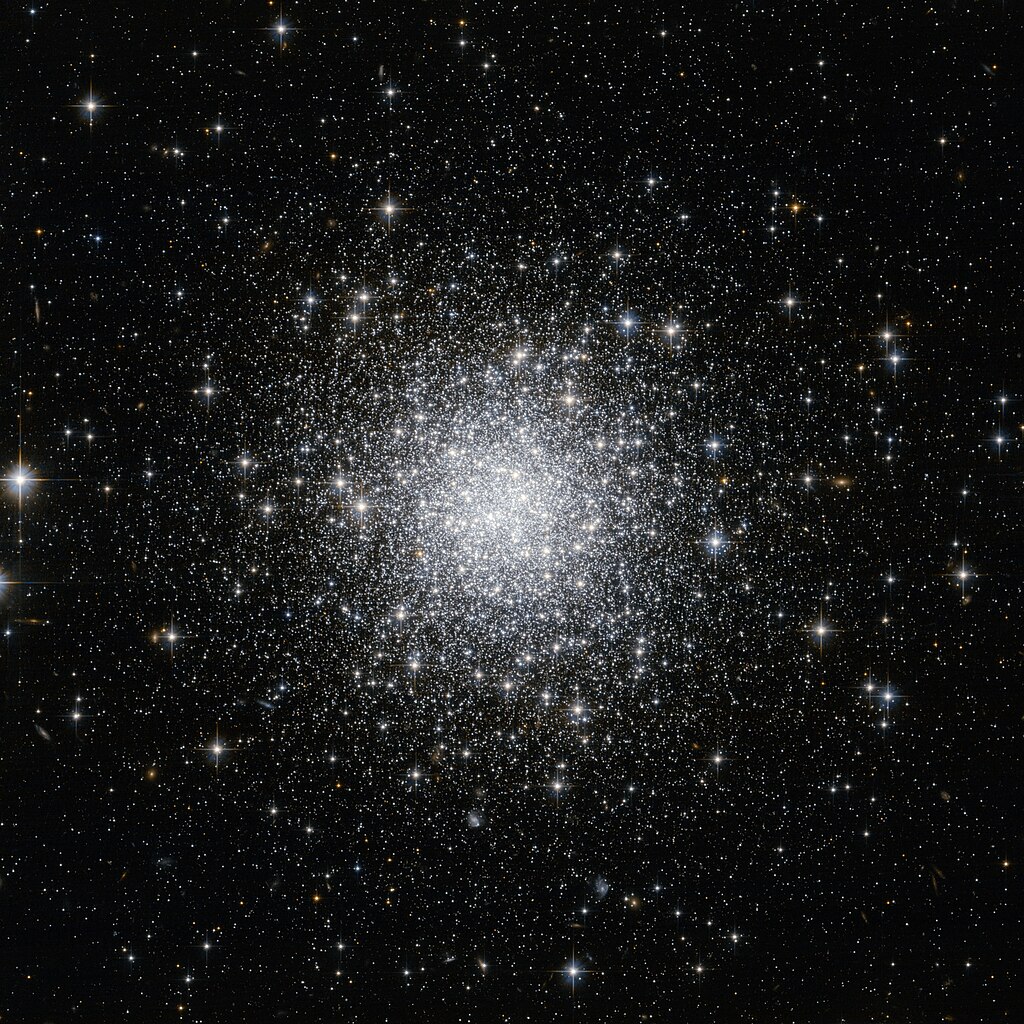
English: Caldwell 42, also known as NGC 7006, is one of 18 globular clusters in the Caldwell catalog. If you look at this Hubble image of the cluster closely, you may be able to spot several tiny background galaxies (which appear fuzzier and more extended than the cluster’s stars). Each of those distant island universes likely contains a hundred or more globular clusters of its own. Unlike open star clusters, which are smaller and more loosely bound, globular clusters are densely packed with hundreds of thousands of stars held in a roughly spherical shape by their mutual gravity.

Globular clusters like Caldwell 42 are relics of the galaxy’s earliest years. Since they were born as the nascent galaxy was forming, these clusters provide a glimpse backward in time and provide a hint of what the Milky Way was like billions of years ago. Studying globular clusters allows scientists to learn more about how the first stars formed in our galaxy and the role the clusters played in the galaxy’s development. However, Caldwell 42 has a very elongated orbit around the center of our galaxy, which might hint toward an extragalactic origin. It seems that some globular clusters may have once been independent dwarf galaxies that were later absorbed by the Milky Way.

The cluster is nestled in the diminutive constellation Delphinus and is best viewed in the late summer in the Northern Hemisphere or late winter in the Southern Hemisphere. It was discovered in 1784 by British astronomer William Herschel — the discoverer of dozens of celestial objects in the Caldwell catalog. Caldwell 42 isn’t terribly bright to begin with compared to other star clusters, so at its distance of about 135,000 light-years from Earth it’s really not the most impressive sight to most amateur astronomers. In a moderate-sized telescope, the magnitude-10.5 cluster appears as a dim, circular smudge. It is difficult to pick out individual stars in the cluster, though large amateur telescopes may be able to resolve a few of the cluster’s most vibrant stellar members.

This image, taken by Hubble’s Advanced Camera for Surveys, includes light detected at both visible and infrared wavelengths. When viewed in visible wavelengths alone, Caldwell 42 appears dimmer. This is because intervening dust between us and Caldwell 42 scatters some of the cluster’s visible light but lets the infrared light pass through. Hubble’s multi-wavelength view transforms this otherwise faint smudge into a dazzling spectacle, while helping astronomers analyze the cluster’s stars and investigate Caldwell 42’s history.

For more information about Hubble’s observations of Caldwell 42, see:

www.spacetelescope.org/images/potw1137a/

Credit: ESA/Hubble & NASA

For Hubble's Caldwell catalog site and information on how to find these objects in the night sky, visit:

www.nasa.gov/content/goddard/hubble-s-caldwell-catalog
Tarih 12 Eylül 2011, 10:00:00
Kaynak https://www.flickr.com/photos/144614754@N02/49200475127/
Yazar NASA Hubble

Lisanslama

w:tr:Creative Commons
atıf
Bu dosya, Creative Commons Atıf 2.0 Genel lisansı ile lisanslanmıştır
Şu seçeneklerde özgürsünüz:
  • paylaşım – eser paylaşımı, dağıtımı ve iletimi
  • içeriği değiştirip uyarlama – eser adaptasyonu
Aşağıdaki koşullar geçerli olacaktır:
  • atıf – Esere yazar veya lisans sahibi tarafından belirtilen (ancak sizi ya da eseri kullanımınızı desteklediklerini ileri sürmeyecek bir) şekilde atıfta bulunmalısınız.
https://creativecommons.org/licenses/by/2.0CC BY 2.0 Creative Commons Attribution 2.0 truetrue
Bu resim, ilk olarak Flickr sitesine https://flickr.com/photos/144614754@N02/49200475127 (arşiv) adresinde NASA Hubble tarafından yüklendi. 23 Şubat 2020 tarihinde FlickreviewR 2 tarafından incelendi ve cc-by-2.0 şartları uyarınca lisanslı olduğu doğrulandı.

23 Şubat 2020

Altyazılar

Bu dosyanın temsil ettiği şeyin tek satırlık açıklamasını ekleyin.
Caldwell 42

Bu dosyada gösterilen öğeler

betimlenen

NGC 7006

küresel yıldız kümesi

Delphinus

yaratıcı

Vikiveri ögesi olmayan bir değer

Flickr kullanıcı kimliği: 144614754@N02
bağlantısı olmayan yazarı: NASA Hubble Space Telescope
URL: https://www.flickr.com/people/nasahubble/

yayınlandığı

Flickr

yayın tarihi: 10 Aralık 2019

telif hakkı durumu

telif hakkı alınmış

telif hakkı lisansı

Creative Commons Attribution 2.0 Generic İngilizce

kuruluşu

12 Eylül 2011

dosya kaynağı

internette olan dosya

açıklandığı URL: https://www.flickr.com/photos/nasahubble/49200475127/
işletici: Flickr
URL: https://live.staticflickr.com/65535/49200475127_ecf25a6ce0_o.jpg

ortam türü

image/jpeg

sağlama toplamı

d65d841dd0049a13e47034febd21291fe3f3f899

tespit yöntemi: SHA-1

dosya boyutu

11.653.754 bayt

boyu

3.851 piksel

genişliği

3.851 piksel

Flicker fotoğraf KN

49200475127

Dosya geçmişi

Dosyanın herhangi bir zamandaki hâli için ilgili tarih/saat kısmına tıklayın.

Tarih/SaatKüçük resimBoyutlarKullanıcıYorum
güncel20.04, 23 Şubat 202020.04, 23 Şubat 2020 tarihindeki sürümün küçültülmüş hâli3.851 × 3.851 (11,11 MB)KillarneeUser created page with UploadWizard

Dosya kullanımı

Bu görüntü dosyasına bağlantısı olan sayfalar:

  • Küresel yıldız kümesi
  • NGC 7006

Küresel dosya kullanımı

Aşağıdaki diğer vikiler bu dosyayı kullanmaktadır:

  • ar.wikipedia.org üzerinde kullanımı
    • NGC 7006
  • ast.wikipedia.org üzerinde kullanımı
    • NGC 7006
  • az.wikipedia.org üzerinde kullanımı
    • NGC 7006
  • bn.wikipedia.org üzerinde kullanımı
    • বর্তুলাকার স্তবক
  • ca.wikipedia.org üzerinde kullanımı
    • Constel·lació del Dofí
    • Cúmul globular
    • NGC 7006
  • ce.wikipedia.org üzerinde kullanımı
    • NGC 7006
  • cs.wikipedia.org üzerinde kullanımı
    • NGC 7006
  • da.wikipedia.org üzerinde kullanımı
    • Bruger:AstroOgier/Caldwell-kataloget
  • de.wikipedia.org üzerinde kullanımı
    • NGC 7006
  • diq.wikipedia.org üzerinde kullanımı
    • NGC 7006
  • el.wikipedia.org üzerinde kullanımı
    • NGC 7006
  • en.wikipedia.org üzerinde kullanımı
    • Globular cluster
    • Caldwell catalogue
    • List of globular clusters
    • Herschel 400 Catalogue
    • NGC 7006
  • en.wikiversity.org üzerinde kullanımı
    • User:Marshallsumter/Regions/Astronomy
    • Stars/Galaxies
    • Stars/Galaxies/Milky Way
  • eo.wikipedia.org üzerinde kullanımı
    • NGC 7006
  • es.wikipedia.org üzerinde kullanımı
    • Delphinus (constelación)
    • Cúmulo globular
    • NGC 7006
  • et.wikipedia.org üzerinde kullanımı
    • NGC 7006
  • eu.wikipedia.org üzerinde kullanımı
    • NGC 7006
  • fa.wikipedia.org üzerinde kullanımı
    • ان‌جی‌سی ۷۰۰۶
  • fr.wikipedia.org üzerinde kullanımı
    • NGC 7006
    • Wikipédia:Projets pédagogiques/Cégep de Chicoutimi/Mois de la contribution
    • Liste d'amas stellaires
  • hr.wikipedia.org üzerinde kullanımı
    • NGC 7006
  • hu.wikipedia.org üzerinde kullanımı
    • NGC 7006
  • id.wikipedia.org üzerinde kullanımı
    • NGC 7006
  • it.wikipedia.org üzerinde kullanımı
    • Catalogo Herschel 400
  • ja.wikipedia.org üzerinde kullanımı
    • いるか座
    • NGC 7006
  • kk.wikipedia.org üzerinde kullanımı
    • NGC 7006
    • Үйіржұлдыз
  • ko.wikipedia.org üzerinde kullanımı
    • 콜드웰 목록
  • mk.wikipedia.org üzerinde kullanımı
    • Збиено ѕвездено јато
  • mr.wikipedia.org üzerinde kullanımı
    • गोलाकार तारकागुच्छ
  • ms.wikipedia.org üzerinde kullanımı
    • Kelompok globul
  • nl.wikipedia.org üzerinde kullanımı
    • NGC 7006
  • pl.wikipedia.org üzerinde kullanımı
    • NGC 7006
  • pt.wikipedia.org üzerinde kullanımı
    • NGC 7006
  • ro.wikipedia.org üzerinde kullanımı
    • NGC 7006
  • ru.wikipedia.org üzerinde kullanımı
    • Каталог Колдуэлла
  • sk.wikipedia.org üzerinde kullanımı
    • NGC 7006
  • sr.wikipedia.org üzerinde kullanımı
    • NGC 7006

Bu dosyanın daha fazla küresel kullanımını görüntüle.

Üstveri

Bu dosyada, muhtemelen fotoğraf makinesi ya da tarayıcı tarafından eklenmiş ek bilgiler mevcuttur. Eğer dosyada sonradan değişiklik yapıldıysa, bazı bilgiler yeni değişikliğe göre eski kalmış olabilir.

Verinin ilk yaratılma zamanı10.00, 12 Eylül 2011
Resim başlığı
  • This NASA/ESA Hubble Space Telescope image shows a compact and distant globular star cluster that lies in one of the smallest constellations in the night sky, Delphinus (The Dolphin). Due to its modest size, great distance and relatively low brightness, NGC 7006 is often ignored by amateur astronomers. But even remote globular clusters such as this one appear bright and clear when imaged by Hubble’s Advanced Camera for Surveys. NGC 7006 resides in the outskirts of the Milky Way. It is about 135 000 light-years away, five times the distance between the Sun and the centre of the galaxy, and it is part of the galactic halo. This roughly spherical region of the Milky Way is made up of dark matter, gas and sparsely distributed stellar clusters. Like other remote globular clusters, NGC 7006 provides important clues that help astronomers to understand how stars formed and assembled in the halo. The cluster now pictured by Hubble has a very eccentric orbit indicating that it may have formedindependently, in a small galaxy outside our own that was then captured by the Milky Way. Although NGC 7006 is very distant for a Milky Way globular cluster, it is much closer than the many faint galaxies that can be seen in the background of this image. Each of these faint smudges is probably accompanied by many globular clusters similar to NGC 7006 that are too faint to be seen even by Hubble. This image was taken using the Wide Field Channel of the Advanced Camera for Surveys, in a combination of visible and near-infrared light. The field of view is a little over 3 by 3 arcminutes.
YayıncıESA/Hubble
Kısa başlık
  • A remote outpost of the Milky Way
Katkı/SağlayıcıESA/Hubble&NASA
KaynakESA/Hubble
Kullanım şartları
  • Creative Commons Attribution 4.0 International License
JPEG dosyası yorumuThis NASA/ESA Hubble Space Telescope image shows a compact and distant globular star cluster that lies in one of the smallest constellations in the night sky, Delphinus (The Dolphin). Due to its modest size, great distance and relatively low brightness, NGC 7006 is often ignored by amateur astronomers. But even remote globular clusters such as this one appear bright and clear when imaged by Hubble’s Advanced Camera for Surveys. NGC 7006 resides in the outskirts of the Milky Way. It is about 135 000 light-years away, five times the distance between the Sun and the centre of the galaxy, and it is part of the galactic halo. This roughly spherical region of the Milky Way is made up of dark matter, gas and sparsely distributed stellar clusters. Like other remote globular clusters, NGC 7006 provides important clues that help astronomers to understand how stars formed and assembled in the halo. The cluster now pictured by Hubble has a very eccentric orbit indicating that it may have formed independently, in a small galaxy outside our own that was then captured by the Milky Way. Although NGC 7006 is very distant for a Milky Way globular cluster, it is much closer than the many faint galaxies that can be seen in the background of this image. Each of these faint smudges is probably accompanied by many globular clusters similar to NGC 7006 that are too faint to be seen even by Hubble. This image was taken using the Wide Field Channel of the Advanced Camera for Surveys, in a combination of visible and near-infrared light. The field of view is a little over 3 by 3 arcminutes.
YönlendirmeNormal
Yatay çözünürlük72 dpi
Dikey çözünürlük72 dpi
Kullanılan yazılımAdobe Photoshop CS5 Windows
Dosya değişiklik tarihi ve zamanı10.51, 15 Haziran 2011
Y ve C yerleştirmeOrtalanmış
Exif sürümü2.31
Dijitalleştirme zamanı10.47, 12 Haziran 2011
Her bileşenin anlamı
  1. Y
  2. Cb
  3. Cr
  4. bulunmuyor
Desteklenen Flashpix sürümü1
Renk aralığıKalibrasyonsuz
Bileşen başına bit sayısı
  1. 8
  2. 8
  3. 8
Yükseklik3.851 px
Genişlik3.851 px
Piksel bileşimi2
Bileşen sayısı3
İletişim bilgileri

http://www.spacetelescope.org/

Karl-Schwarzschild-Strasse 2

Garching bei München, , D-85748 Germany

Anahtar kelimelerNGC 7006
Medya türüObservation
Üst veri son değişim tarihi12.51, 15 Haziran 2011
Özgün belgenin benzersiz kimliğiuuid:2B5D399DB094E011BB7599C223246ECD
Telif hakkı durumuTelif hakkı durumu belirtilmemiş
"https://tr.wikipedia.org/wiki/Dosya:Caldwell_42.jpg" sayfasından alınmıştır
  • Gizlilik politikası
  • Vikipedi hakkında
  • Sorumluluk reddi
  • Davranış Kuralları
  • Geliştiriciler
  • İstatistikler
  • Çerez politikası
  • Mobil görünüm
  • Wikimedia Foundation
  • Powered by MediaWiki
Dosya:Caldwell 42.jpg
Konu ekle