

Dosya:Betelgeuse captured by ALMA.jpg - Vikipedi
İçeriğe atla
Ana menü
Gezinti
  • Anasayfa
  • Hakkımızda
  • İçindekiler
  • Rastgele madde
  • Seçkin içerik
  • Yakınımdakiler
Katılım
  • Deneme tahtası
  • Köy çeşmesi
  • Son değişiklikler
  • Dosya yükle
  • Topluluk portalı
  • Wikimedia dükkânı
  • Yardım
  • Özel sayfalar
Vikipedi Özgür Ansiklopedi
Ara
  • Bağış yapın
  • Hesap oluştur
  • Oturum aç
  • Bağış yapın
  • Hesap oluştur
  • Oturum aç

Dosya:Betelgeuse captured by ALMA.jpg
Sayfa içeriği diğer dillerde desteklenmemektedir.
  • Dosya
  • Tartışma
  • Oku
  • Wikimedia Commons üzerinde gör
  • Yerel açıklama ekle
  • Yerel açıklama kaynağı ekle
Araçlar
Eylemler
  • Oku
  • Wikimedia Commons üzerinde gör
  • Yerel açıklama ekle
  • Yerel açıklama kaynağı ekle
Genel
  • Sayfaya bağlantılar
  • Basılmaya uygun görünüm
  • Sayfa bilgisi
  • Kısaltılmış URL'yi al
  • Karekodu indir
Diğer projelerde
Görünüm
Vikipedi, özgür ansiklopedi
  • Dosya
  • Dosya geçmişi
  • Dosya kullanımı
  • Küresel dosya kullanımı
  • Üstveri
Dosya:Betelgeuse captured by ALMA.jpg
Bu önizlemenin boyutu: 600 × 600 piksel. Diğer çözünürlükler: 240 × 240 piksel | 480 × 480 piksel | 768 × 768 piksel | 1.024 × 1.024 piksel | 2.048 × 2.048 piksel | 4.000 × 4.000 piksel.
Tam çözünürlük ((4.000 × 4.000 piksel, dosya boyutu: 741 KB, MIME tipi: image/jpeg))
Bu dosya Wikimedia Commons'ta bulunmaktadır. Dosyanın açıklaması aşağıda gösterilmiştir.
Commons, serbest/özgür telifli medya dosyalarının bulundurulduğu depodur. Siz de yardım edebilirsiniz.
Bu dosya Wikimedia Commons'ta bulunmaktadır.

Özet

AçıklamaBetelgeuse captured by ALMA.jpg
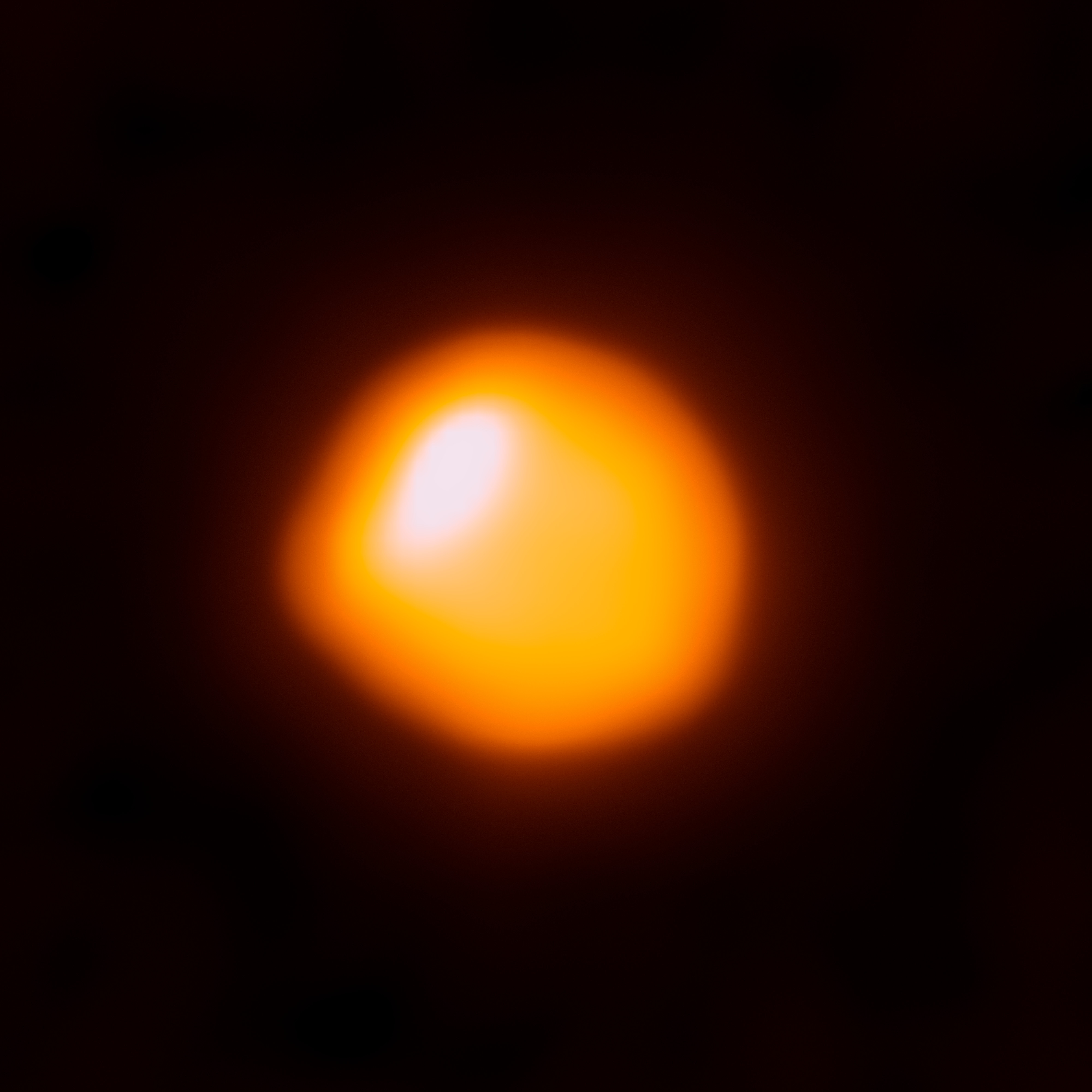
English: This orange blob shows the nearby star Betelgeuse, as seen by the Atacama Large Millimeter/submillimeter Array (ALMA). This is the first time that ALMA has ever observed the surface of a star and this first attempt has resulted in the highest-resolution image of Betelgeuse available. Betelgeuse is one of the largest stars currently known — with a radius around 1400 times larger than the Sun’s in the millimeter continuum. About 600 light-years away in the constellation of Orion (The Hunter), the red supergiant burns brightly, causing it to have only a short life expectancy. The star is just about eight million years old, but is already on the verge of becoming a supernova. When that happens, the resulting explosion will be visible from Earth, even in broad daylight. The star has been observed in many other wavelengths, particularly in the visible, infrared, and ultraviolet. Using ESO’s Very Large Telescope astronomers discovered a vast plume of gas almost as large as our Solar System. Astronomers have also found a gigantic bubble that boils away on Betelgeuse’s surface. These features help to explain how the star is shedding gas and dust at tremendous rates (eso0927, eso1121). In this picture, ALMA observes the hot gas of the photosphere of Betelgeuse at sub-millimeter wavelengths — where localised increased temperatures explain why it is not symmetric. Scientifically, ALMA can help us to understand the extended atmospheres of these hot, blazing stars. Links: Size comparison: Betelgeuse and the Sun
Español: Esta burbuja naranja es la cercana estrella Betelgeuse vista por ALMA (Atacama Large Millimeter/submillimeter Array). Es la primera vez que ALMA observa la superficie de una estrella, y este primer intento ha dado como resultado la imagen de mayor resolución de Betelgeuse disponible hasta ahora.

Betelgeuse es una de las estrellas más grandes conocidas en la actualidad, con un radio unas 1.400 veces más grande que el del Sol en el continuo del rango milimétrico. Situada a unos 600 años luz de distancia, en la constelación de Orión (el cazador), esta supergigante roja refulge ardiente, lo que provoca que tenga una corta esperanza de vida. La estrella tiene tan solo unos 8 millones años, pero ya está a punto de convertirse en una supernova. Cuando esto suceda, la explosión resultante será visible desde la Tierra, incluso a plena luz del día.

La estrella se ha observado en muchas otras longitudes de onda, especialmente en los espectros visible, infrarrojo y ultravioleta. Utilizando el VLT (Very Large Telescope) de ESO, los astrónomos descubrieron un vasto penacho de gas casi tan grande como nuestro Sistema Solar. Los astrónomos también han descubierto una hirviente burbuja gigantesca en la superficie de Betelgeuse. Estas características ayudan a explicar cómo la estrella está deshaciéndose en gas y polvo a enormes velocidades (eso0927, eso1121). En esta imagen, ALMA observa el gas caliente de la baja cromosfera de Betelgeuse en longitudes de onda submilimétricas, donde las temperaturas crecientes localizadas explican por qué no es simétrica. Científicamente, ALMA nos puede ayudar a comprender la atmósfera expandida de estas ardientes estrellas calientes.
Tarih 26 Haziran 2017, 06:00:00
Kaynak http://www.eso.org/public/unitedkingdom/images/potw1726a/
Yazar ALMA (ESO/NAOJ/NRAO)/E. O’Gorman/P. Kervella

Lisanslama

w:tr:Creative Commons
atıf
atıf
This image was produced by the ALMA Observatory.
Unless specifically noted, the images and videos distributed from the public ALMA websites (www.almaobservatory.org, www.alma.cl, and kids.alma.cl) along with the texts of press releases, announcements, pictures of the week and captions, are licensed under a Creative Commons Attribution 4.0 International License, and may on a non-exclusive basis be reproduced without fee provided the credit is clear and visible. Details on how to interpret this are given below for those who need further explanation. See the ALMA copyright notice for complete information.

Conditions:

  • If you want to use our materials without having to pay, the full image or footage credit must be presented in a clear and readable manner to all users, with the wording unaltered (for example: "Ralph Bennett – ALMA (ESO/NAOJ/NRAO)". The credit should not be hidden or disassociated from the image footage. Links should be active if the credit is online. See the copyright Q&A section on this page for guidance.
  • The text of press releases, announcements, pictures of the week and captions should be credited to ALMA, except when used by media.
  • ALMA materials, images and videos may not be used to state or imply the endorsement by ALMA or any ALMA employee, or ALMA partner (ESO, NRAO, or NAOJ) of a commercial product or service.
  • We welcome a copy of the product sent to us to be indexed in our archive. Please send it to copyright@alma.cl.
  • If an image includes a picture of an identifiable person, using that image for commercial purposes is not permitted.

Notes:

  • Note that this general permission does not extend to the use of ALMA's logo, which shall remain protected and may not be used or reproduced without prior and individual written consent of ALMA. Owners of external websites wishing to link to the ALMA web site may use ALMA's logo for the link, provided they have obtained prior authorization from the ALMA Education and Public Outreach Department and on the condition that such use is clearly identifiable as a web link.
  • Also note that music, scientific papers, code, and text other than press releases, announcements, pictures of the week and captions on this site are not released under the Creative Commons Attribution 4.0 International License and cannot be used for non-ALMA products.
  • By reproducing ALMA material, in part or in full, the user acknowledges the terms on which such use is permitted.
w:tr:Creative Commons
atıf
Bu dosya Creative Commons Atıf 4.0 Uluslararası lisansı altında lisanslanmıştır.
Atıf:
ALMA
Şu seçeneklerde özgürsünüz:
  • paylaşım – eser paylaşımı, dağıtımı ve iletimi
  • içeriği değiştirip uyarlama – eser adaptasyonu
Aşağıdaki koşullar geçerli olacaktır:
  • atıf – Esere yazar veya lisans sahibi tarafından belirtilen (ancak sizi ya da eseri kullanımınızı desteklediklerini ileri sürmeyecek bir) şekilde atıfta bulunmalısınız.
https://creativecommons.org/licenses/by/4.0CC BY 4.0 Creative Commons Attribution 4.0 truetrue

Altyazılar

Bu dosyanın temsil ettiği şeyin tek satırlık açıklamasını ekleyin.
plsss
217

Bu dosyada gösterilen öğeler

betimlenen

Betelgeuse

telif hakkı durumu

telif hakkı alınmış

telif hakkı lisansı

Creative Commons Atıf 4.0 Uluslararası

kuruluşu

26 Haziran 2017

ortam türü

image/jpeg

sağlama toplamı

59b142e974d7af1b4f7bfdbbca1127249e3e79df

tespit yöntemi: SHA-1

dosya boyutu

759.275 bayt

boyu

4.000 piksel

genişliği

4.000 piksel

Dosya geçmişi

Dosyanın herhangi bir zamandaki hâli için ilgili tarih/saat kısmına tıklayın.

Tarih/SaatKüçük resimBoyutlarKullanıcıYorum
güncel03.01, 27 Haziran 201703.01, 27 Haziran 2017 tarihindeki sürümün küçültülmüş hâli4.000 × 4.000 (741 KB)QuantanewUser created page with UploadWizard

Dosya kullanımı

Bu görüntü dosyasına bağlantısı olan sayfalar:

  • Yıldız

Küresel dosya kullanımı

Aşağıdaki diğer vikiler bu dosyayı kullanmaktadır:

  • ca.wikipedia.org üzerinde kullanımı
    • Estrella supergegant
  • da.wikipedia.org üzerinde kullanımı
    • Betelgeuse
  • en.wikipedia.org üzerinde kullanımı
    • Star
    • List of stars with resolved images
    • User:Fabzzz
    • User:DarklitShadow/Userboxes
    • User:TheMourningOwl
    • Wikipedia:Userboxes/Science/Astronomy
    • User:TheMourningOwl/Userboxes/Betelgeuse
    • User:Mpprogram6771
    • User:Recessio
    • User:Visnelma
    • User:Redrafting/Userboxes
    • User:Redrafting/userboxes\template
    • User:Avation user
    • User:IowaBird
    • User:B33net
    • User:Socopogogo
    • User:LexiLemonade
    • User:HSeabiscuits
    • User:CGraphite
  • en.wikiversity.org üzerinde kullanımı
    • User:Marshallsumter/Radiation astronomy/Submillimeters
    • User:Marshallsumter/Radiation astronomy1/Millimeters
  • es.wikipedia.org üzerinde kullanımı
    • Betelgeuse
    • Orión (constelación)
  • fr.wikipedia.org üzerinde kullanımı
    • Étoile
    • Bételgeuse
    • Utilisateur:Ancalagon3
    • Wikipédia:Boîtes utilisateur humoristiques
    • Utilisateur:Clabeurf/Boîtes Utilisateur
    • Modèle:Utilisateur Bételgeuse
    • Utilisateur:Ventury-Networks
    • Utilisateur:MecchaMatt
    • Utilisateur:Ceddrik
    • Utilisateur:Esnico30
    • Utilisateur:Shruction
    • Utilisateur:Pierre de Montfalcon
    • Utilisatrice:Tanagra09
    • Utilisateur:Moietpastoi94
    • Utilisateur:LazareMazel
    • Utilisateur:Pierre.hamelin/Autres contributions
    • Utilisateur:Yann Tremblay
    • Utilisateur:JDumont004
    • Utilisateur:Yzlega
  • he.wikipedia.org üzerinde kullanımı
    • ביטלג'וז
  • hu.wikipedia.org üzerinde kullanımı
    • Betelgeuze
  • it.wikipedia.org üzerinde kullanımı
    • Betelgeuse
    • Utente:Byrykhynho
  • ja.wikipedia.org üzerinde kullanımı
    • ベテルギウス
    • 旧神

Bu dosyanın daha fazla küresel kullanımını görüntüle.

Üstveri

Bu dosyada, muhtemelen fotoğraf makinesi ya da tarayıcı tarafından eklenmiş ek bilgiler mevcuttur. Eğer dosyada sonradan değişiklik yapıldıysa, bazı bilgiler yeni değişikliğe göre eski kalmış olabilir.

Katkı/SağlayıcıALMA (ESO/NAOJ/NRAO)/E. O’Gorman/P. Kervella
KaynakEuropean Southern Observatory
Kısa başlık
  • Betelgeuse captured by ALMA
Resim başlığı
  • This orange blob shows the nearby star Betelgeuse, as seen by the Atacama Large Millimeter/submillimeter Array (ALMA). This is the first time that ALMA has ever observed the surface of a star and this first attempt has resulted in the highest-resolution image of Betelgeuse available. Betelgeuse is one of the largest stars currently known — with a radius around 1400 times larger than the Sun’s in the millimeter continuum. About 600 light-years away in the constellation of Orion (The Hunter), the red supergiant burns brightly, causing it to have only a short life expectancy. The star is just about eight million years old, but is already on the verge of becoming a supernova. When that happens, the resulting explosion will be visible from Earth, even in broad daylight. The star has been observed in many other wavelengths, particularly in the visible, infrared, and ultraviolet. Using ESO’s Very Large Telescope astronomers discovered a vast plume of gas almost as large as our Solar System. Astronomers have also found a gigantic bubble that boils away on Betelgeuse’s surface. These features help to explain how the star is shedding gas and dust at tremendous rates (eso0927, eso1121). In this picture, ALMA observes the hot gas of the photosphere of Betelgeuse at sub-millimeter wavelengths — where localised increased temperatures explain why it is not symmetric. Scientifically, ALMA can help us to understand the extended atmospheres of these hot, blazing stars. Links: Size comparison: Betelgeuse and the Sun
Kullanım şartları
  • Creative Commons Attribution 4.0 International License
Verinin ilk yaratılma zamanı06.00, 26 Haziran 2017
Anahtar kelimelerBetelgeuse
İletişim bilgileri

http://www.eso.org

Karl-Schwarzschild-Strasse 2

Garching bei München, , D-85748 Germany

IIM sürümü4
"https://tr.wikipedia.org/wiki/Dosya:Betelgeuse_captured_by_ALMA.jpg" sayfasından alınmıştır
  • Gizlilik politikası
  • Vikipedi hakkında
  • Sorumluluk reddi
  • Davranış Kuralları
  • Geliştiriciler
  • İstatistikler
  • Çerez politikası
  • Mobil görünüm
  • Wikimedia Foundation
  • Powered by MediaWiki
Dosya:Betelgeuse captured by ALMA.jpg
Konu ekle